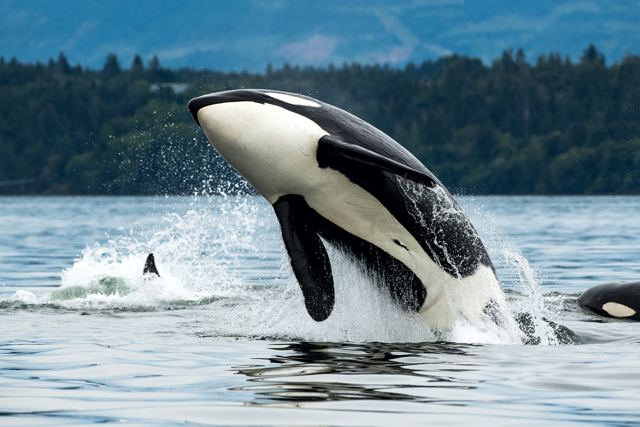
A humpback whale breaching off Sydney, Australia.
In this article
- Humpback whale quick facts
- How big are humpback whales?
- Why do humpback whales sing?
- How far do humpback whales migrate?
- How do humpback whales feed?
- Why do humpback whales breach?
- Humpbacks that rescue other animals
- Every humpback has a unique tail
- Are humpback whales endangered?
- Frequently asked questions
- Want more?
Humpback whales are the acrobats of the ocean. They launch their 40-ton bodies out of the water, sing songs that spread across entire oceans and make some of the longest migrations of any mammal. They have even been seen rescuing other animals from orcas.
Here are the facts about humpback whales: how big they get, why they sing, how far they travel and why they breach.
Humpback whale quick facts
- Scientific name
- Megaptera novaeangliae ("big-winged New Englander")
- Length
- Up to around 18 metres; most adults are 12 to 16 metres
- Weight
- Up to around 40 tons
- Flippers
- Up to a third of their body length, the longest of any whale
- Diet
- Krill and small schooling fish
- Lifespan
- Around 80 to 90 years
- Where they live
- Every ocean, migrating between cold feeding grounds and warm breeding grounds
- Conservation status
- Least Concern globally, after a big recovery from whaling
How big are humpback whales?
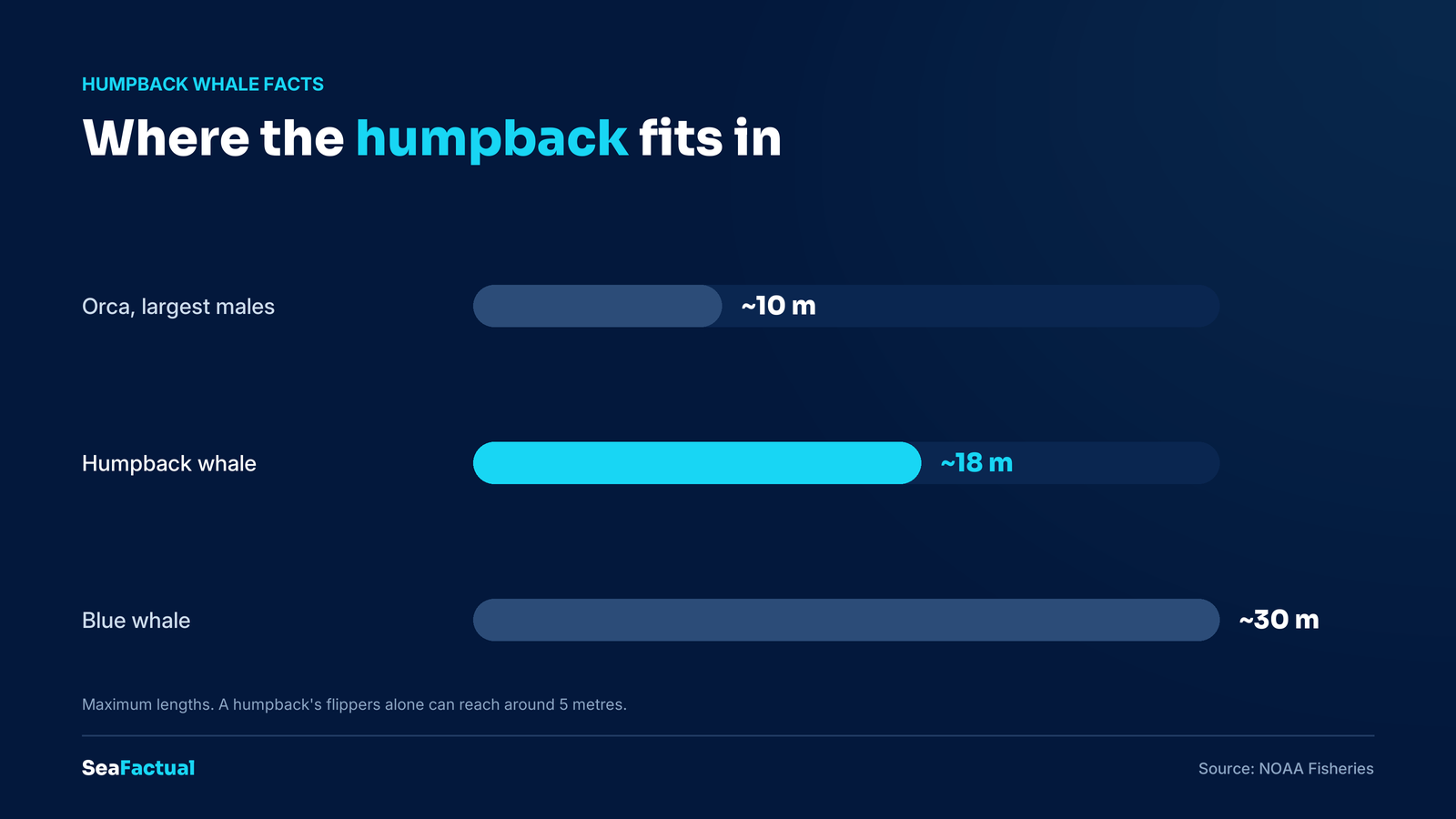
According to NOAA, humpback whales grow up to around 18 metres long and can weigh around 40 tons. Females are usually slightly bigger than males. Calves are already around 4 metres long at birth.
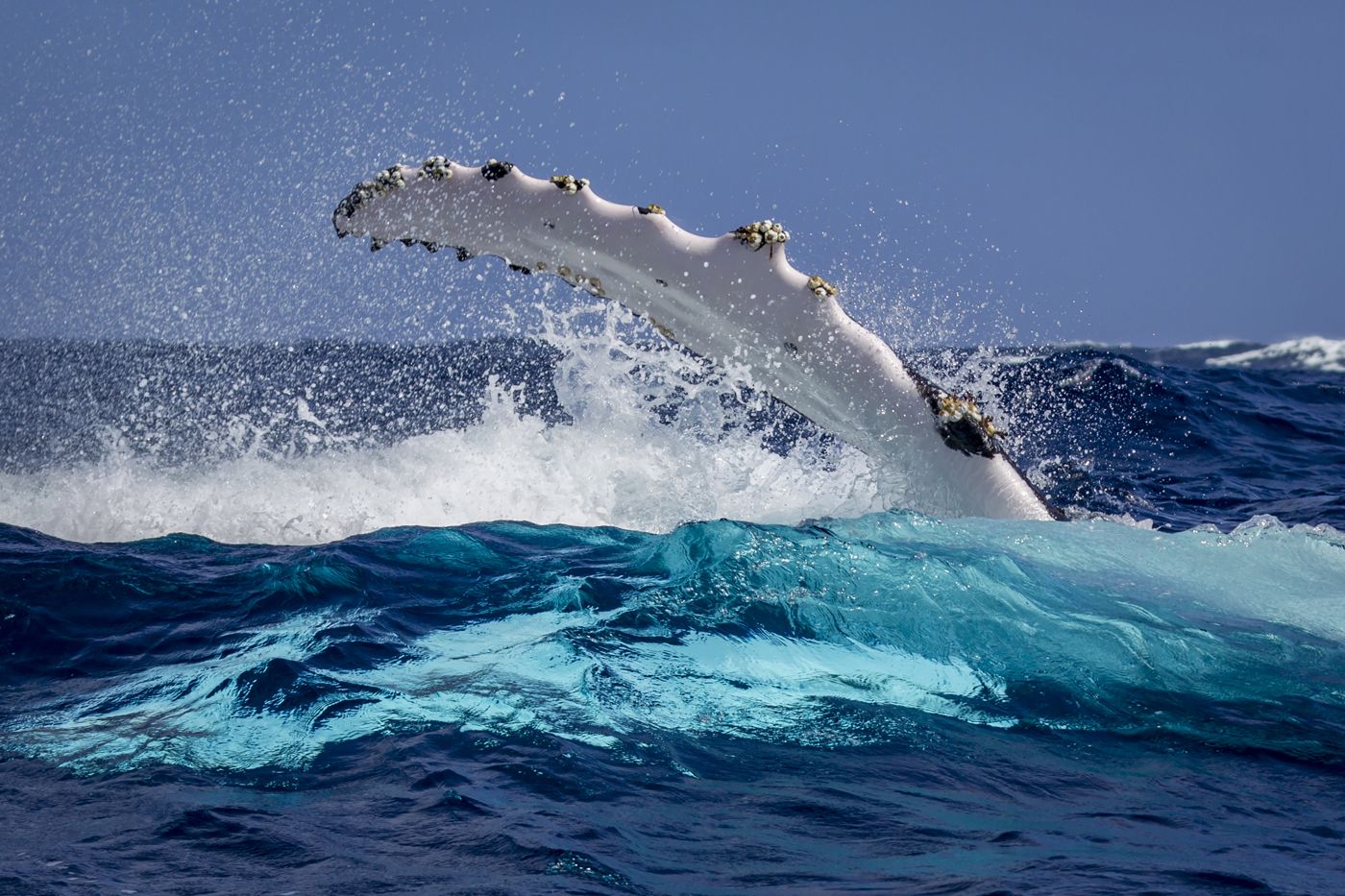
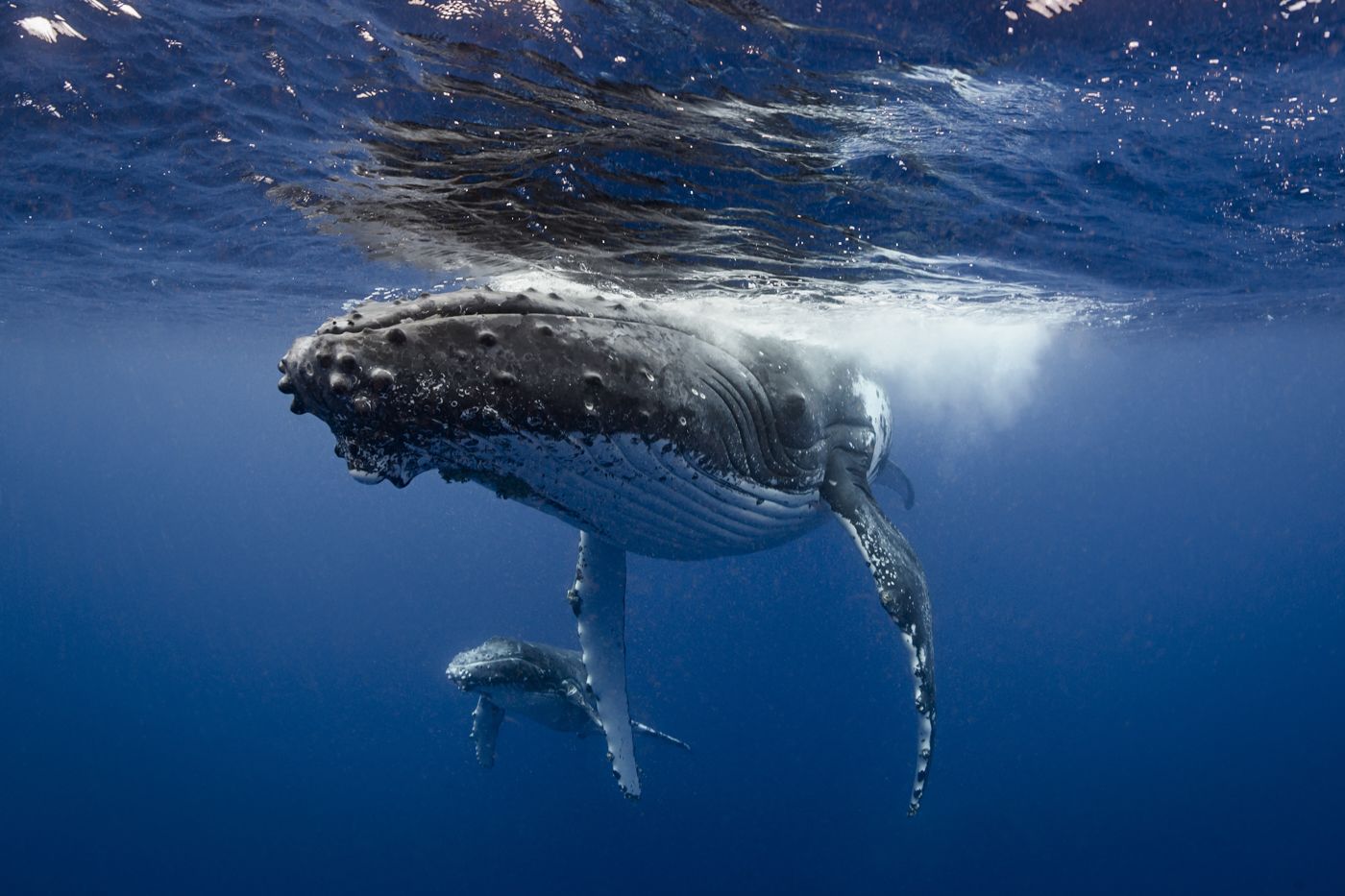
Their most striking feature is their flippers. A humpback's pectoral fins can reach a third of its body length, up to around 5 metres. That is where the scientific name Megaptera, meaning "big wing", comes from. The flippers help them turn sharply when hunting, and the bumps along their edges improve their grip on the water.
Why do humpback whales sing?
Male humpback whales sing long, complex songs made of moans, cries and whoops. A single song can last up to 20 minutes, and males may repeat it for hours. Because only males sing, and they sing most on the breeding grounds, scientists believe the songs are linked to mating, but exactly how is still debated.
The strangest part is that all the males in a population sing the same song, and it keeps changing. In the South Pacific, researchers tracked new songs spreading from whales off eastern Australia across the ocean to French Polynesia over about two years, like a hit record. It is one of the clearest examples of culture spreading in any animal other than us.
We cover this in Episode 1 of SeaFactual, alongside nine other animals that break the rules of nature.
How far do humpback whales migrate?
Humpbacks make some of the longest migrations of any mammal. They spend summer feeding in cold, food-rich polar waters, then travel to warm tropical waters in winter to breed and give birth. Some humpbacks swim more than 8,000 kilometres each way, for example between Antarctica and the coast of Central America.
During the breeding season, many humpbacks eat little or nothing at all, living off the fat they built up while feeding.
How do humpback whales feed?
Humpbacks eat krill and small schooling fish such as herring. Their most famous technique is bubble-net feeding. One or more whales swim in a spiral below a shoal of fish, blowing bubbles that rise like a curtain and trap the fish in a tight ball. Then the whales lunge up through the middle with their mouths wide open.
Groups of humpbacks in Alaska work together to do this, with different whales taking different roles, and some techniques seem to be passed on from whale to whale.
Why do humpback whales breach?
Nobody knows for certain why humpbacks leap out of the water. The main ideas are that breaching is a way of communicating, since the crash can be heard a long way underwater, a way to knock off parasites and barnacles, or simply play. It is likely a mix of all three. Humpbacks also slap the water with their flippers and tails, which may send similar signals.
Humpbacks that rescue other animals
One of the most surprising humpback behaviours was described in a 2016 study. Humpback whales have been seen charging at orcas that were attacking other animals, including seals, sea lions and even other whale species, and sometimes chasing the orcas away.
No one is sure why. One idea is that humpbacks respond to the sound of an orca attack because orcas also hunt humpback calves, and the protection of other species is a side effect. Whatever the reason, there are recorded cases of a seal being carried to safety on a humpback's belly. Read more about their enemy in our orca facts.
Every humpback has a unique tail
The underside of a humpback's tail fluke has a pattern of black and white markings and scars that is unique to each whale. Researchers and whale watchers photograph the tails as the whales dive, then match them against catalogues of thousands of known individuals. This is how scientists have tracked the same humpbacks between feeding and breeding grounds for decades.
Are humpback whales endangered?
Humpbacks are one of conservation's great success stories. Commercial whaling drove them close to extinction in the 20th century, but after they were protected, most populations recovered strongly. Humpbacks are now listed as Least Concern on the IUCN Red List, although some individual populations remain small. Today's threats include entanglement in fishing gear, ship strikes and ocean noise.
Frequently asked questions
Can you see humpback whales in the UK?
Yes, and more often than in the past. According to the Sea Watch Foundation and other recorders, humpbacks are increasingly spotted off Cornwall, especially in winter, and around Shetland and north-east Scotland. They are still rare compared with places like Iceland or Norway, but sightings have become much more common in recent years.
How long do humpback whales live?
NOAA estimates that humpback whales live for around 80 to 90 years.
Do female humpback whales sing?
No. Only male humpbacks sing the long, complex songs they are famous for, although both males and females make other calls and sounds.
How much does a humpback whale eat?
A large humpback can eat well over a tonne of krill and small fish a day during the feeding season, then eat very little for months while migrating and breeding.
What is the biggest whale?
The blue whale, which can reach around 30 metres. Humpbacks are large, but blue whales are nearly twice their length. The biggest animal ever is covered in Episode 1 of SeaFactual.
Want more?
Follow SeaFactual for a new ocean fact every day, and get the fact of the week in your inbox using the form below.
Sources and further reading
- NOAA Fisheries: Humpback whale
- Garland et al. 2011, Current Biology: Cultural transmission of humpback whale song
- Rasmussen et al. 2007, Biology Letters: The longest mammalian migration
- Pitman et al. 2016, Marine Mammal Science: Humpback whales interfering when killer whales attack other species
- IUCN Red List
- Sea Watch Foundation
- Whale and Dolphin Conservation