Sea turtles have lived in the oceans for well over 100 million years.
In this article
- Sea turtle quick facts
- How many species of sea turtle are there?
- What do sea turtles eat?
- The sand decides boy or girl
- How do sea turtles find their way home?
- Why do so few hatchlings survive?
- How long do sea turtles live?
- The giant leatherback found in Wales
- Are sea turtles endangered?
- Frequently asked questions
- Want more?
Sea turtles are ancient ocean travellers. They cross entire oceans, find their way back to the beach where they hatched decades earlier, and some can dive more than a kilometre deep. Yet the temperature of a few handfuls of sand decides whether each one becomes male or female.
Here are the facts about sea turtles: the seven species, how long they live, how they navigate, and the record-breaking turtle that washed up in Wales.
Sea turtle quick facts
- Number of species
- Seven
- Biggest
- The leatherback, which can weigh several hundred kilograms
- Lifespan
- Thought to be 50 years or more for many species
- Diet
- Depends on the species, from seagrass to jellyfish to sponges
- Sex
- Decided by the temperature of the sand the eggs incubate in
- Where they live
- Tropical and temperate seas worldwide; leatherbacks reach cold waters, including around the UK
- Conservation status
- Six of the seven species are threatened
How many species of sea turtle are there?
There are seven species of sea turtle:
- Leatherback, the biggest, with a leathery shell instead of hard plates
- Green turtle, named for the green colour of its fat, not its shell
- Loggerhead, with a huge head and powerful jaws for crushing shellfish
- Hawksbill, with a narrow, pointed beak and beautiful patterned shell
- Kemp's ridley, the smallest and one of the rarest
- Olive ridley, famous for mass nesting events
- Flatback, found only around Australia
What do sea turtles eat?
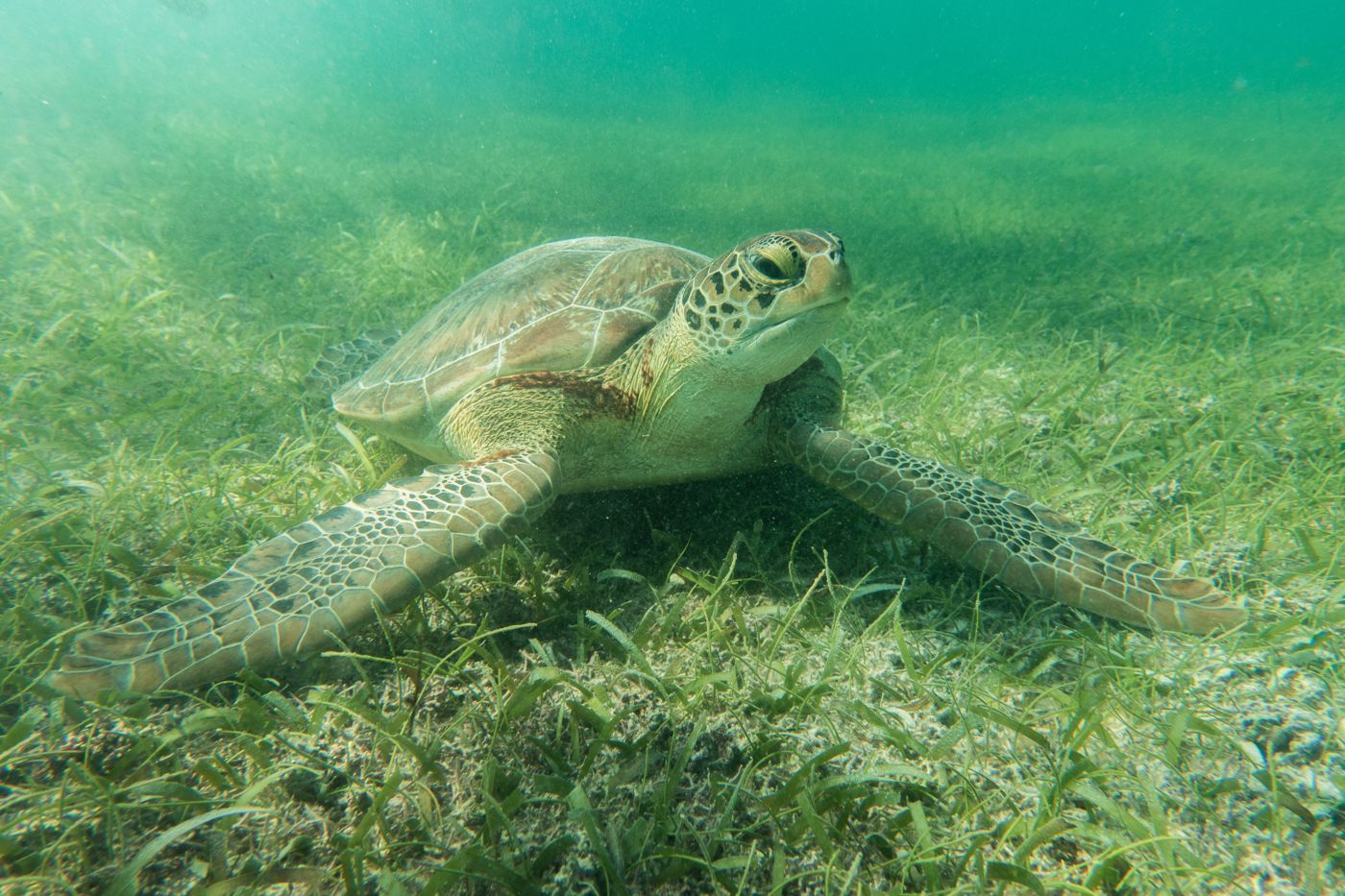
Each species has its own menu. Adult green turtles are mostly vegetarian, grazing on seagrass and algae, which helps keep seagrass meadows healthy. Leatherbacks live almost entirely on jellyfish. Loggerheads crush crabs and shellfish. And hawksbills specialise in something few animals can eat: sponges, many of which are full of glass-like spikes and toxins.
The sand decides boy or girl
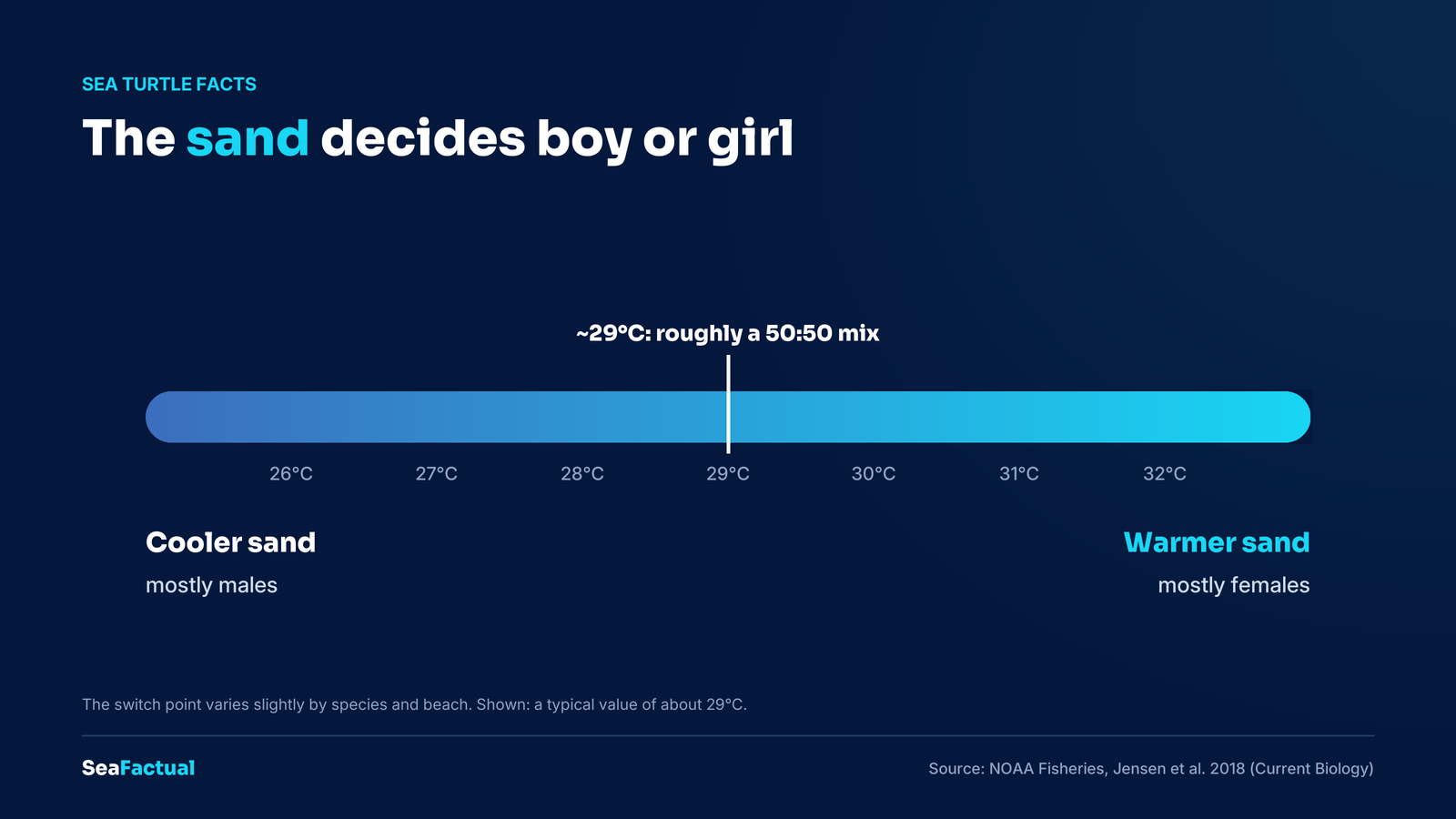
A sea turtle's sex isn't decided by its genes. It is decided by the temperature of the sand while the eggs incubate. For many species, eggs kept above roughly 29°C hatch mostly female, and cooler eggs hatch mostly male.
That makes sea turtles vulnerable to warming beaches. In 2018, scientists studying green turtles from the northern Great Barrier Reef found that around 99% of young turtles from the region's warmest nesting beaches were female. Conservation teams now shade some nests and move others to cooler spots to keep a healthy balance.
How do sea turtles find their way home?
Female sea turtles usually return to nest on the same stretch of coast where they hatched, sometimes after travelling thousands of kilometres and decades later. A study of loggerheads published in 2015 found that they seem to remember the magnetic signature of their home beach, the unique combination of the Earth's magnetic field at that spot, and use it to find their way back.
Why do so few hatchlings survive?
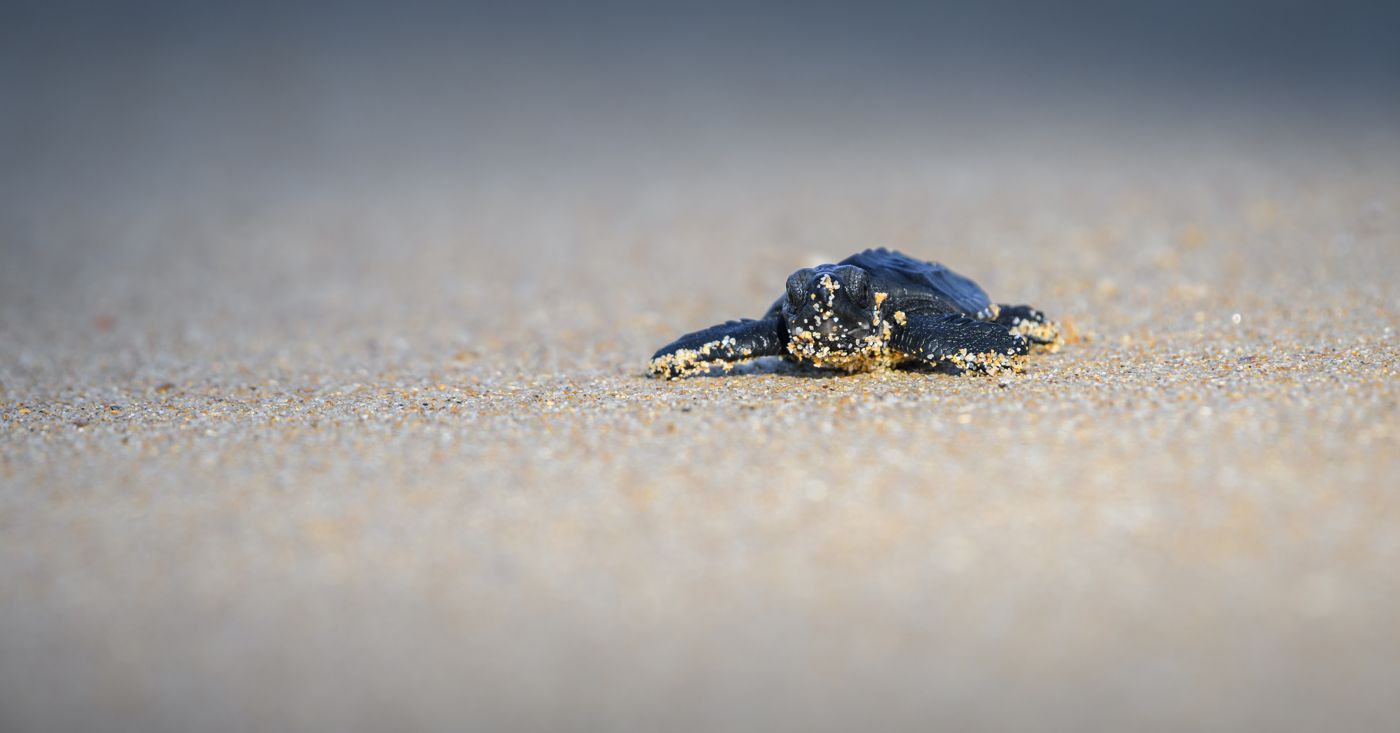
A female may lay around a hundred eggs at a time, and nest several times a season. But only a tiny fraction of hatchlings survive to adulthood. Birds, crabs and fish pick them off on the beach and in the shallows, and artificial lights can lead them inland instead of towards the sea. A commonly quoted estimate is that only around 1 in 1,000 hatchlings makes it to adulthood, though the true figure varies between species and beaches.
How long do sea turtles live?
Nobody knows exactly, because it is so hard to follow a turtle through its whole life. Sea turtles grow slowly and many species take 20 to 30 years or more to start breeding. Scientists think many live for 50 years or longer.
The giant leatherback found in Wales
Leatherbacks are the biggest turtles alive and the only sea turtles that regularly visit cold seas. They can keep their bodies warmer than the water around them, and they dive deeper than 1,000 metres in search of jellyfish.
The biggest one ever recorded washed up on Harlech beach in Wales in September 1988. The male measured about 2.9 metres long and weighed around 914 kilograms. It is now on display at the National Museum in Cardiff. Leatherbacks still visit UK waters in summer and autumn to feed on jellyfish.
Are sea turtles endangered?
Six of the seven species are listed as threatened on the IUCN Red List, and the hawksbill and Kemp's ridley are critically endangered. The flatback is listed as data deficient. The main threats are accidental capture in fishing gear, loss of nesting beaches, plastic pollution, hunting and egg collection, and climate change.
There is good news too. Protecting nesting beaches has helped some populations bounce back, including green turtles in several parts of the world.
Frequently asked questions
Are there sea turtles in the UK?
Yes. Leatherback turtles visit UK and Irish waters in summer and autumn to feed on jellyfish, and are sometimes spotted off Cornwall, Wales and western Scotland. Other species, such as loggerheads and Kemp's ridleys, occasionally wash up after being carried north by currents and storms. If you see a turtle, report it to the Marine Conservation Society.
Can sea turtles pull their heads into their shells?
No. Unlike many land turtles and tortoises, sea turtles cannot pull their heads or flippers inside their shells.
Why do sea turtles cry?
They are not sad. Sea turtles have glands near their eyes that get rid of extra salt from the seawater they swallow, which makes them look as if they are crying.
Why do sea turtles eat plastic bags?
Floating plastic bags can look like jellyfish, a favourite food of leatherbacks and other turtles. Swallowing plastic can block their gut and kill them.
What is the biggest sea turtle?
The leatherback. The largest one ever recorded, found in Wales in 1988, weighed around 914 kilograms.
Want more?
Watch the sea turtle in Episode 1 of SeaFactual, follow us for a new ocean fact every day, and get the fact of the week in your inbox using the form below.
Sources and further reading
- NOAA Fisheries: Sea turtles
- Brothers & Lohmann 2015, Current Biology: Geomagnetic imprinting and natal homing in sea turtles
- Jensen et al. 2018, Current Biology: Environmental warming and feminization of sea turtles
- Amgueddfa Cymru – Museum Wales: The largest turtle in the world
- Marine Conservation Society: Leatherback turtle
- State of the World's Sea Turtles (SWOT)
- IUCN Red List