A giant oceanic manta off San Benedicto Island, Mexico.
In this article
Manta rays are the gentle giants of the ray world. They glide through the ocean on wings up to seven metres wide, have the biggest brains of any fish, and may even recognise themselves in a mirror. Despite their size, they feed on some of the smallest animals in the sea.
Here are the facts about manta rays: how big they get, how smart they are, what they eat and whether they are dangerous.
Manta ray quick facts
- Species
- Two, the giant oceanic manta and the reef manta
- Wingspan
- Up to around 7 metres for the giant oceanic manta; up to around 5 metres for the reef manta
- Brain
- The largest of any fish
- Diet
- Zooplankton, tiny animals filtered from the water
- Lifespan
- Thought to be 40 years or more
- Young
- Usually a single pup at a time
- Sting
- None, unlike many of their stingray relatives
- Conservation status
- Giant oceanic manta Endangered; reef manta Vulnerable
How big do manta rays get?
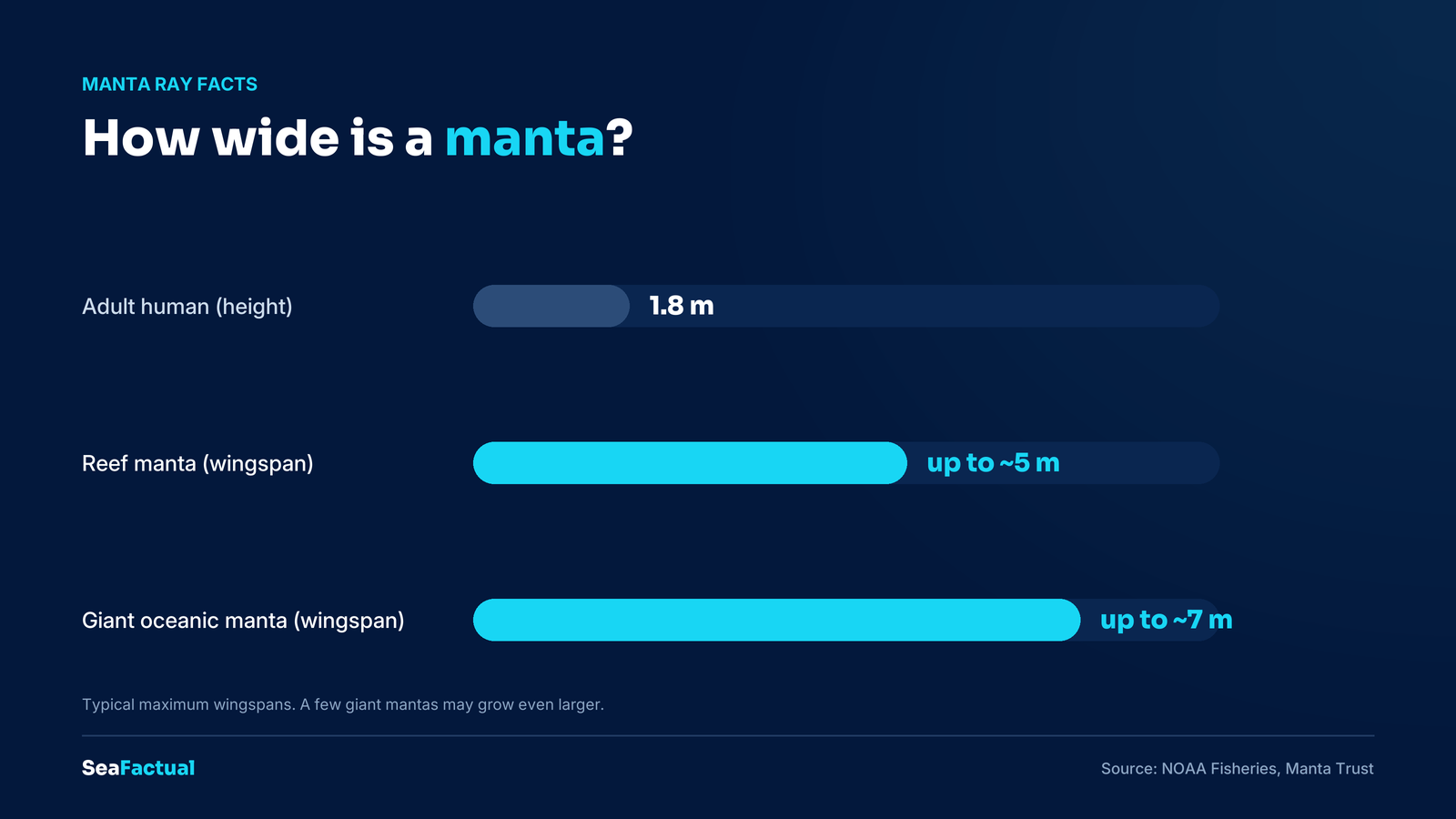
There are two species of manta ray. The giant oceanic manta is the biggest ray in the world, with a wingspan of up to around 7 metres, wider than most living rooms are long. NOAA says the largest can weigh more than two tonnes. The reef manta is smaller, with a wingspan of up to around 5 metres.
Scientists only confirmed that there were two separate species in 2009. Until then, all mantas were thought to be one species.
Manta rays have the biggest brain of any fish
Manta rays have the largest brains of any fish, both in overall size and relative to their body. And they seem to use them.
In a 2016 study, captive giant mantas were shown a mirror. They behaved in ways that suggested they might recognise themselves: circling, repeatedly moving in front of the mirror and making unusual movements, rather than treating the reflection as another manta. Only a handful of animals, such as great apes, dolphins and elephants, have shown signs of this ability. More research is needed, but it suggests mantas may be far more aware than we once thought.
Mantas also appear to remember places. They regularly return to the same cleaning stations on the reef, where small fish pick parasites and dead skin off them.
What do manta rays eat?
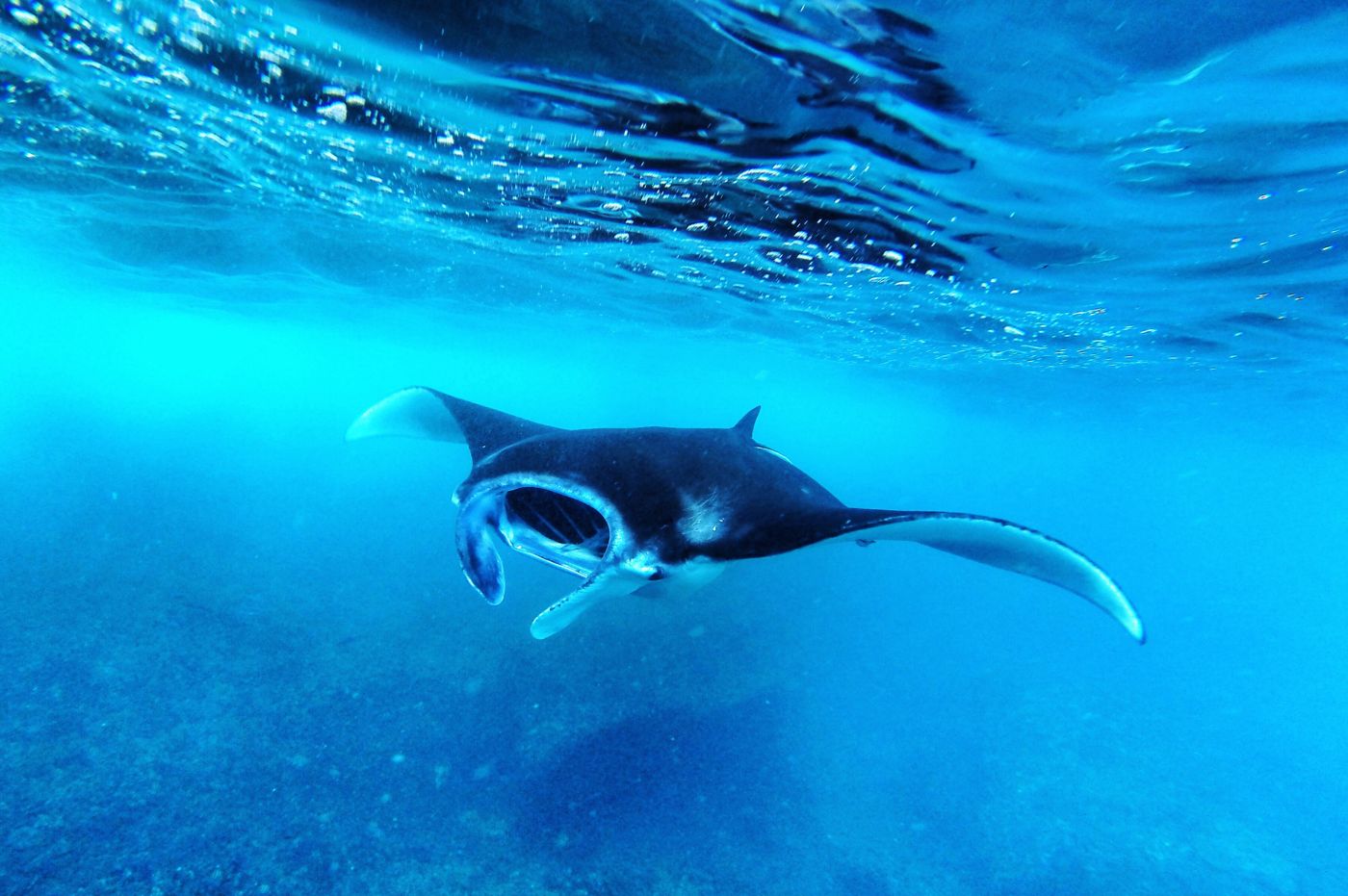
Despite their size, manta rays eat zooplankton: tiny shrimp, krill, fish eggs and larvae. They swim with their huge mouths open and filter the food out of the water using special plates in their gills.
The two fins on either side of the head, called cephalic fins, unroll during feeding to funnel food into the mouth, then roll up again when the manta is cruising. Mantas sometimes feed in groups, swimming in loops and even somersaulting backwards through rich patches of plankton.
Are manta rays dangerous?
No. Manta rays are harmless to people. Unlike many stingrays, they have no stinging barb on their tail, and their tiny teeth are not used for feeding. Divers and snorkellers can swim with them safely, as long as they give the mantas space and never touch them, which damages the protective mucus on their skin.
The stingray family has a sense that mantas share too: they can detect tiny electrical signals in the water.
Can manta rays jump out of the water?
Yes. Mantas sometimes leap clear of the surface and land with a loud slap, alone or in groups. Nobody knows exactly why. It may be a way to communicate, to court a mate, or to shake off parasites.
How do manta rays have babies?
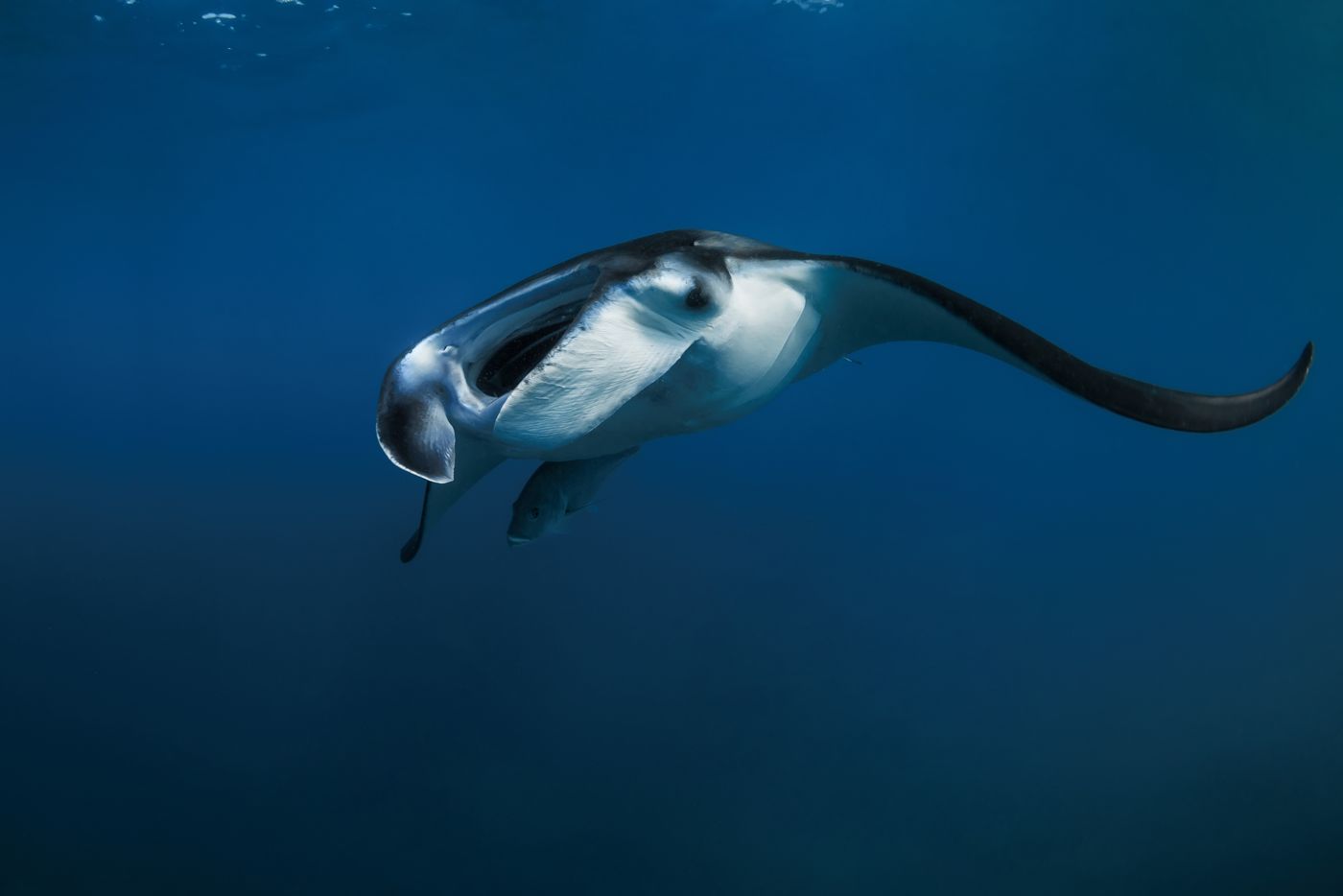
Manta rays reproduce very slowly. After a pregnancy of around a year, a female usually gives birth to a single pup, born live and already about as wide as a person is tall. Many females only give birth every two to five years. That slow breeding makes mantas especially vulnerable when numbers fall.
Are manta rays endangered?
The giant oceanic manta is listed as Endangered and the reef manta as Vulnerable on the IUCN Red List. The biggest threats are fishing, including a trade in their gill plates for use in some traditional remedies, accidental capture in nets, and boat strikes. Mantas are now protected in many countries, and international trade is controlled.
Manta tourism also helps. Studies suggest a living manta can be worth far more to local communities through diving and snorkelling over its lifetime than it would be as a catch.
Where can you see manta rays?
Some of the best-known places to see manta rays include:
- The Maldives, especially Hanifaru Bay, where reef mantas gather to feed
- Raja Ampat and Komodo, Indonesia
- Kona, Hawaii, famous for night dives as mantas feed under lights
- Mozambique, around Tofo
- San Benedicto and the Revillagigedo Islands, Mexico, for giant oceanic mantas
Choose operators that follow a code of conduct: keep your distance, never touch or chase the mantas, and limit the number of swimmers in the water.
Frequently asked questions
What is the difference between a manta ray and a stingray?
Manta rays are filter feeders that swim in open water, have no stinging barb and have cephalic fins on their heads. Most stingrays live on or near the seabed, eat shellfish and other animals, and many have a venomous barb on their tail.
Are there manta rays in the UK?
No. Manta rays live in tropical and subtropical seas. UK waters have their own rays, such as thornback and undulate rays, which live close to the seabed and are much smaller.
How long do manta rays live?
Scientists think manta rays can live for at least 40 years, but exact lifespans are hard to measure in the wild.
Do manta rays have to keep swimming?
Yes. Manta rays need to keep moving to push water over their gills so they can breathe, so they never truly stop swimming.
Which fish has the biggest brain?
The manta ray has the largest brain of any fish, both in absolute size and relative to body size. It is also featured in our episode 10 Ocean Animals That Hold Incredible World Records, and the biggest fish overall is covered in our whale shark facts.
Want more?
Follow SeaFactual for a new ocean fact every day, and get the fact of the week in your inbox using the form below.