The whale shark is the biggest fish on Earth.
In this article
- Whale shark quick facts
- Is a whale shark a whale or a shark?
- How big do whale sharks get?
- What do whale sharks eat?
- Are whale sharks dangerous to humans?
- Every whale shark has its own pattern of spots
- How deep can whale sharks dive?
- How long do whale sharks live?
- How are whale sharks born?
- Where can you swim with whale sharks?
- Are whale sharks endangered?
- Frequently asked questions
- Want more?
The whale shark is the biggest fish in the world, as long as a bus and heavier than an elephant. Yet this giant shark is completely harmless, feeding on some of the smallest animals in the sea. Every one has its own pattern of spots, and scientists identify them using a trick borrowed from astronomy.
Here are the facts about whale sharks: how big they get, what they eat, how long they live and where you can see them in the wild.
Whale shark quick facts
- Scientific name
- Rhincodon typus
- What it is
- A shark, and the largest fish on Earth (not a whale)
- Length
- Usually 5 to 12 metres; the largest accepted record is around 18.8 metres
- Weight
- Large adults can weigh many tonnes, with estimates of 20 tonnes or more for the biggest
- Diet
- Plankton, krill, fish eggs and small fish
- Lifespan
- At least 50 years, and possibly more than 100
- Where they live
- Warm tropical and subtropical seas worldwide
- Conservation status
- Endangered (IUCN Red List)
Is a whale shark a whale or a shark?
The whale shark is a shark, not a whale. It breathes through gills, has a skeleton made of cartilage and swims by sweeping its tail from side to side, like other sharks. Whales are mammals that breathe air and move their tails up and down. The name simply comes from its whale-like size and the fact that, like some whales, it filter-feeds.
How big do whale sharks get?
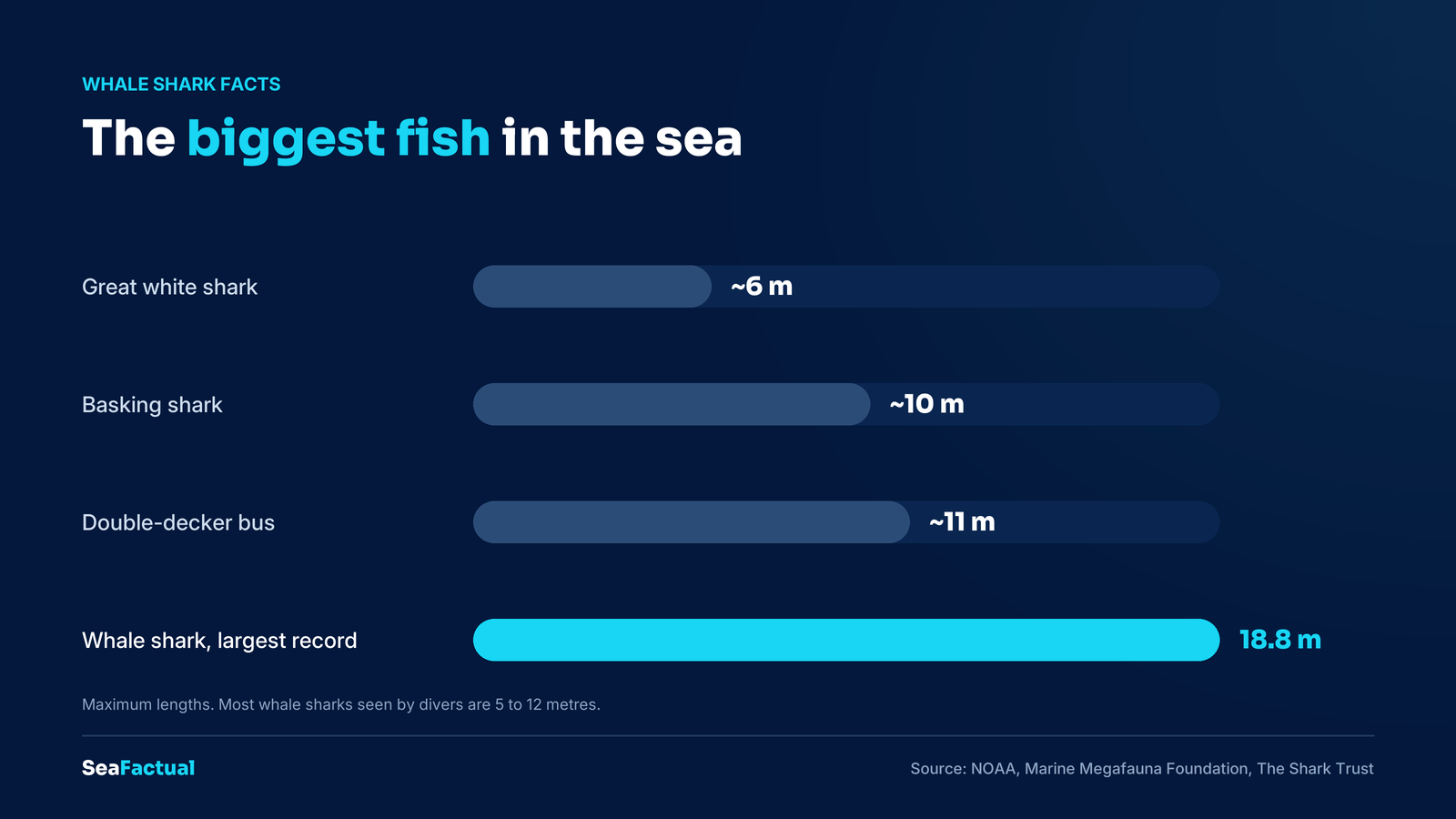
Most whale sharks seen by divers are between 5 and 12 metres long. The largest accepted measurement is around 18.8 metres, about the length of four cars parked end to end. NOAA says the biggest may weigh as much as 40 tons by some estimates, though weighing a live whale shark is almost impossible, so all weights are estimates.
What do whale sharks eat?
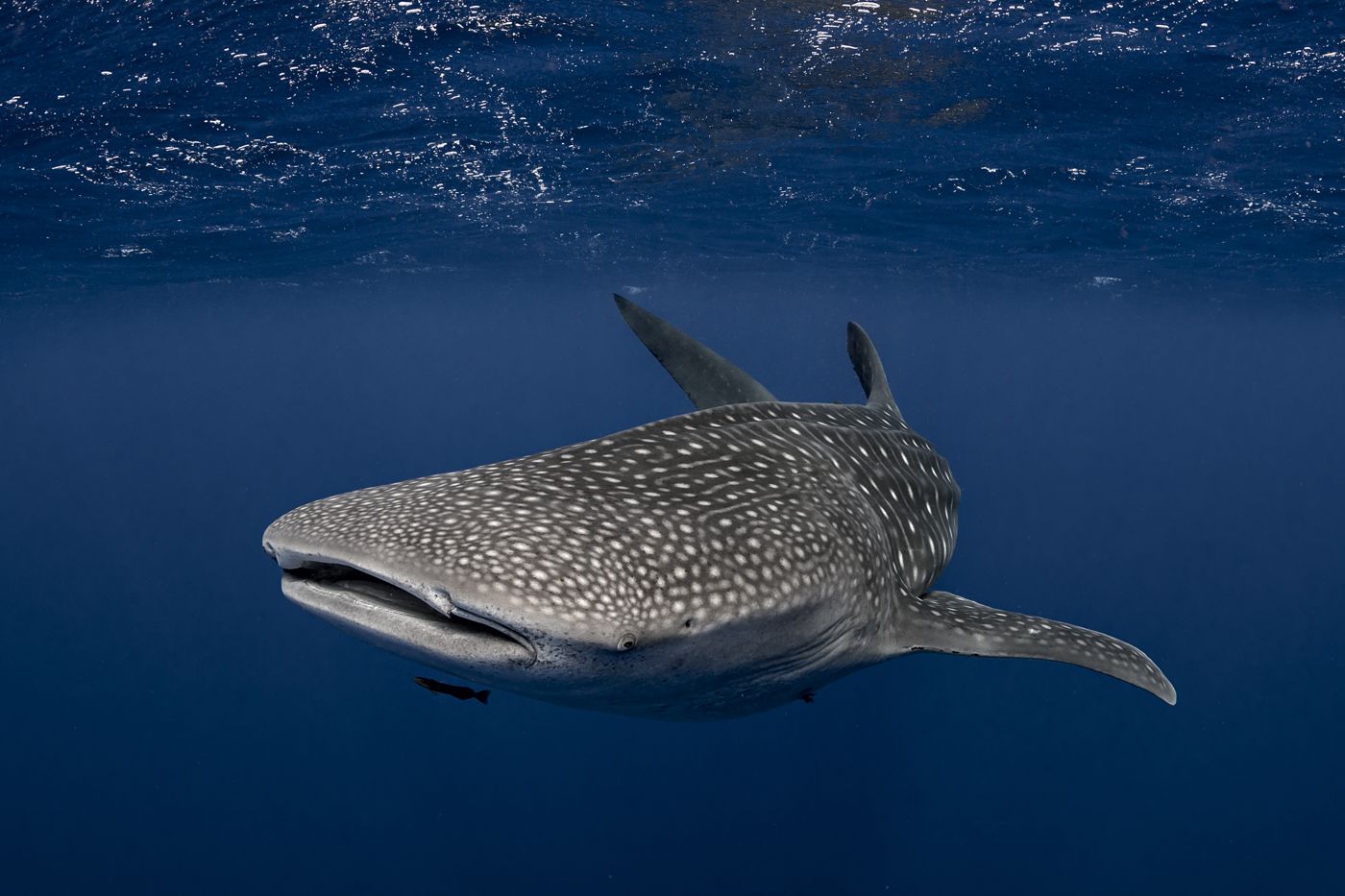
Despite their size, whale sharks eat some of the smallest food in the ocean: plankton, krill, fish eggs, tiny shrimp and small fish. They are filter feeders. A whale shark swims with its enormous mouth open, or sucks in water, and sieves out the food using filter pads in its gills, processing thousands of litres of water an hour.
Whale sharks do have teeth, thousands of them, but they are tiny and play no real part in feeding.
They also know where the food will be. Whale sharks gather at the same places at the same time each year, often when fish spawn or plankton blooms, and some travel thousands of kilometres between feeding sites.
Are whale sharks dangerous to humans?
No. Whale sharks are gentle, slow-moving giants that cruise at around walking pace. They cannot eat anything large, and divers and snorkellers regularly swim alongside them.
The real danger runs the other way. Boat propellers often injure whale sharks feeding near the surface, so responsible tours keep their distance and limit how many swimmers are in the water at once. Never touch a whale shark or ride on one.
Every whale shark has its own pattern of spots
The pale spots and stripes on a whale shark's back are unique to each individual, like a fingerprint. Scientists photograph the area just behind the gills and match the pattern using software based on an algorithm originally designed to map patterns of stars. Thanks to photos sent in by divers and tourists, thousands of individual whale sharks are now identified around the world.
How deep can whale sharks dive?
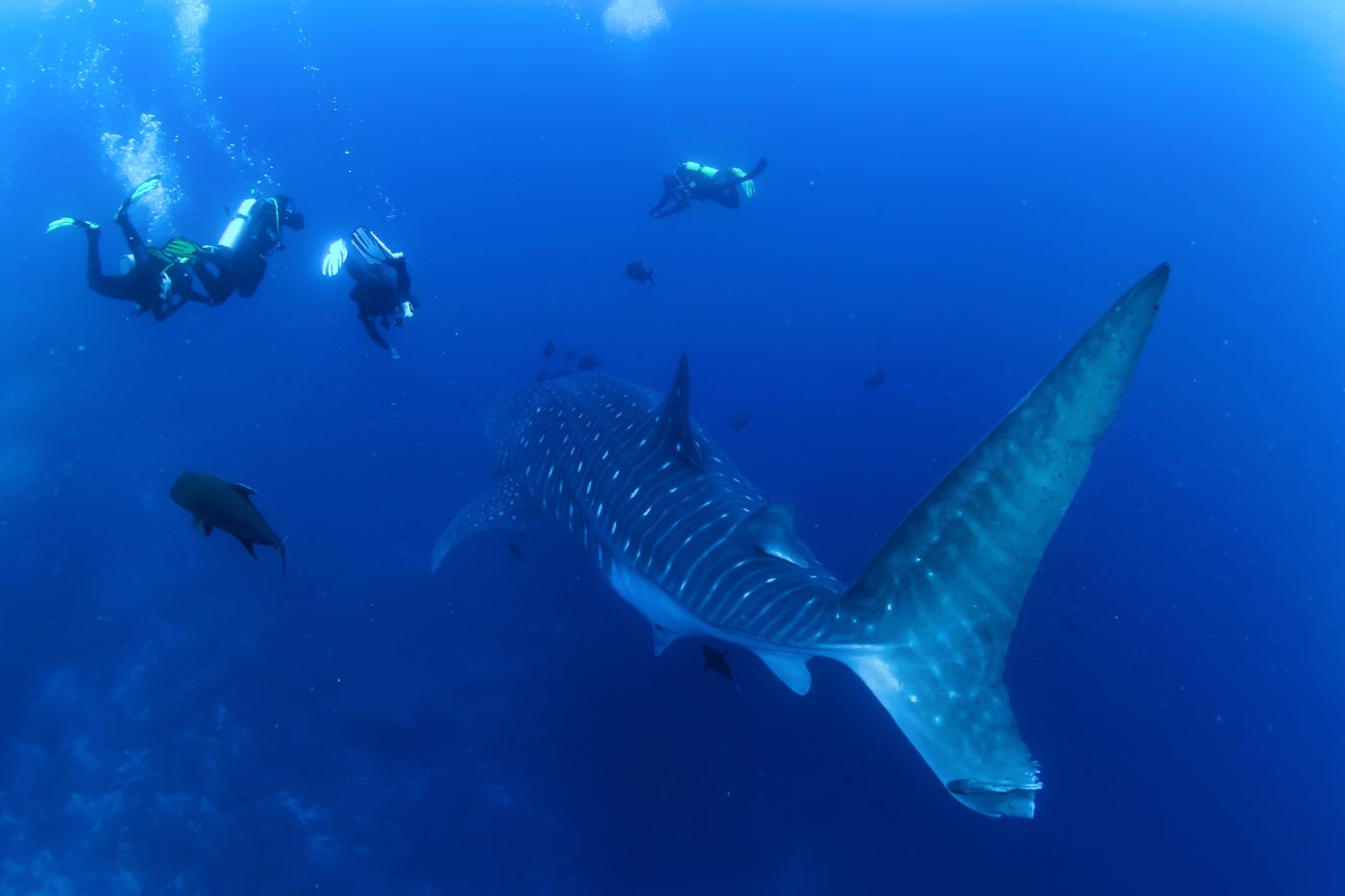
Whale sharks spend a lot of time near the surface, but they can dive astonishingly deep. Tagged whale sharks have been recorded diving to nearly 2,000 metres, deep into the darkness of the ocean. Scientists think these deep dives may help with navigation or searching for food.
How long do whale sharks live?
Whale sharks are hard to age, because they do not have hard bones with clear growth rings. In 2020, scientists used carbon left in the oceans by nuclear bomb tests in the 1950s and 60s to confirm that one whale shark was around 50 years old. That also proved their backbones add one growth layer a year, and researchers think the biggest whale sharks may live for 100 years or more.
How are whale sharks born?
Whale sharks do not lay eggs in the open sea. The eggs hatch inside the mother and the young are born live. In 1996, scientists examined a female caught off Taiwan and found she was carrying around 300 unborn pups at different stages of development. Newborn whale sharks are only around half a metre long.
Where can you swim with whale sharks?
Whale sharks visit warm waters all over the world, and several places have well-known seasons for seeing them, including:
- Ningaloo Reef, Western Australia
- The Maldives, especially South Ari Atoll
- Isla Mujeres and Holbox, Mexico
- Tofo, Mozambique
- Donsol, the Philippines
- Djibouti, in the Gulf of Aden
Choose operators that follow a code of conduct: no touching, no feeding, a safe distance and a limit on swimmers. Avoid places where whale sharks are fed to keep them in one spot, as this changes their natural behaviour.
Are whale sharks endangered?
Whale sharks are listed as Endangered on the IUCN Red List. Their numbers have fallen sharply, mainly because of fishing in the past, accidental capture in nets and collisions with ships. They grow slowly and mature late, so populations take a long time to recover. Whale sharks are now protected in many countries, and international trade in them is controlled.
Frequently asked questions
Is a whale shark bigger than a great white shark?
Much bigger. The largest great whites reach around 6 metres, while whale sharks can grow to around 18 metres. But the great white is the biggest predatory fish, while the whale shark eats plankton. Read more in our great white shark facts.
Do whale sharks have teeth?
Yes, thousands of tiny teeth arranged in rows, but they are not used for feeding. Whale sharks filter their food from the water instead.
Can you see whale sharks in the UK?
No. Whale sharks live in warm tropical and subtropical seas. The UK does have its own giant filter-feeding shark, though: the basking shark, the second-biggest fish in the world, which visits Cornwall, the Isle of Man and western Scotland in summer.
How fast do whale sharks swim?
Slowly. Whale sharks usually cruise at around 5 km/h, about walking pace, which is why snorkellers can keep up with them for a while.
How many whale sharks are left?
Nobody knows exactly, because they are spread across all the world's warm oceans and dive deep. Scientists have identified thousands of individuals by their spots, and the global population is thought to have fallen by more than half in recent generations.
Want more?
Follow SeaFactual for a new ocean fact every day, and get the fact of the week in your inbox using the form below.
Sources and further reading
- NOAA Ocean Service: What is the largest fish in the ocean?
- Marine Megafauna Foundation: Whale shark facts
- Ong et al. 2020, Frontiers in Marine Science: Annual bands in whale shark vertebrae validated by bomb radiocarbon
- Tyminski et al. 2015, PLOS ONE: Vertical movements and diving behaviour of whale sharks
- Joung et al. 1996, Environmental Biology of Fishes: The whale shark is a livebearer
- Arzoumanian et al. 2005, Journal of Applied Ecology: An astronomical pattern-matching algorithm for whale sharks
- IUCN Red List
- The Shark Trust