An octopus can change the colour and texture of its skin in a fraction of a second.
In this article
The octopus is about as close to an alien as anything on Earth. It has three hearts, blue blood and arms that can taste what they touch and act almost on their own. It can vanish into the background in a split second, squeeze through any gap bigger than its beak, and carry its own portable shelter.
Here are the facts about octopuses: their hearts and blood, their brains, how long they live, how they change colour and more.
Octopus quick facts
- Number of species
- Around 300
- Hearts
- Three
- Blood
- Blue
- Arms
- Eight (not tentacles)
- Neurons
- Around 500 million in the common octopus, most of them in the arms
- Lifespan
- Usually one to two years; the giant Pacific octopus lives around three to five
- Diet
- Crabs, shellfish, fish and other small animals
- Where they live
- Every ocean, from rock pools to the deep sea
Why do octopuses have three hearts?
An octopus has three hearts. Two of them pump blood through the gills, where it picks up oxygen. The third, the main heart, pumps that oxygen-rich blood around the rest of the body.
The main heart actually stops beating while an octopus swims, which is one reason octopuses prefer crawling to swimming. Swimming tires them out quickly.
Why is octopus blood blue?
Our blood is red because it uses iron, in a protein called haemoglobin, to carry oxygen. Octopus blood uses copper instead, in a protein called haemocyanin, which turns blue when it carries oxygen. Copper-based blood works well in cold water with little oxygen, but it is less efficient than ours, which helps explain why octopuses need three hearts.
Octopuses have brains in their arms
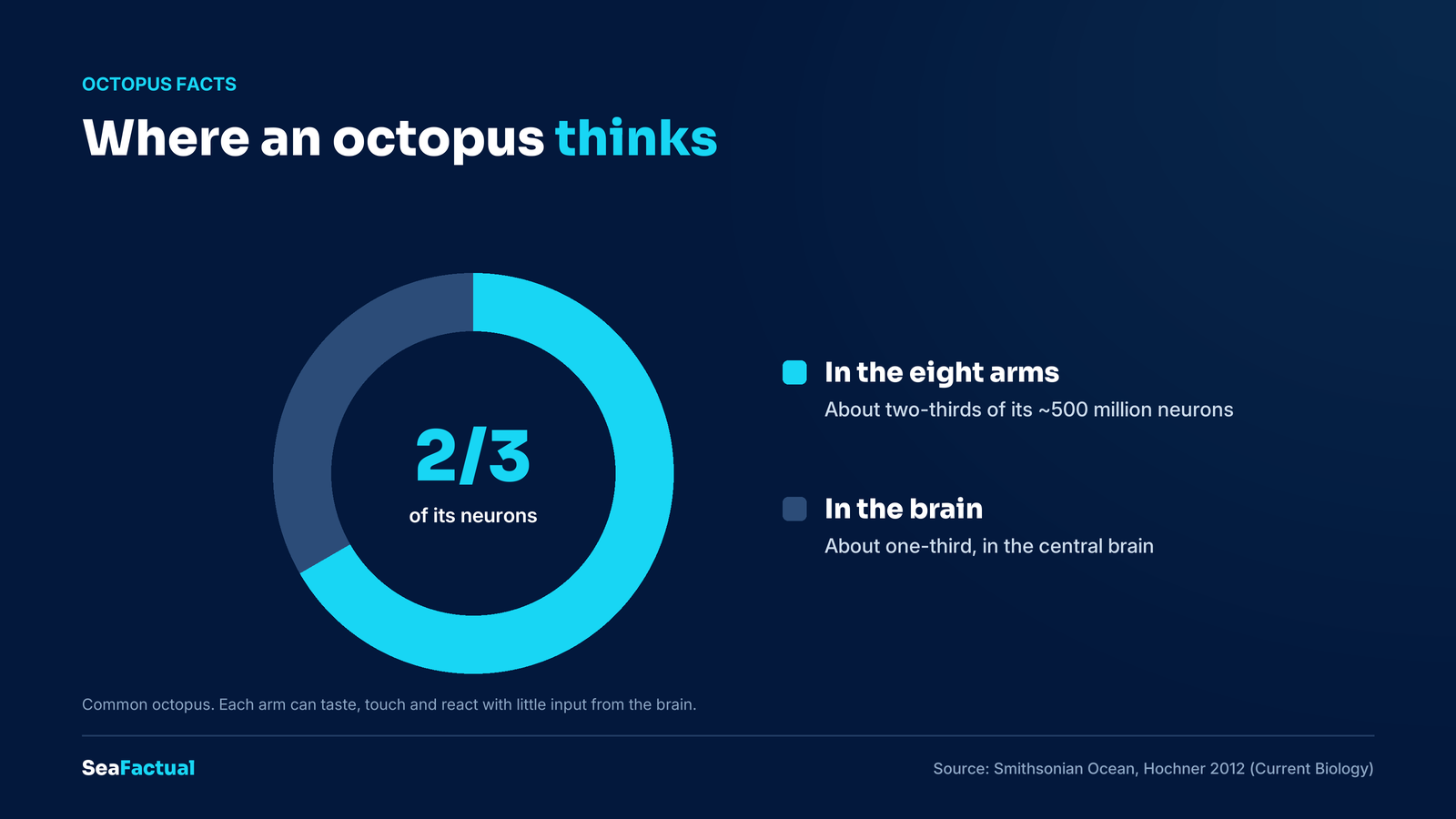
The common octopus has around 500 million neurons, a similar number to a dog. But only about a third of them are in its head. Around two-thirds are in its arms.
That means each arm can do a lot by itself. Its suckers can both feel and taste what they touch, and an arm can carry out complex movements such as reaching and grabbing with little instruction from the brain. Scientists still don't fully understand how the central brain and the eight arms share the work.
And yes, they are arms, not tentacles. Octopuses have eight arms with suckers along their length. Squid and cuttlefish have eight arms plus two longer tentacles.
How do octopuses change colour?
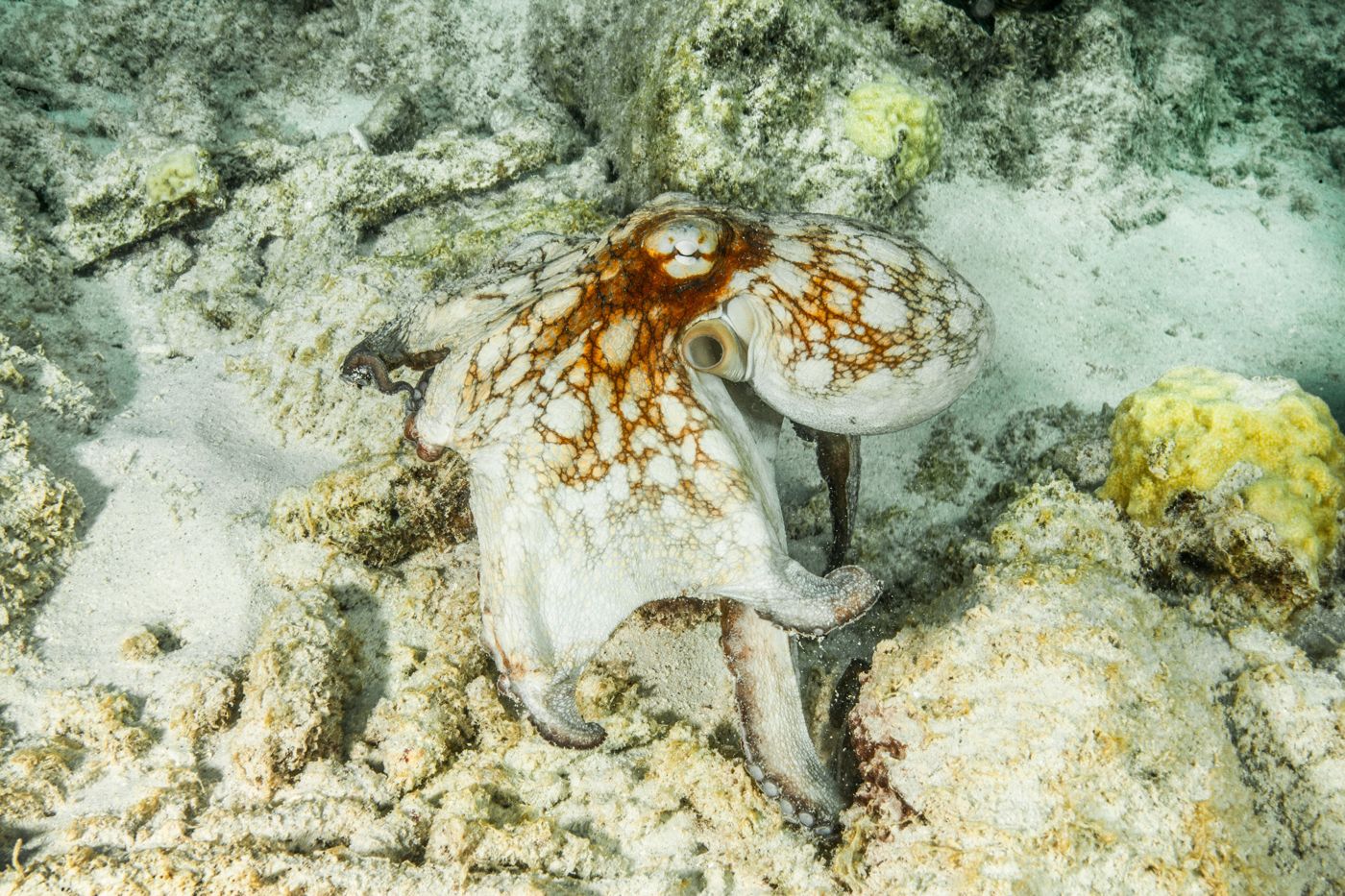
An octopus's skin is packed with thousands of tiny colour sacs called chromatophores, each controlled by nerves and muscles. By stretching or squeezing them, an octopus can change colour and pattern in a fraction of a second. It can also raise small bumps called papillae to change the texture of its skin, so it looks like rock, coral or seaweed.
Octopuses use this to hide from predators, sneak up on prey and signal mood. Strangely, most octopuses are thought to be colour-blind, and scientists are still working out how they match colours so well.
How smart are octopuses?
Octopuses are some of the most intelligent invertebrates known. In aquariums they solve puzzles, unscrew jar lids to reach food and recognise individual keepers.
In the wild, the veined octopus has been filmed collecting coconut shell halves, carrying them across the seabed and assembling them into a shelter when it needs one. It was one of the first examples of tool use found in an invertebrate.
They are also famous escape artists. Because they have no bones, an octopus can squeeze through any gap larger than its hard beak. In 2016, an octopus named Inky escaped from the National Aquarium of New Zealand by slipping out of his tank and down a drainpipe into the sea.
How long do octopuses live?
Surprisingly short lives. Most octopuses live for only one to two years. Even the biggest, the giant Pacific octopus, usually lives just three to five years.
Their lives end with breeding. Males die soon after mating. Females lay their eggs in a den and guard them, cleaning them and pumping water over them, and stop eating the whole time. When the eggs hatch, the mother dies.
In 2014, scientists reported a deep-sea octopus that guarded her eggs for 53 months, around four and a half years, without leaving them. It is the longest known brooding period of any animal.
The biggest octopus in the world
The giant Pacific octopus is the largest octopus species. Adults typically weigh around 15 to 50 kilograms, and the biggest have an arm span of several metres. Much bigger records exist, but many of them are old and hard to verify.
Are octopuses dangerous?
All octopuses have venom, which they use to subdue prey, but almost all are harmless to people. The big exception is the blue-ringed octopus of the Indian and Pacific Oceans. It is small enough to fit in your hand, but its venom contains a nerve toxin that can be deadly to humans. Its bright blue rings are a warning: leave it alone.
Frequently asked questions
Are there octopuses in the UK?
Yes. The common octopus and the curled octopus both live in UK waters. In 2025, the south-west of England saw its biggest octopus bloom in at least 75 years. Warm seas brought huge numbers of common octopus to the coasts of Cornwall and Devon, and more than 400 tonnes were landed in May 2025 alone, a record for the UK.
What is the plural of octopus?
"Octopuses" is the standard plural in English. "Octopodes" is also correct, based on the word's Greek origin. "Octopi" is widely used but is based on a mistaken idea that the word comes from Latin.
Do octopuses have bones?
No. Octopuses have no skeleton at all. The only hard part of their body is their parrot-like beak, which is why they can squeeze through tiny gaps.
How many hearts does a squid have?
Squid also have three hearts and blue blood, like octopuses and cuttlefish. All three are cephalopods.
Can octopuses regrow their arms?
Yes. If an octopus loses an arm, for example to a predator, it can grow a new one, complete with suckers and nerves.
Want more?
Watch the octopus in Episode 1 of SeaFactual, follow us for a new ocean fact every day, and get the fact of the week in your inbox using the form below.
Sources and further reading
- Natural History Museum: Octopuses keep surprising us
- Hochner 2012, Current Biology: An embodied view of octopus neurobiology
- Finn et al. 2009, Current Biology: Defensive tool use in a coconut-carrying octopus
- Robison et al. 2014, PLOS ONE: The longest-known egg-brooding period of any animal
- Marine Biological Association: 2025 octopus bloom summary
- Smithsonian Ocean
- Monterey Bay Aquarium