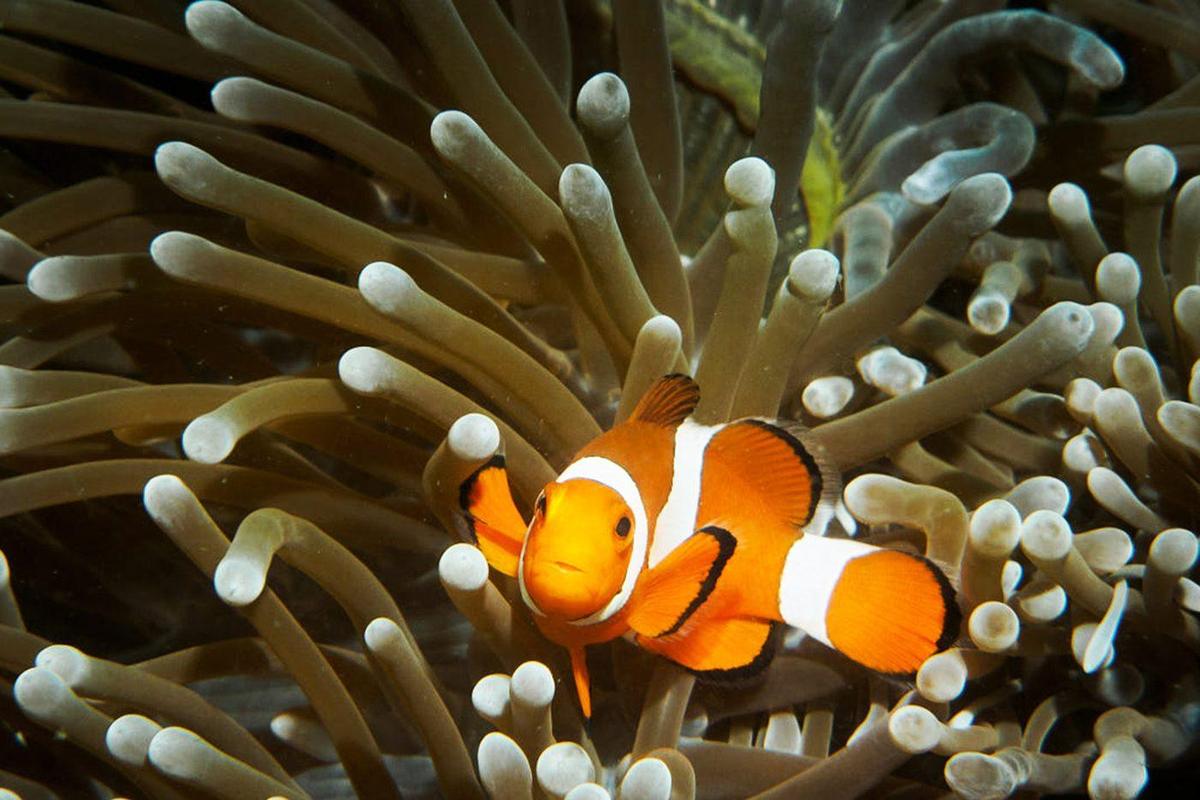
A clownfish in its host anemone. It may spend almost its whole adult life in this one spot.
In this article
Every clownfish is born male. They live in tiny groups ruled by a single female, inside an animal covered in stinging tentacles, and if that female dies, a male changes sex and takes her place. In real life, Nemo's dad would have become his mum.
Here are the facts about clownfish: how they change sex, how they survive inside a sea anemone, how long they live and what the films got right and wrong.
Clownfish quick facts
- Also called
- Anemonefish
- Species
- Nearly 30, all in the Indian and Pacific Oceans
- Size
- The orange clownfish reaches about 11 cm (4.3 inches)
- Home
- Sea anemones on tropical coral reefs
- Diet
- Algae, plankton and leftovers from their anemone
- Sex
- All born male; the dominant fish becomes female
- Eggs
- 100 to over 1,000 per clutch, guarded by the male
- Lifespan
- 6 to 10 years is typical; breeding females may live far longer
How many kinds of clownfish are there?
There are nearly 30 species of clownfish, found on reefs across the Indian Ocean and western Pacific, from East Africa to the Pacific islands. Not all of them are orange with white stripes. Some are black, some yellow, some pink, and some, like the fish below, have just a single white band behind the head.
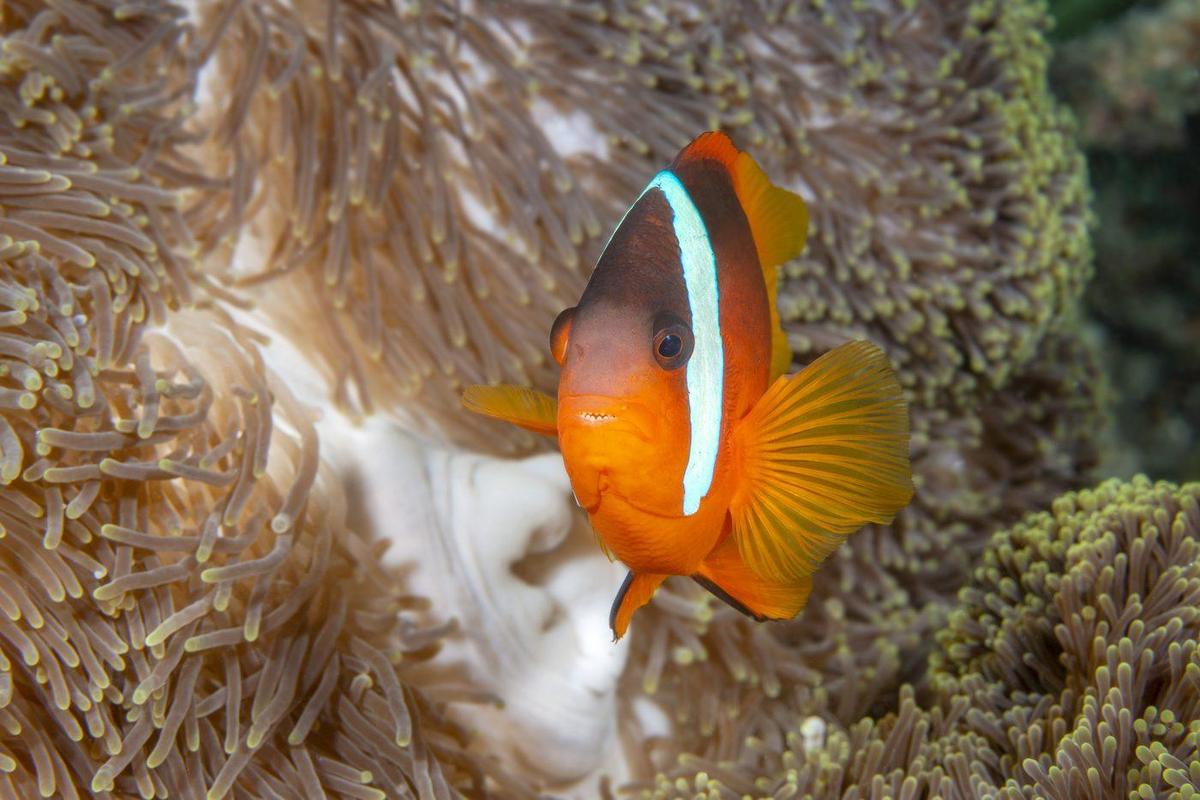
Scientists think the anemone partnership is what made clownfish so diverse. A 2012 study found that clownfish evolved new species faster than their close relatives that do not live with anemones, with different species adapting to different host anemones.
The two clownfish most people know are the orange clownfish (Amphiprion percula) and the very similar clown anemonefish (Amphiprion ocellaris). According to the Florida Museum, the orange clownfish has thick black edges around its white bands and a bright orange eye, while the clown anemonefish has thin black edges, sometimes so thin they seem to be missing.
Why is every clownfish born male?
Clownfish are protandrous hermaphrodites, which means every fish starts life as a male and can later become female.
Each anemone is home to a small group with a strict pecking order. The largest fish is the only female. The second largest is the breeding male. Below them are up to four smaller males that do not breed and wait their turn. The Florida Museum explains that the female keeps the others in line through aggressive dominance, which stops another female from forming.
If the female dies or disappears, the breeding male changes sex and becomes the new female, and the biggest non-breeder moves up to become her mate. This was described in a classic 1977 study in Nature, which showed the switch is controlled by social rank.
The non-breeders also keep themselves small. A 2003 study in Nature found that each fish stays a set size below the one above it in the queue, which avoids a challenge it would probably lose and could be evicted for. Clownfish are featured in our episode 10 Ocean Animals That Break the Rules of Nature for exactly this reason.
Why don't sea anemones sting clownfish?
Sea anemones are covered in stinging cells that fire into small fish that touch them. Clownfish live among those tentacles unharmed thanks to a protective layer of mucus on their skin.
A young clownfish is not fully protected straight away. According to the Florida Museum, it gets used to a new anemone by touching the tentacles gently, first with its fins and then its whole body, and may be stung many times before it settles in. Repeated contact helps it build up its protective coating.
The deal works both ways:
- The clownfish gets a safe home that most predators will not enter, plus scraps of food.
- The anemone gets a bodyguard that chases off fish trying to nibble it, and may benefit from the clownfish's waste and the water it stirs up.
Only around ten species of sea anemone host clownfish, and each clownfish species uses just some of them.
How do clownfish have babies?
Clownfish pairs stay together, and in warm tropical water they can breed all year round. Before spawning, the male cleans a patch of bare rock next to the anemone, where its tentacles can protect the nest.
The female lays anywhere from 100 to over 1,000 eggs, depending on her size and age, and the male fertilises them. He then does most of the parenting, fanning the eggs to keep them supplied with oxygen, removing dead ones and guarding them. The eggs hatch after about 6 to 7 days.
The newly hatched larvae drift in the plankton for about a week before settling on the reef and searching for an anemone. Remarkably, they may find their way partly by smell. In a 2008 study, young orange clownfish in Papua New Guinea preferred water from reefs near islands, and were drawn to water scented with anemones or with leaves from rainforest trees, a cue that could guide them towards island reefs.
How long do clownfish live?
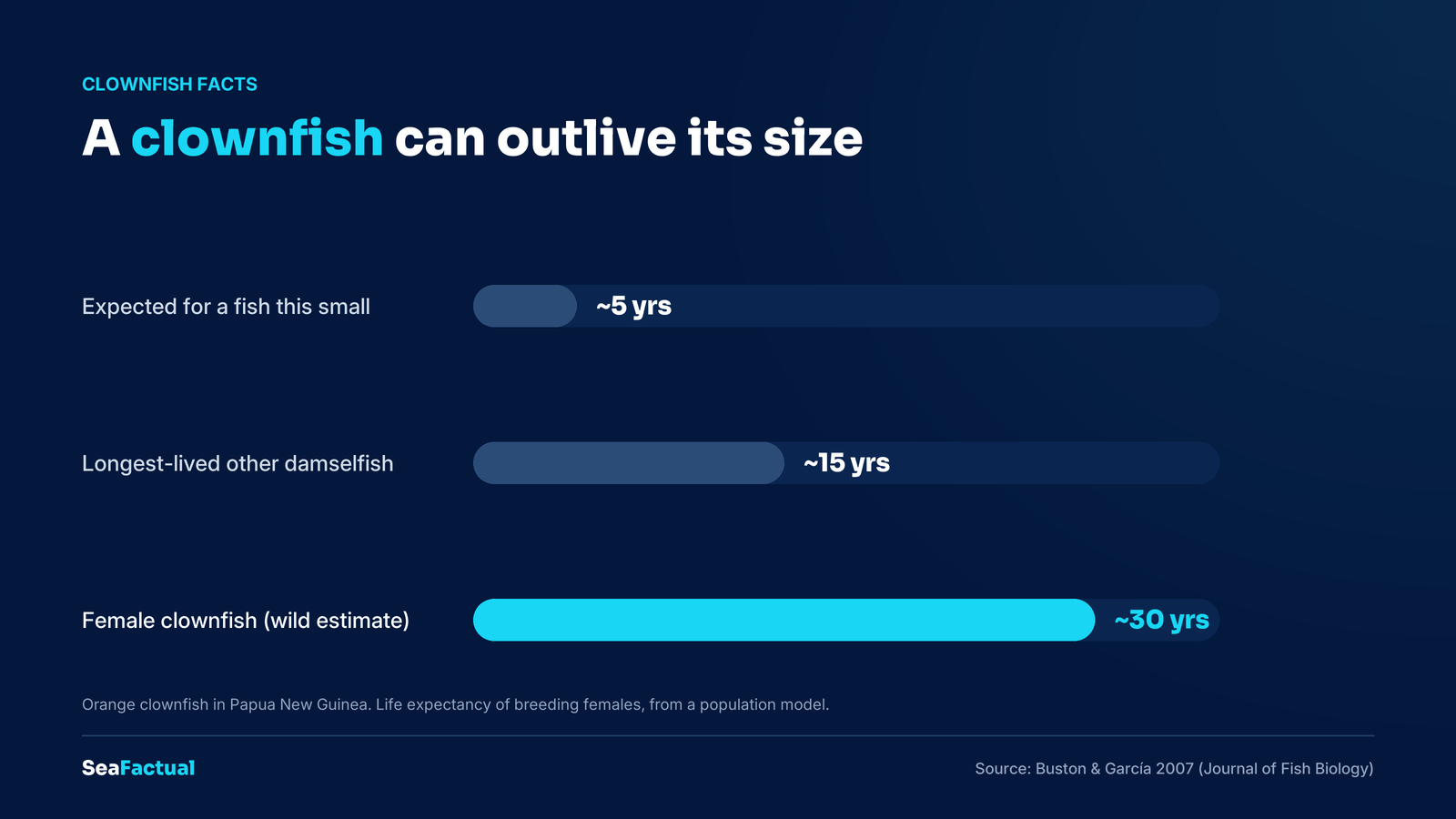
The usual figure is 6 to 10 years in the wild, and up to 18 years in aquariums, according to the Florida Museum.
But breeding females may live much longer. A 2007 study followed a wild population in Papua New Guinea and used its survival rates to model lifespans. It estimated that female orange clownfish have a life expectancy of around 30 years: about twice as long as any other damselfish, and about six times longer than expected for a fish that size. The likely reason is that life inside an anemone is so safe that very few adults are eaten.
What did Finding Nemo get wrong?
The film gets a lot right, including the clownfish's close bond with its anemone. But it leaves out the biology:
- Nemo's dad would have changed sex. When Nemo's mother died, Marlin, as the breeding male, would have become female.
- Clownfish do not go on long journeys. Adults rarely leave the safety of their anemone. The big travelling happens when they are tiny larvae drifting in the plankton.
- The "Nemo effect" was overstated. Many people assumed the film caused a rush to buy wild clownfish. A 2017 study looked at import and export figures and found little evidence of a boom in wild-caught clownfish in the 18 months after the film came out.
Frequently asked questions
Can clownfish live without an anemone?
In aquariums, yes. Many clownfish are kept and bred without anemones. In the wild, though, an anemone is their protection from predators, and a clownfish without one is unlikely to survive long.
Where do clownfish live in the wild?
Only on warm tropical reefs in the Indian and Pacific Oceans, from the Red Sea and East Africa to Australia's Great Barrier Reef, Indonesia and the Philippines. There are no wild clownfish in the Atlantic, including the Caribbean and Florida. Outside the tropics, the easiest place to see them is a public aquarium.
Are clownfish poisonous?
No. Clownfish are not poisonous or venomous. Their protection comes from living inside a stinging sea anemone.
Why are clownfish orange?
Scientists are not completely sure, but bright colours help clownfish recognise their own species, and their bold pattern stands out against the anemone they defend.
Which fish is Nemo?
Nemo is usually identified as a clown anemonefish (Amphiprion ocellaris), which looks almost identical to the orange clownfish (Amphiprion percula). Scientists often treat the two together as "Nemo".
Want more?
Follow SeaFactual for a new ocean fact every day, and get the fact of the week in your inbox using the form below.
Sources and further reading
- Florida Museum: Orange clownfish
- Fricke & Fricke 1977, Nature: Monogamy and sex change by aggressive dominance in coral reef fish
- Buston & García 2007, Journal of Fish Biology: An extraordinary life span estimate for the clown anemonefish
- Buston 2003, Nature: Size and growth modification in clownfish
- Dixson et al. 2008, Proceedings of the Royal Society B: Coral reef fish smell leaves to find island homes
- Litsios et al. 2012, BMC Evolutionary Biology: Mutualism with sea anemones triggered the adaptive radiation of clownfishes
- Militz & Foale 2017, Fish and Fisheries: The Nemo Effect
Spotted a mistake? Tell us How we fact-check Last checked 21 November 2026