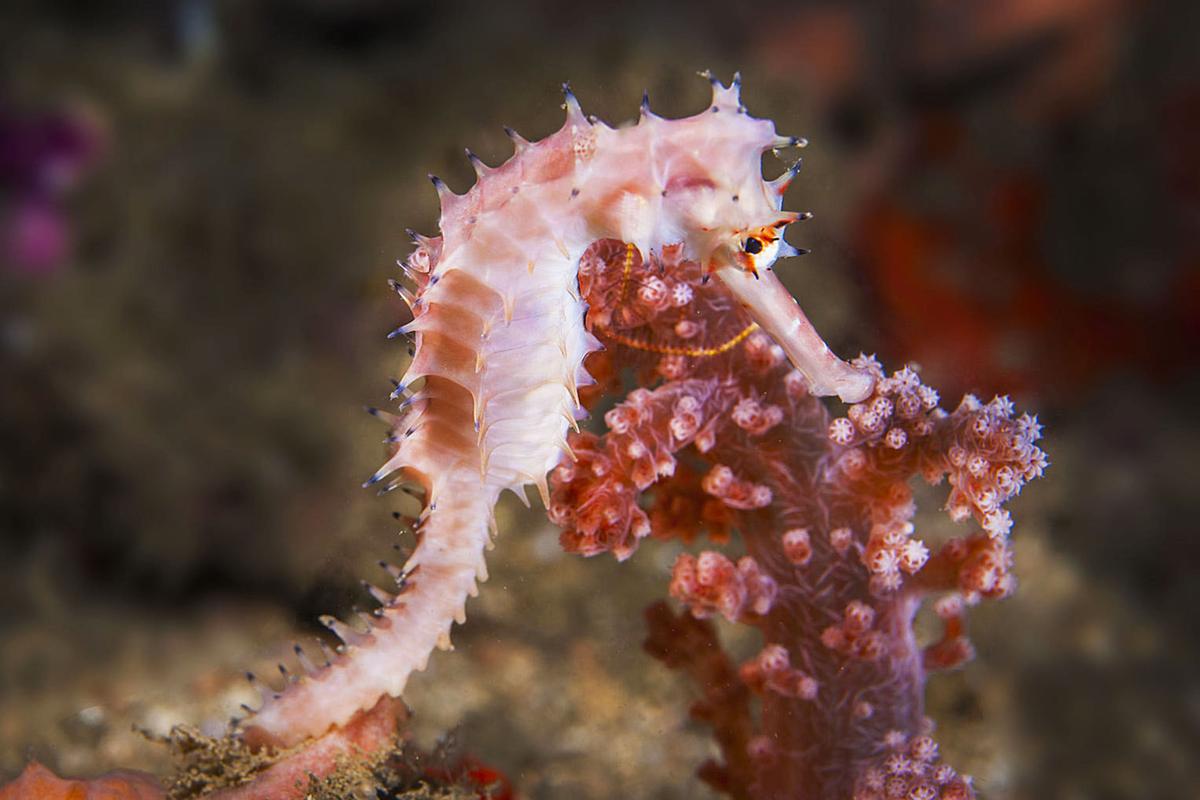
A seahorse on a reef off Cyprus, in the Mediterranean.
In this article
- Seahorse quick facts
- Is a seahorse a fish?
- Do male seahorses really get pregnant?
- How many babies does a seahorse have?
- Do seahorses mate for life?
- How many species of seahorse are there?
- How big do seahorses get?
- How do seahorses hunt?
- Can seahorses swim fast?
- Are seahorses endangered?
- Where can you see seahorses?
- Frequently asked questions
Seahorses look nothing like other fish. They swim upright, grip seaweed with their tails, have a head shaped like a horse and eyes that can look in two directions at once. And they are famous for one of the strangest facts in nature: it is the father who gets pregnant and gives birth.
Here are the facts about seahorses: how male pregnancy works, how many babies they have, how many species there are, how they hunt and why many are under threat.
Seahorse quick facts
- Type of animal
- A bony fish, related to pipefish and seadragons
- Species
- Around 40 or more; a 2016 global review recognised 41, and new species are still being found
- Size
- From about 2.5 cm (1 inch) to more than 30 cm (12 inches), depending on the species
- Pregnancy
- Males carry the eggs in a pouch and give birth
- Babies
- From about 5 to 2,000 young per birth, depending on the species
- Lifespan
- Around 1 to 5 years in the wild
- Diet
- Tiny shrimp-like animals, sucked up through the snout
- Habitat
- Seagrass, coral reefs, seaweed, mangroves and estuaries in warm and temperate seas
Is a seahorse a fish?
Yes. Despite their unusual shape, seahorses are bony fish. They breathe with gills, have a swim bladder and swim using fins. They belong to the genus Hippocampus, from the Greek for "horse" and "sea monster", and to the same family as pipefish and seadragons, including Australia's leafy seadragon, which is camouflaged to look like drifting seaweed.
Instead of scales, seahorses are covered in bony plates under the skin, which make them stiff and armoured.
Do male seahorses really get pregnant?
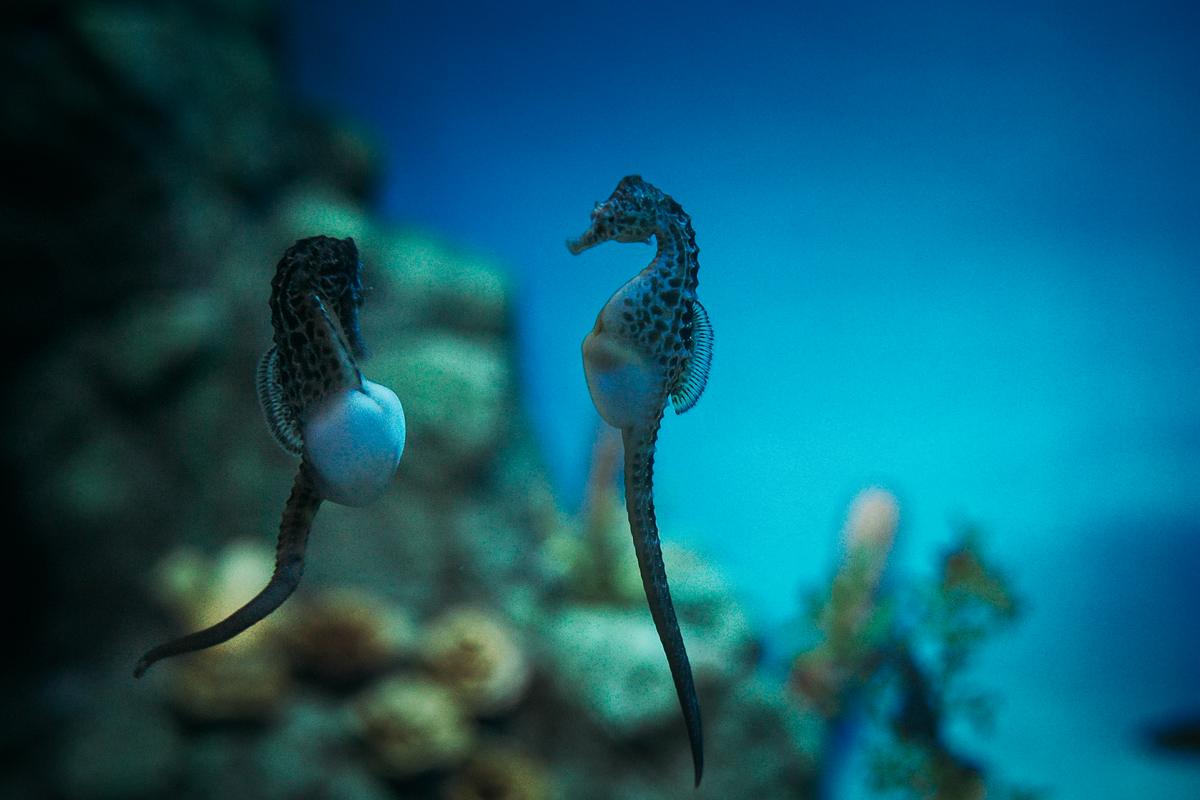
Yes. Seahorses, along with their pipefish and seadragon relatives, are the only animals in which the male becomes pregnant. During courtship, the female transfers her eggs into a brood pouch on the male's belly. He fertilises them inside the pouch, where the developing embryos are supplied with oxygen and protected until they hatch.
When the young are ready, the male goes into labour. He pumps his body back and forth, and tiny, fully formed seahorses shoot out of the pouch into the water. From that moment, the babies are on their own: neither parent cares for them.
In many species, the female visits her mate every morning during the pregnancy for a short greeting dance, which may help to keep the pair in sync for the next breeding cycle.
How many babies does a seahorse have?
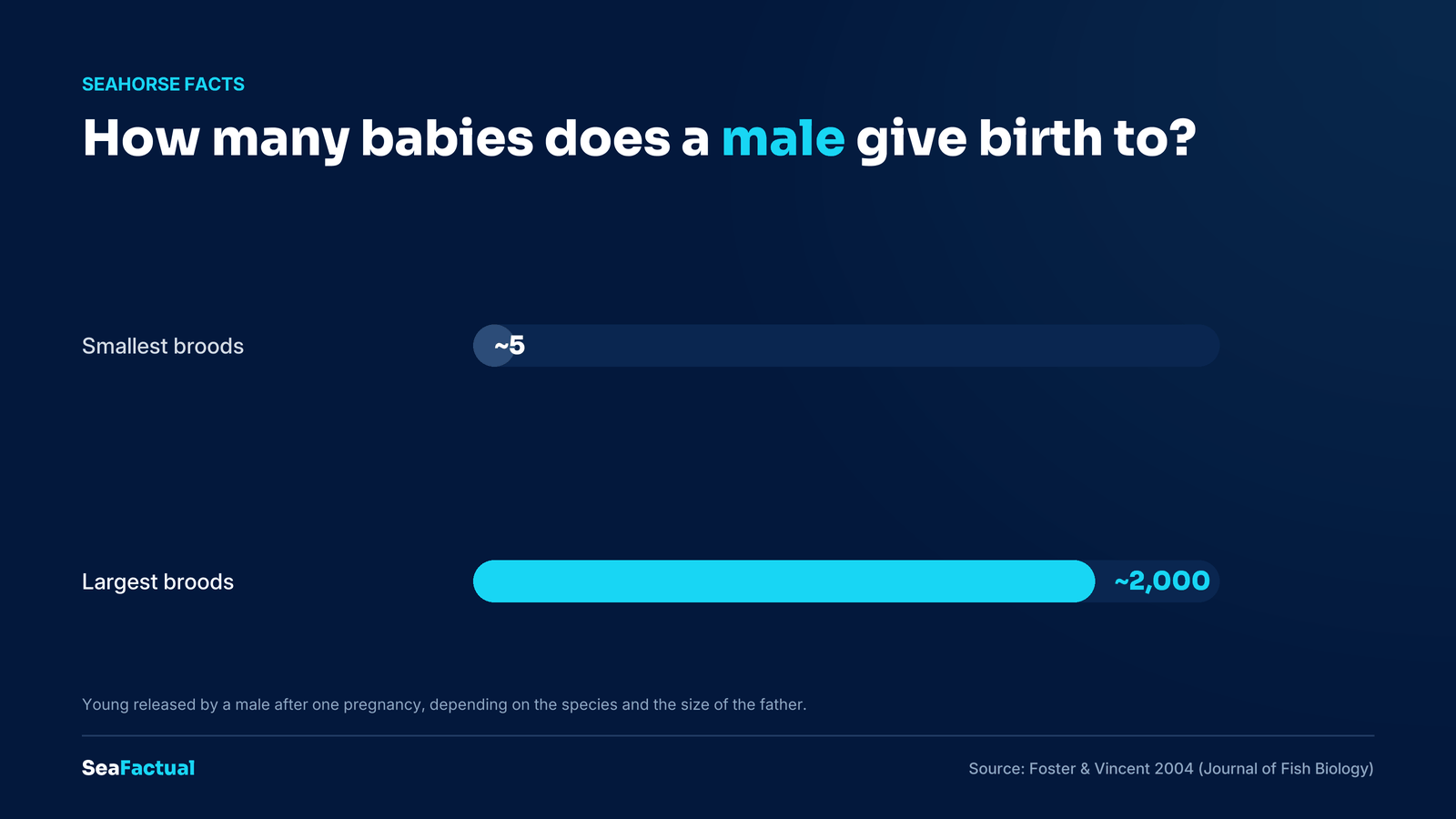
It varies hugely. According to the first major review of seahorse biology, published in 2004, males release anywhere from about 5 to 2,000 young in a single birth, depending on the species and the size of the father.
The babies are only a few millimetres long, and very few survive. Most are eaten by fish and other predators in their first days of life, which is why seahorses produce so many.
Do seahorses mate for life?
Some come close. The same 2004 review found that all seahorse species studied were monogamous within a breeding cycle: a male and female stay together while he is pregnant. Some species also stay with the same partner across many cycles, while others change partners between them.
How many species of seahorse are there?
Counting seahorses has proved surprisingly difficult, because the same species can look very different from place to place. A 2016 global revision recognised 41 species as valid. New ones are still being discovered and named: one recent example is Hippocampus amandavincentae, an Indian Ocean species named in honour of the co-founder of Project Seahorse.
How big do seahorses get?
The smallest are the pygmy seahorses, some of which are barely 2 cm (under an inch) tall and live camouflaged on sea fans. The dwarf seahorse of Florida, the Gulf of Mexico and the Caribbean grows to only about 2.5 cm (1 inch) and lives about a year, according to NOAA, which lists it as the third-smallest seahorse in the world.
At the other end of the scale, the largest species, such as the big-belly seahorse of southern Australia and New Zealand, can grow longer than 30 cm (12 inches).
How do seahorses hunt?
Seahorses are ambush predators. They wait, often anchored to seagrass by their tails, for tiny shrimp-like animals such as copepods to drift close. Then they flick their heads up and suck the prey into their snout in a fraction of a second.
Their head shape helps. In a 2013 study, researchers found that the seahorse's arched snout creates very little disturbance in the water as it moves forward. That lets it sneak within striking distance of copepods, which are extremely sensitive to water movement and normally escape most predators.
Seahorses have no teeth, and their eyes can move independently, so they can watch for prey in one direction and danger in another.
Can seahorses swim fast?
No. Seahorses are some of the slowest-swimming fish in the sea. They move upright, pushed along by a small fin on their back that beats very fast, and steer with tiny fins behind the head. In a strong current, they hold on to seagrass or coral with their prehensile tail, which works a little like a monkey's.
Are seahorses endangered?
Many species are threatened. Seahorses live in some of the ocean's most damaged habitats, including seagrass meadows, coral reefs and mangroves, and the 2004 review found that they usually live at low densities, which makes populations slow to recover.
The biggest threats are:
- Bycatch: huge numbers are caught accidentally in shrimp and bottom trawl nets, a problem Project Seahorse has highlighted for decades
- Trade: dried seahorses are used in traditional medicines and sold as souvenirs, and live ones are taken for aquariums
- Habitat loss: from coastal development, pollution and damage to seagrass
Since 2004, international trade in all seahorse species has been regulated under CITES, the global agreement on wildlife trade, and some countries have banned exports altogether.
Where can you see seahorses?
Seahorses live in shallow coastal waters around much of the world. Some well-known places to look include:
- Lembeh Strait and Bali, Indonesia, for pygmy seahorses and many others
- Florida and the Caribbean, in seagrass beds
- Southern Australia, including Sydney Harbour and Port Phillip Bay in Victoria
- The Mediterranean, including Greece, Cyprus and the Ria Formosa lagoon in Portugal
- Southern England, where spiny and short-snouted seahorses live in seagrass at places such as Studland Bay in Dorset
Look but never touch: seahorses are easily stressed, and in many places they are legally protected. Divers can help scientists by logging sightings with Project Seahorse's iSeahorse citizen science programme.
Frequently asked questions
Why do male seahorses get pregnant?
Nobody knows for certain. One idea is that it speeds up breeding: while the male carries one brood, the female can start producing the next batch of eggs, so the pair can breed again almost as soon as he gives birth.
How long is a seahorse pregnant?
Usually around two to four weeks, depending on the species and the water temperature.
Do seahorses have stomachs?
Seahorses have a very simple digestive system and no true stomach, so food passes through quickly. That is one reason they feed almost constantly.
Where can you see seahorses?
Seahorses live in warm and temperate coastal waters worldwide. Good places include Indonesia's Lembeh Strait, Florida and the Caribbean, southern Australia, the Mediterranean and southern England's seagrass meadows. Male pregnancy also features in our episode 10 Ocean Animals That Break the Rules of Nature, alongside the clownfish, which can change sex.
How long do seahorses live?
In the wild, most seahorses are thought to live between about one and five years. Small species such as the dwarf seahorse may live only about a year.
Want more?
Follow SeaFactual for a new ocean fact every day, and get the fact of the week in your inbox using the form below.
Sources and further reading
- Foster & Vincent 2004, Journal of Fish Biology: Life history and ecology of seahorses
- Lourie, Pollom & Foster 2016, Zootaxa: A global revision of the seahorses Hippocampus
- Gemmell et al. 2013, Nature Communications: Morphology of seahorse head hydrodynamically aids in capture of evasive prey
- NOAA Fisheries: Dwarf seahorse
- Project Seahorse
- Oceana: Leafy seadragon
- CITES
Spotted a mistake? Tell us How we fact-check Last checked 22 November 2026