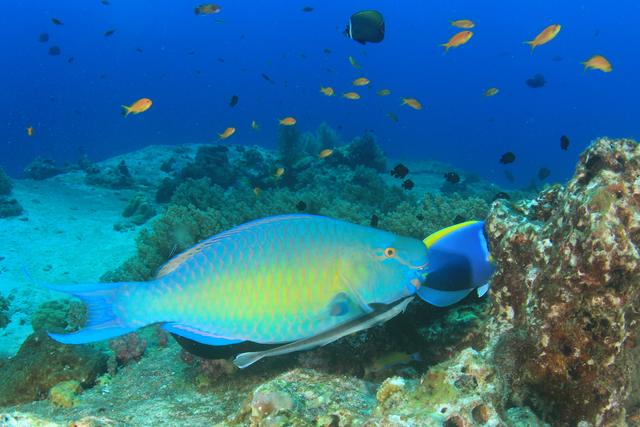
A moray eel being cleaned by a cleaner wrasse.
In this article
Eels are some of the most mysterious fish in the sea. Morays hide in reef crevices with a hidden second set of jaws in their throats. Freshwater eels from European rivers swim thousands of kilometres across the Atlantic to breed in a place no one has ever seen them spawn. And the most famous "eel" of all, the electric eel, is not really an eel.
Here are the facts about eels: what they are, how morays hunt, where eels breed, how electric eels make electricity and why some eels are in serious trouble.
Eel quick facts
- Type of animal
- True eels are bony fish in the order Anguilliformes
- Kinds
- Include morays, conger eels, garden eels and freshwater eels such as the European and American eel
- Moray secret
- A second set of jaws in the throat
- Longest migration
- European eels swim 5,000 to 10,000 km (3,100 to 6,200 miles) to breed
- Breeding place
- The Sargasso Sea, in the western Atlantic
- Electric eels
- Not true eels, and can discharge up to 860 volts
- Conservation
- The European eel is Critically Endangered
What is an eel?
True eels are bony fish with long, snake-like bodies. Most have no pelvic fins, and many have tiny scales or none at all, with skin protected by a layer of slime. They swim by rippling their whole body in waves.
Eels live in almost every kind of water, from coral reefs and the deep sea to rivers and lakes. The group includes:
- Moray eels, the big-mouthed predators of reefs and rocky coasts
- Conger eels, large eels of temperate seas
- Garden eels, which live in burrows in the sand
- Freshwater eels, such as the European, American and Japanese eel, which spend most of their lives in rivers and lakes but breed at sea
Some animals called eels are not eels at all. Electric eels are knifefish, related to catfish and carp, and wolf eels are a kind of wolffish.
How do moray eels eat?
Moray eels have one of the strangest feeding tricks in nature. Like other fish, they have a second set of jaws, called pharyngeal jaws, in their throat. But in morays these jaws can shoot forward into the mouth.
In a 2007 study, scientists used high-speed video to show how it works. When a moray bites a fish with its front jaws, the throat jaws lunge forward, grab the prey and drag it back into the throat. This lets morays swallow large prey without needing to suck it in, which is difficult for a fish with such a narrow head. The idea is often compared to the second mouth of the creature in the Alien films.
Are moray eels dangerous?
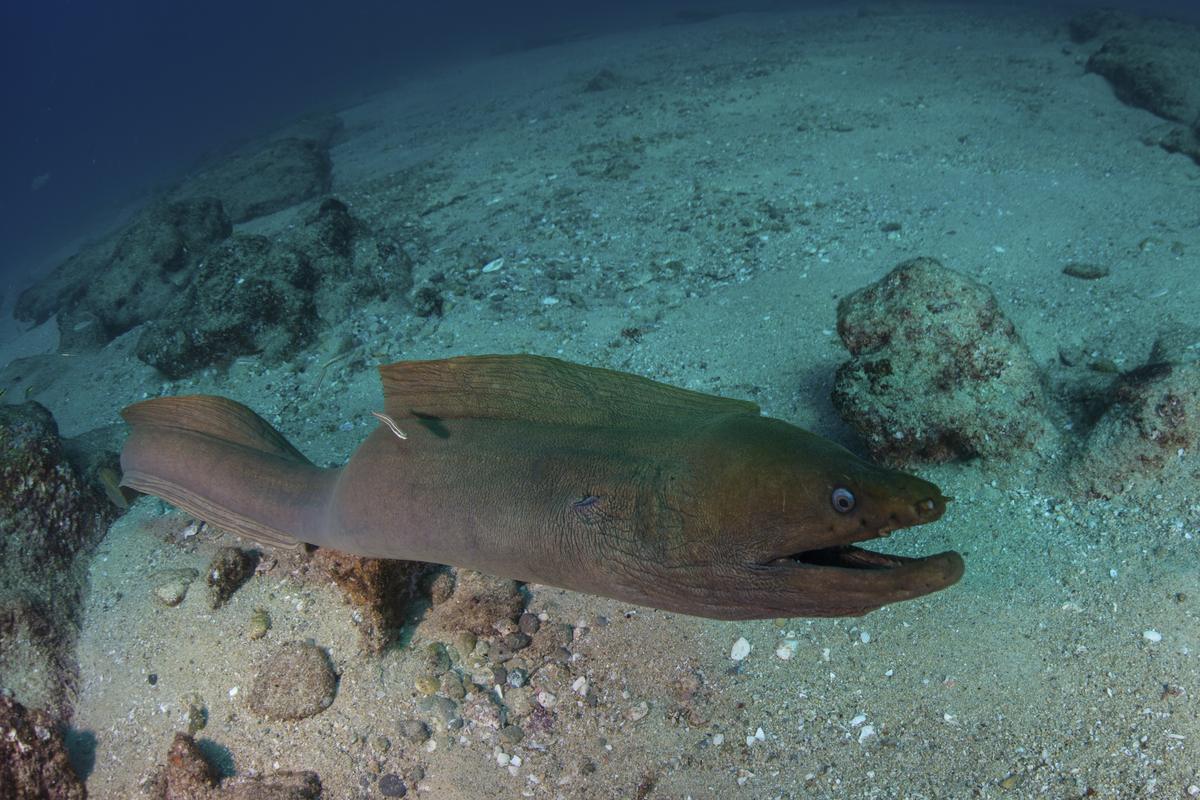
Morays are not aggressive, but they can give a serious bite if provoked. They spend the day with their heads poking out of a crevice, opening and closing their mouths. That looks threatening, but it is how they breathe, pumping water over their gills.
The green moray of the western Atlantic typically measures around 1.8 metres (5.9 feet) and can reach 2.5 metres (8.2 feet) and 29 kg (64 lb), according to Oceana, which notes that adults have few natural predators because of their dangerous bite. Most bites on divers happen when people put their hands into holes or try to feed morays. Their teeth often point backwards, which makes the bite hard to pull free from.
Many morays visit cleaning stations on the reef, where small fish called cleaner wrasse swim right inside their mouths to pick off parasites and dead skin, without being eaten.
Where do eels breed?
For centuries, nobody knew where eels came from. European eels lived in rivers and lakes all over Europe, but no one had ever found their eggs or seen them breed. Aristotle thought they appeared from mud.
In the early 1900s, the Danish scientist Johannes Schmidt found the smallest eel larvae in the Sargasso Sea, in the western Atlantic near Bermuda, and concluded that European and American eels must breed there. But even now, no one has ever seen eels spawning or collected their eggs in the wild.
In a 2022 study, scientists finally tracked adult European eels with satellite tags all the way into the Sargasso Sea. The study describes the European eel's journey as the longest spawning migration of any freshwater eel, a distance of 5,000 to 10,000 km (3,100 to 6,200 miles) across the Atlantic.
The eel life cycle
Freshwater eels have one of the most remarkable life cycles of any fish, changing shape and colour several times:
- Leaf-shaped larvae called leptocephali hatch in the Sargasso Sea and drift on ocean currents, including the Gulf Stream, for months or even years
- Near the coast they change into transparent glass eels
- As they swim into rivers they darken and become elvers
- They grow for years, often a decade or more, as yellow eels
- Finally they turn into silver eels, stop eating, and swim back to the Sargasso Sea to breed once and die
Why is the European eel endangered?
The European eel is listed as Critically Endangered. According to the 2022 study, the number of young eels arriving in European rivers has fallen by around 95% since the 1980s.
The causes include dams and weirs that block their journeys up and down rivers, pollution, disease, changing ocean conditions and fishing, including a large illegal trade in glass eels smuggled to Asia to be farmed. Many countries now limit eel fishing, and conservation projects build eel passes around barriers and carry young eels past dams.
Electric eels are not eels
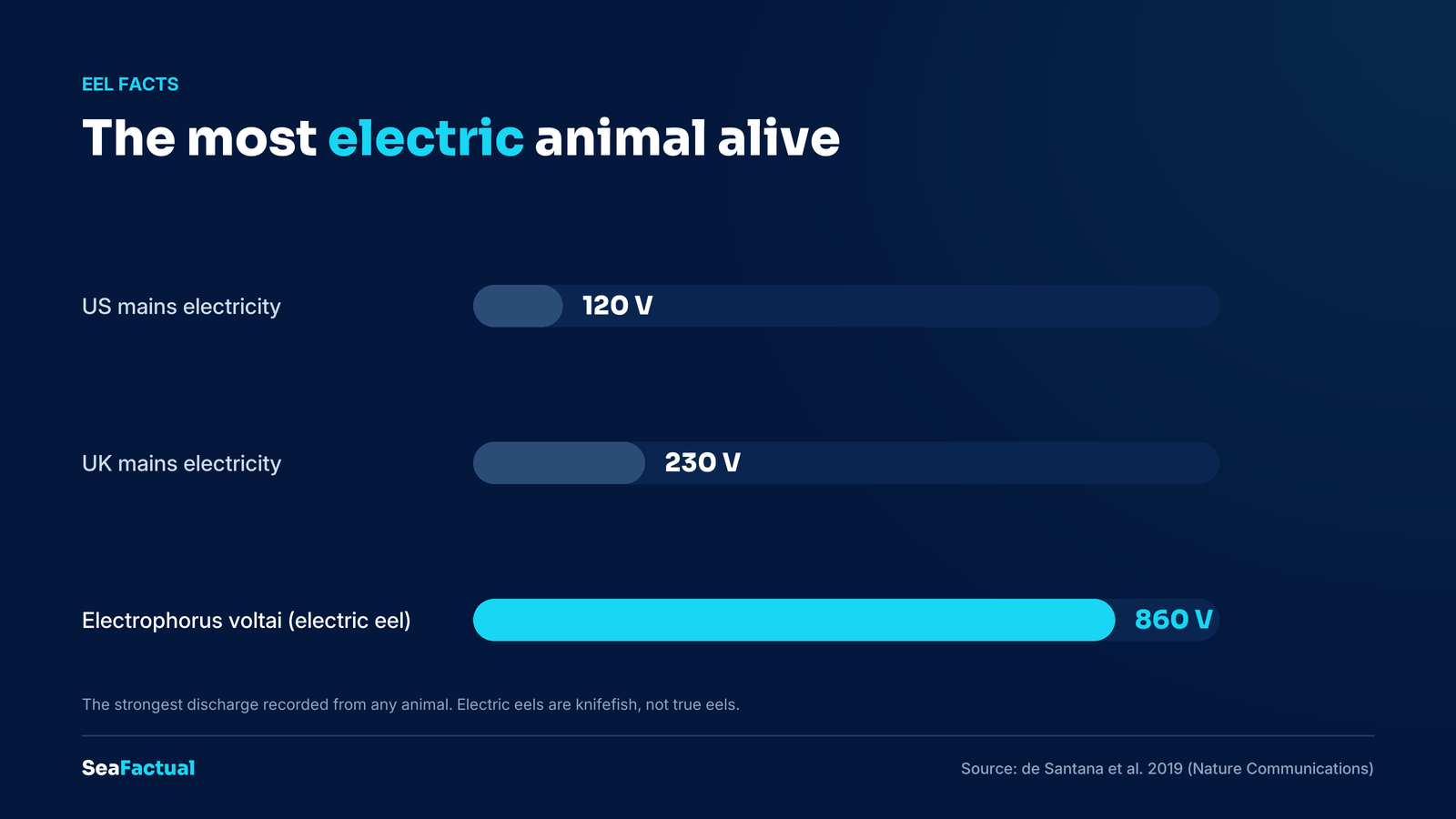
Despite the name, electric eels are knifefish from South American rivers, more closely related to catfish than to true eels. They breathe air, surfacing every few minutes, and use special organs made of thousands of modified muscle cells to produce electricity.
They use small pulses to sense their surroundings and much stronger shocks to stun prey and fend off attackers. For a long time, scientists thought there was only one species. Then a 2019 study showed there are at least three, and recorded a discharge of 860 volts from one of the new species, Electrophorus voltai: the strongest known from any animal, far above the 650 volts previously cited for electric eels.
Garden eels
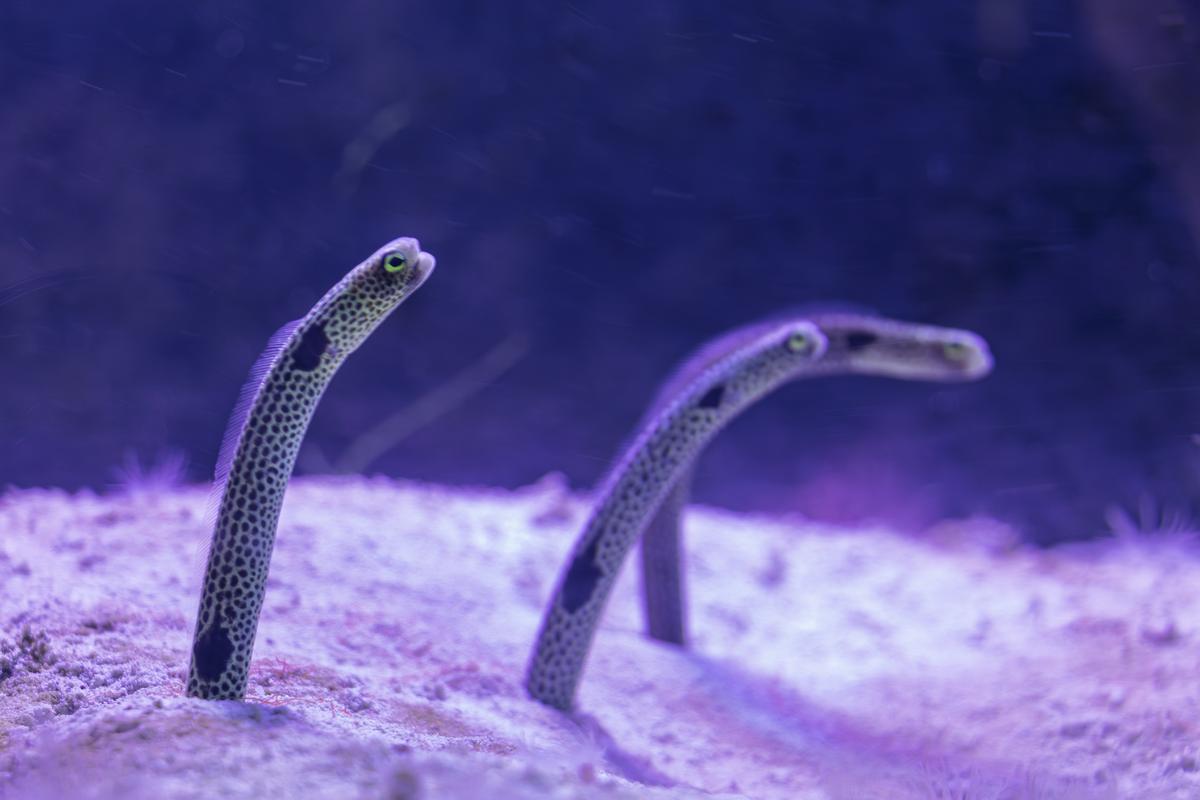
Garden eels live in colonies on sandy seabeds, each in its own burrow lined with mucus. They stick their bodies out of the sand to snatch passing plankton, swaying in the current like plants in a garden, and vanish back into their holes the moment a diver gets too close.
Frequently asked questions
Are eels fish?
Yes. True eels are bony fish, even though they look like snakes. They have gills, fins and a backbone.
Can eels live out of water?
Freshwater eels can survive out of water for a while if they stay damp, and they are famous for wriggling across wet grass from one pond or stream to another.
How long do eels live?
It varies by species. European eels usually spend around 5 to 20 years in fresh water before migrating, and some eels kept in captivity have lived for decades.
Where can you see eels?
Moray eels are common on coral and rocky reefs worldwide, including the Red Sea, the Caribbean, Hawaii, Australia and the Mediterranean. Garden eels are often seen on sandy slopes in the Red Sea and Indo-Pacific. Freshwater eels live in rivers across Europe, North America, Asia and Australasia, and conger eels can be found around wrecks off the coasts of the UK and Ireland.
What do moray eels eat?
Morays eat fish, octopuses, squid, crabs and shrimp, mostly hunting at night by smell. Some even hunt alongside groupers, with the eel flushing prey out of crevices. Read about one of the fish they hunt in our parrotfish facts.
Want more?
Follow SeaFactual for a new ocean fact every day, and get the fact of the week in your inbox using the form below.
Sources and further reading
- Wright et al. 2022, Scientific Reports: First direct evidence of adult European eels migrating to their breeding place in the Sargasso Sea
- Mehta & Wainwright 2007, Nature: Raptorial jaws in the throat help moray eels swallow large prey
- de Santana et al. 2019, Nature Communications: Unexpected species diversity in electric eels
- Oceana: Green moray eel
- IUCN Red List
Spotted a mistake? Tell us How we fact-check Last checked 22 November 2026