A parrotfish grazing on a coral reef.
In this article
- Parrotfish quick facts
- Why are they called parrotfish?
- What do parrotfish eat?
- How many kinds of parrotfish are there?
- Do parrotfish really poop sand?
- Why do parrotfish sleep in a mucus bubble?
- Do parrotfish change sex?
- Why are parrotfish important for coral reefs?
- The biggest parrotfish
- Frequently asked questions
If you have walked on a white sand beach in the tropics, there is a good chance some of it passed through a parrotfish. These brightly coloured reef fish bite chunks off coral and rock with a beak made of fused teeth, grind it up and leave a trail of fine sand behind them. At night, many wrap themselves in a sleeping bag made of their own mucus.
Here are the facts about parrotfish: how they eat, how they make sand, why they sleep in a cocoon, how they change sex and why coral reefs depend on them.
Parrotfish quick facts
- Family
- Scaridae, with dozens of species on tropical reefs worldwide
- Mouth
- A beak made of hundreds of teeth fused together
- Diet
- Algae scraped from coral and rock, and in some species live coral
- Sand
- A single parrotfish can produce hundreds of pounds of sand a year
- Sleep
- Many species sleep inside a mucus cocoon
- Sex
- Many start life as females and later change into males
- Biggest
- The bumphead parrotfish, which can grow longer than 1.2 metres (4 feet)
Why are they called parrotfish?
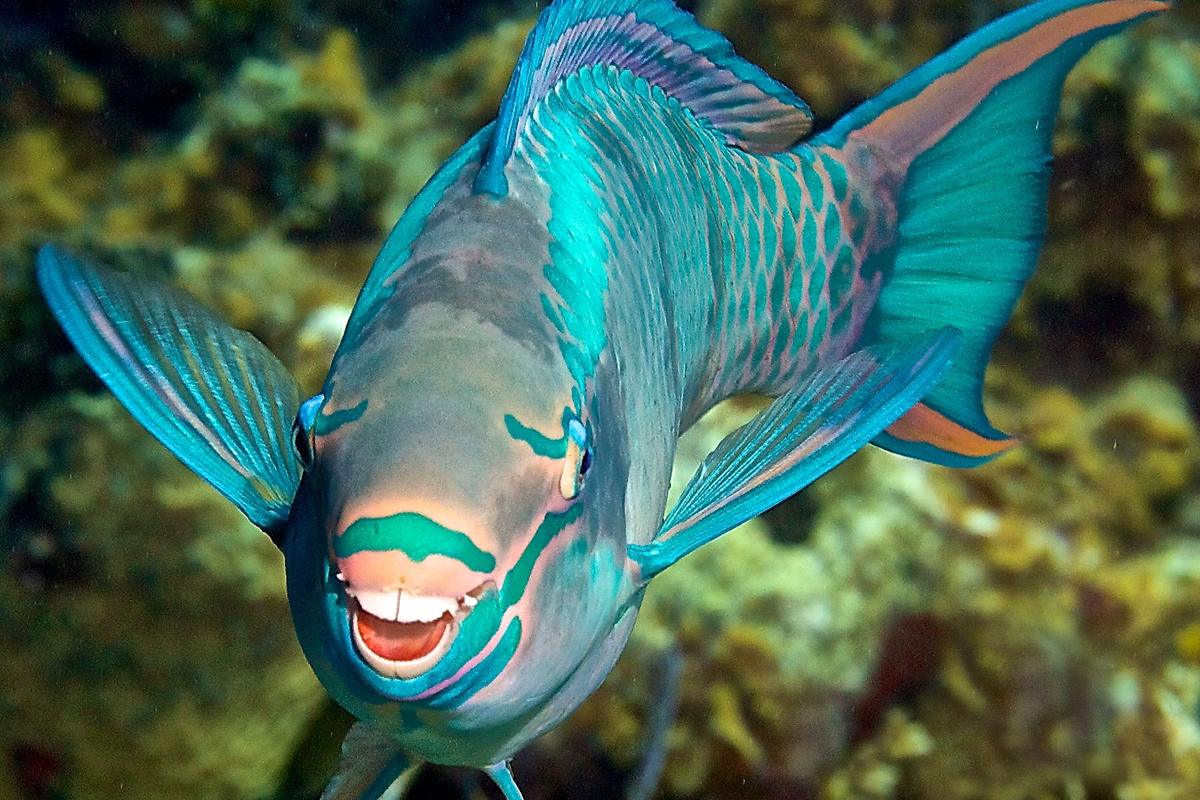
For two reasons: their bright colours and their beak. A parrotfish's teeth are fused together into a hard, parrot-like beak on the outside of its jaws. It uses the beak to scrape and bite algae off coral and rock, and you can often hear parrotfish crunching as they feed on a reef.
That is only the first set of teeth. Inside the throat, a second set of grinding plates works like a mill, crushing the chunks of coral and rock into fine particles so the fish can digest the algae and other food inside them.
What do parrotfish eat?
Most parrotfish are grazers. Their main food is the thin film of algae, bacteria and other tiny organisms that grows on dead coral and rock, along with seaweed and seagrass in some species. To get at it, they scrape or bite off the surface underneath, which is why their beaks wear down and keep growing throughout their lives, a little like a rabbit's teeth.
Scientists group parrotfish by how they feed:
- Scrapers take shallow bites, scraping the surface of the reef clean
- Excavators take deeper bites, removing chunks of the reef along with the algae
- Browsers feed mainly on seaweed and seagrass rather than the reef itself
A few large species, such as the bumphead parrotfish, also bite off and eat live coral. Parrotfish feed almost constantly during the day, taking thousands of bites, and spend the night sheltering on the reef.
How many kinds of parrotfish are there?
There are dozens of species of parrotfish, living on tropical and warm-temperate reefs around the world. The Caribbean has its own species, such as the stoplight, queen and rainbow parrotfish, while the Indo-Pacific has many more, from the steephead to the giant bumphead. Because each species can change colour several times as it grows and changes sex, identifying parrotfish underwater is famously difficult, even for experienced divers.
Do parrotfish really poop sand?
Yes. Because they bite off hard material along with the algae they eat, parrotfish swallow a lot of coral and rock. What they cannot digest passes out the other end as fine, white sand. NOAA says parrotfish can produce hundreds of pounds (well over 100 kg) of white sand each year.
On some reefs, that adds up to a huge share of all the sand. A 2015 study of a reef in the Maldives identified parrotfish as major producers of the sediment that builds the country's low-lying reef islands. In other words, parrotfish help to make the land that people live on.
Why do parrotfish sleep in a mucus bubble?
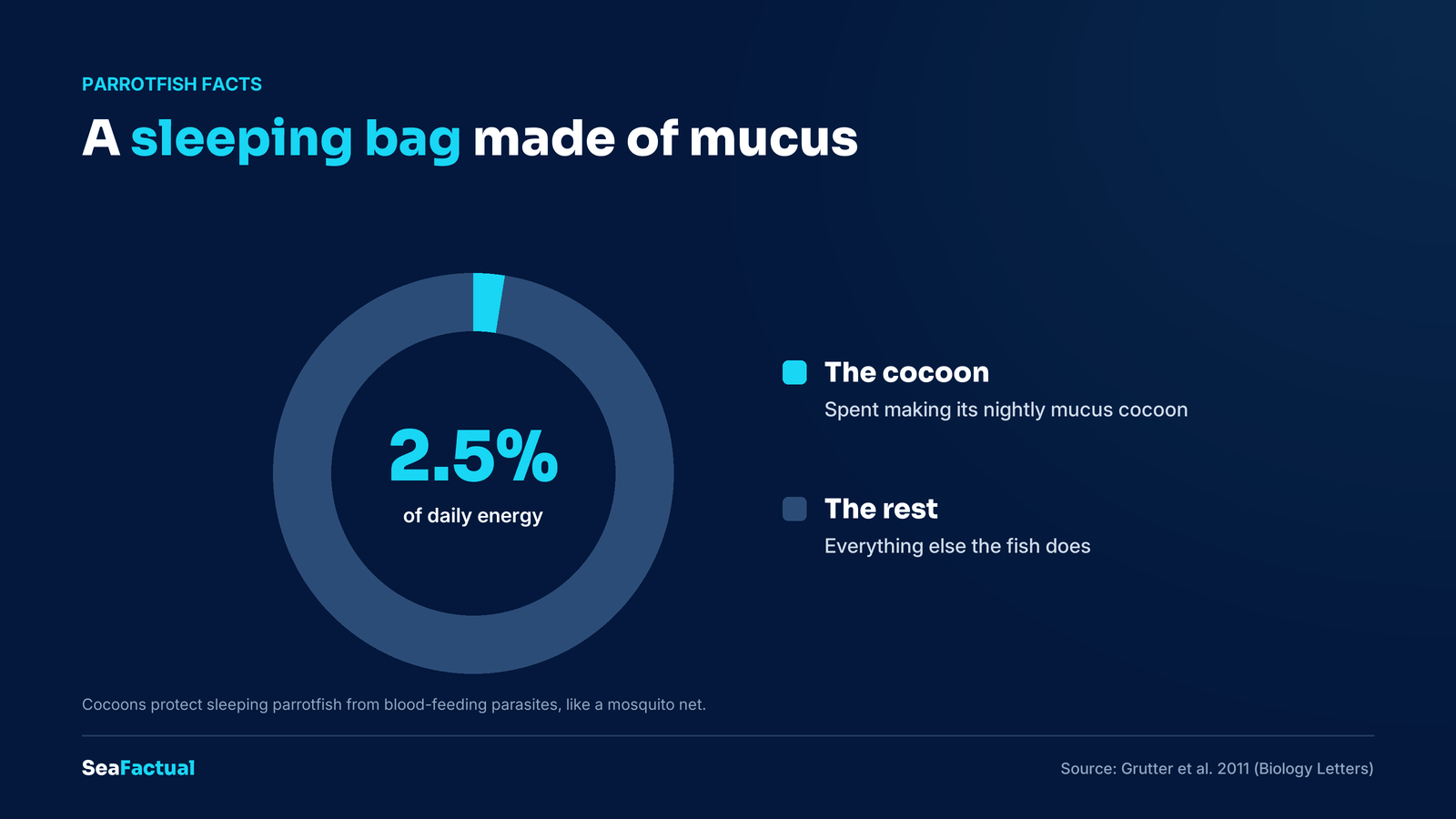
Many parrotfish, and some of their wrasse relatives, do something remarkable at night. They tuck themselves into a crevice on the reef and slowly release mucus from glands near their gills, until they are wrapped in a clear, see-through cocoon. In the morning they swim out and leave it behind.
For a long time, scientists thought the cocoon might hide the sleeping fish's scent from predators such as moray eels. A 2011 study on the Great Barrier Reef found a clearer benefit. Parrotfish without cocoons were attacked far more often by gnathiid isopods, tiny blood-sucking parasites that feed on fish at night. The cocoon acts like a mosquito net, and making it costs the fish only about 2.5% of its daily energy.
Do parrotfish change sex?
Many do. Most parrotfish species start life as females. Later, some of the females change sex and become males, which are often larger and more brightly coloured. Scientists call these different stages "phases", and because the colours change so much, the females, young fish and males of the same species were once thought to be different species altogether.
Some parrotfish are also born male and stay male for life, looking like females until they mature. Changing sex is common among reef fish: clownfish do it the other way round, starting as males and becoming females.
Why are parrotfish important for coral reefs?
Parrotfish are some of the reef's most important gardeners. By grazing constantly on algae, they stop seaweed from smothering the coral and leave clean, bare surfaces where young corals can settle and grow. On reefs where parrotfish are overfished, algae can take over, making it much harder for corals to recover from storms or bleaching. Read more in our coral facts.
That is why some places now protect parrotfish. Their bites can damage individual corals, but on a healthy reef the benefits far outweigh the harm.
The biggest parrotfish
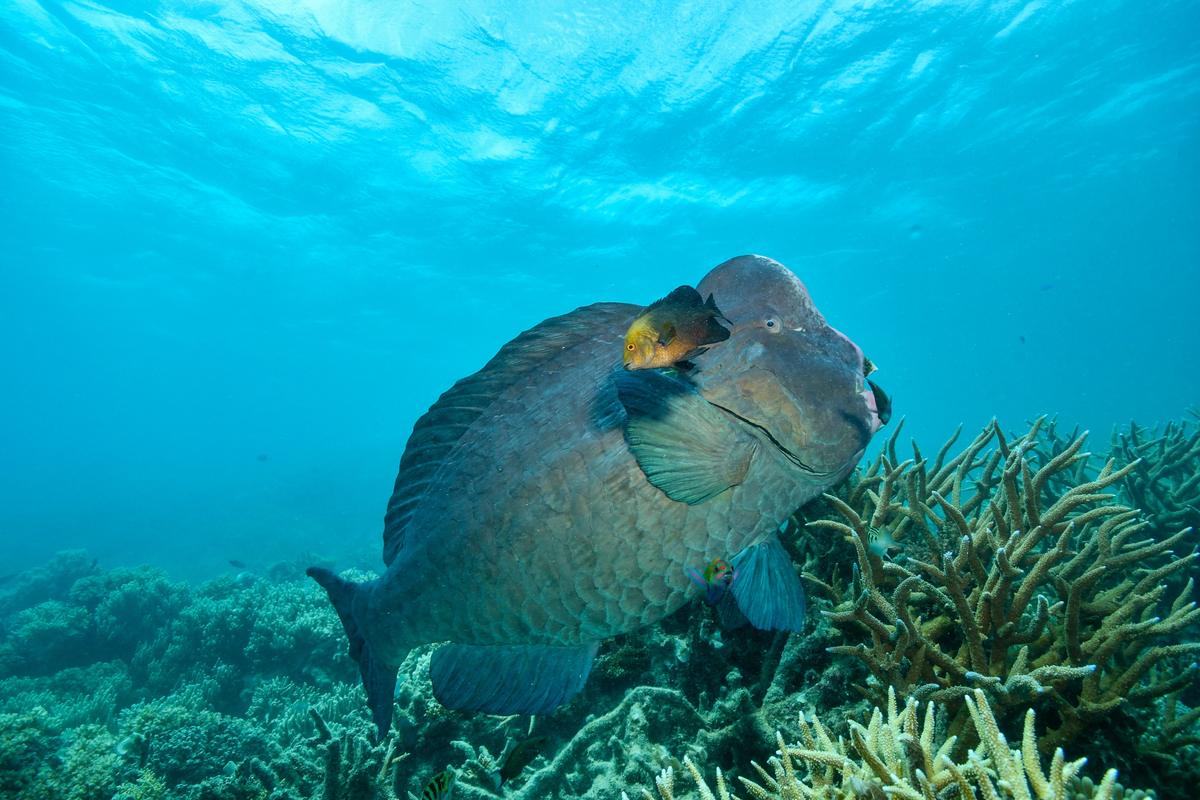
The largest of all is the bumphead parrotfish of the Indo-Pacific, which can grow longer than 1.2 metres (4 feet) and weigh more than 45 kg (100 lb). It has a big bony bump on its forehead, travels in groups and bites off chunks of live coral.
The males use their bumps in a remarkable way. A 2012 study recorded male bumphead parrotfish ramming each other head-on during contests around spawning, a kind of headbutting that had rarely, if ever, been described in fish before. The crack of the impact could be heard underwater.
Bumphead parrotfish grow slowly, sleep in large groups in shallow water and are easy targets for spearfishers at night. They have disappeared from many reefs and are listed as Vulnerable on the IUCN Red List.
Frequently asked questions
Can you eat parrotfish?
Parrotfish are eaten in many tropical countries, but because they are so important for keeping reefs healthy, a growing number of places restrict or ban catching them. In some areas, eating large reef fish can also cause ciguatera, a type of food poisoning.
Do parrotfish bite humans?
Very rarely. Parrotfish are not aggressive towards divers and snorkellers. Their beaks are strong enough to crunch coral, so it is wise not to hand-feed or handle them.
How big do parrotfish get?
Most species are 30 to 50 cm (12 to 20 inches) long. The bumphead parrotfish can reach more than 1.2 metres (4 feet).
Where can you see parrotfish?
Parrotfish live on tropical and subtropical reefs worldwide. Good places to see them include the Red Sea, the Maldives, the Great Barrier Reef, Hawaii, the Florida Keys and the Caribbean, where the colourful stoplight and queen parrotfish are common. A few species live in cooler water, such as the Mediterranean parrotfish found around the Canary Islands and southern Europe.
What eats parrotfish?
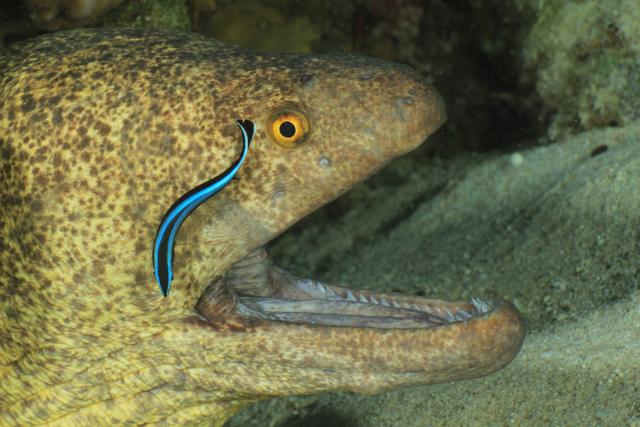
Sharks, groupers, barracudas and moray eels all prey on parrotfish, especially at night. Read more in our eel facts.
Want more?
Follow SeaFactual for a new ocean fact every day, and get the fact of the week in your inbox using the form below.
Sources and further reading
- NOAA Corals Tutorial: Why are coral reefs important?
- Perry et al. 2015, Geology: Linking reef ecology to island building: parrotfish identified as major producers of island-building sediment in the Maldives
- Grutter et al. 2011, Biology Letters: Fish mucous cocoons: the 'mosquito nets' of the sea
- Muñoz et al. 2012, PLoS ONE: Extraordinary aggressive behavior from the giant coral reef fish, Bolbometopon muricatum
- IUCN Red List
Spotted a mistake? Tell us How we fact-check Last checked 22 November 2026