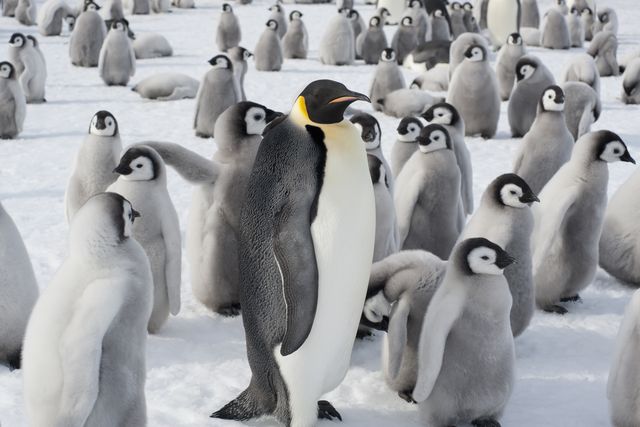
Emperor penguins on the sea ice of McMurdo Sound, Antarctica.
In this article
- Emperor penguin quick facts
- How big are emperor penguins?
- Where do emperor penguins live?
- How do emperor penguins breed in winter?
- Emperor penguin chicks
- How do emperor penguin huddles work?
- How deep can emperor penguins dive?
- How many emperor penguins are there?
- Are emperor penguins endangered?
- Frequently asked questions
The emperor penguin is the largest penguin on Earth and one of the toughest animals alive. It is the only bird that breeds in the depths of the Antarctic winter, standing on sea ice in the dark through blizzards and temperatures below minus 40 °C (minus 40 °F), with an egg balanced on its feet.
Here are the facts about emperor penguins: how big they are, how they survive the winter, how huddles work, how deep they dive and why their future depends on sea ice.
Emperor penguin quick facts
- Scientific name
- Aptenodytes forsteri
- Size
- The largest penguin, up to 1.3 metres (4 feet 3 inches) long
- Weight
- About 23 to 45 kg (51 to 99 lb), depending on the time of year
- Home
- The sea ice around Antarctica, in 46 known breeding colonies
- Population
- About 595,000 adult birds, counted from space
- Deepest dive
- 564 metres (1,850 feet), the deepest of any bird
- Lifespan
- At least 20 years
- Conservation status
- Near Threatened (IUCN Red List)
How big are emperor penguins?
Emperor penguins are the tallest and heaviest of all penguins. They measure up to about 1.3 metres (4 feet 3 inches) from beak to tail. Their weight changes enormously through the year: New Zealand Birds Online says it swings between about 23 and 45 kg (51 and 99 lb), because emperors build up thick layers of fat and then live off them for months at a time.
Adults are dark grey on the back and white below, with a black head and a broad yellow-orange patch on each side of the neck. The only bird they could be confused with is the smaller king penguin, which has a longer bill and a narrower, brighter orange neck patch. You can compare all the species in our penguin facts guide.
Where do emperor penguins live?
Emperor penguins live only in Antarctica. They are birds of the pack ice, and New Zealand Birds Online notes that they are the only bird that breeds on ice. Almost all colonies sit on fast ice, the sea ice attached to the coast, close to permanent patches of open water that let the adults reach the sea to feed.
Very occasionally, a lost bird turns up far to the north. In 2011, a young emperor penguin came ashore on the Kapiti Coast, north of Wellington in New Zealand, thousands of kilometres from the Antarctic ice. Nicknamed "Happy Feet", it was taken into care after eating large amounts of sand and was later released into the Southern Ocean near Campbell Island.
How do emperor penguins breed in winter?
Emperor penguins breed in the coldest, darkest part of the year. Birds walk across the sea ice to their colonies in March and April, at the start of the Antarctic autumn. There is no nest: the female lays a single large egg and passes it to the male, who balances it on top of his feet, tucked under a warm fold of skin called the brood pouch.
The female then heads back to the sea to feed for about two months. According to New Zealand Birds Online, the male incubates the egg on his own for 62 to 67 days, through the middle of winter. Including courtship, he spends about four months at the colony without eating, and can lose up to 45% of his body weight.
The female returns soon after the egg hatches, and from then on both parents take turns to feed the chick, bringing back fish, squid and krill in their stomachs. Chicks leave the colony in December, timed to coincide with the summer break-up of the sea ice.
Emperor penguin chicks
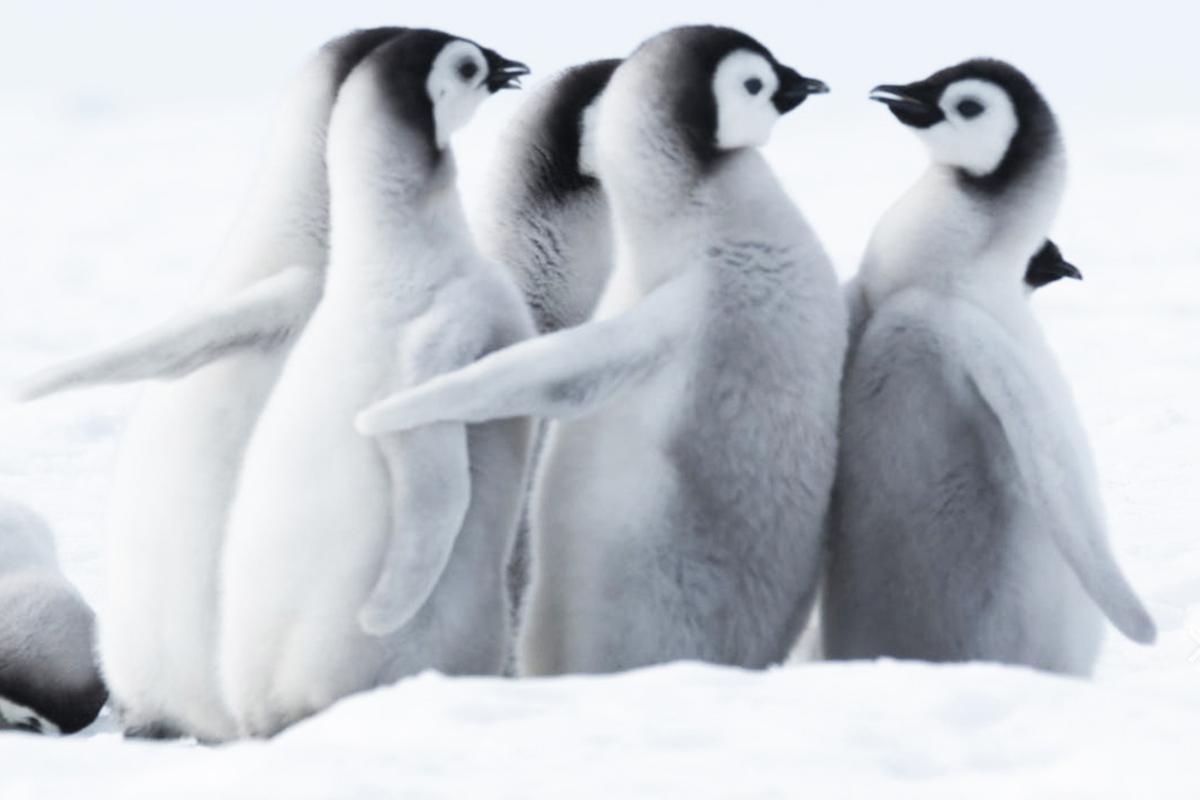
Emperor penguin chicks hatch in the middle of winter, covered in soft silvery-grey down with a black-and-white face. For the first weeks they ride on their parents' feet, tucked into the brood pouch, because they would freeze within minutes on the bare ice.
As they grow, the parents both have to go to sea to find enough food, and the older chicks gather in large groups called crèches for warmth and protection while the adults are away. Parents find their own chick in the crowd by its call. New Zealand Birds Online says the chicks are fed by both parents, which bring up food from their stomachs, until they fledge in December. Recently fledged chicks are only about half the size of the adults, and they head out to sea alone, still growing.
How do emperor penguin huddles work?
To survive the winter storms, the males crowd together in tight huddles of hundreds or thousands of birds, sharing warmth and sheltering one another from the wind.
A huddle is so tightly packed that individual birds can barely move, yet everyone needs a turn in the warm middle. In a 2011 study, scientists filmed huddles in Antarctica and found the answer. Every 30 to 60 seconds, all the penguins take a small step at the same time, and the movement ripples through the huddle like a wave. Over time, these tiny shuffles slowly rearrange the whole huddle, so birds on the freezing edge gradually work their way inside, and those in the centre move out.
How deep can emperor penguins dive?
Emperor penguins are the deepest-diving birds on Earth. In a study of emperor penguins fitted with depth recorders, one bird reached 564 metres (1,850 feet). New Zealand Birds Online says most dives are much shallower, typically to about 50 metres (160 feet), and they can last up to 18 minutes.
They hunt mainly fish, along with squid and krill, chasing prey through the dark water beneath the ice. The emperor penguin is one of the stars of our episode 10 Ocean Animals That Hold Incredible World Records.
How many emperor penguins are there?
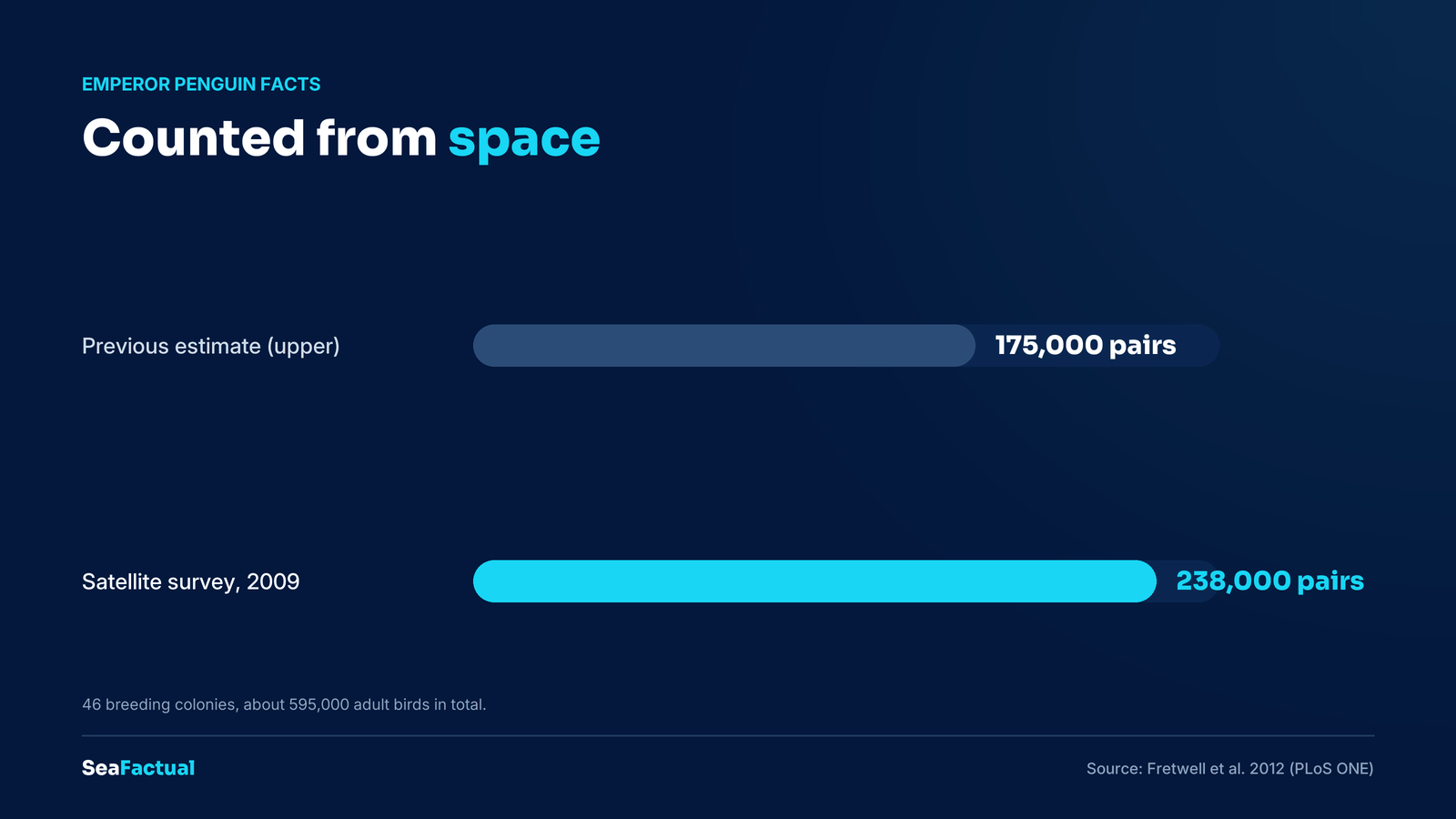
Emperor penguins breed in some of the most remote places on Earth, so for a long time nobody knew how many there were. Then scientists found a way to count them from space. Colonies stand out on the white sea ice as dark patches, and the birds' droppings stain the ice brown.
In a 2012 study, researchers searched satellite images of the entire Antarctic coastline. They found 46 breeding colonies, including four that were previously unknown, and estimated around 238,000 breeding pairs, or about 595,000 adult birds in total. That was far more than earlier estimates of 135,000 to 175,000 pairs. It was the first time an entire species had been counted from space.
Are emperor penguins endangered?
Emperor penguins are listed as Near Threatened on the IUCN Red List, and in 2022 the United States listed them as threatened under the Endangered Species Act. The main danger is the loss of the sea ice they need for breeding.
The chicks cannot swim until they have grown their waterproof adult feathers. If the sea ice breaks up before then, they drown or freeze. In 2022, Antarctic sea ice fell to a record low, and a 2023 study used satellite images to follow five colonies in the Bellingshausen Sea, west of the Antarctic Peninsula. Four of the five suffered total breeding failure: the ice broke up beneath them before the chicks were ready. It was the first recorded case of widespread breeding failure clearly linked to sea ice loss, and scientists expect such events to become more common as the climate warms.
Frequently asked questions
How cold does it get where emperor penguins breed?
Temperatures at the colonies can fall below minus 40 °C (minus 40 °F), and winds can make it feel even colder. Emperor penguins survive with dense, overlapping feathers, a thick layer of fat and by huddling.
How long do emperor penguins live?
New Zealand Birds Online says emperor penguins first breed at about 5 years old and live for at least 20 years.
What eats emperor penguins?
At sea, adults are hunted by leopard seals and orcas. On the ice, chicks can be taken by giant petrels and skuas. Read more in our orca facts.
Where can you see emperor penguins?
Emperor penguins live only in Antarctica. A few specialist expeditions visit colonies such as Snow Hill Island in the Weddell Sea, by icebreaker and helicopter. Outside Antarctica, a small number are kept in aquariums, including SeaWorld San Diego in the United States.
Can emperor penguins fly?
No. Like all penguins, emperors cannot fly in the air, but their stiff, flipper-shaped wings make them powerful swimmers, and they "fly" underwater instead.
Want more?
Follow SeaFactual for a new ocean fact every day, and get the fact of the week in your inbox using the form below.
Sources and further reading
- New Zealand Birds Online: Emperor penguin
- Birdfact: Emperor penguin
- Fretwell et al. 2012, PLoS ONE: An emperor penguin population estimate: the first global, synoptic survey of a species from space
- Zitterbart et al. 2011, PLoS ONE: Coordinated movements prevent jamming in an emperor penguin huddle
- Wienecke et al. 2007, Polar Biology: Extreme dives by free-ranging emperor penguins
- Fretwell et al. 2023, Communications Earth & Environment: Record low 2022 Antarctic sea ice led to catastrophic breeding failure of emperor penguins
- IUCN Red List
Spotted a mistake? Tell us How we fact-check Last checked 22 November 2026