A bull northern elephant seal roaring at Año Nuevo State Park, California.
In this article
- Elephant seal quick facts
- How many kinds of elephant seal are there?
- How big are elephant seals?
- Why do elephant seals have big noses?
- Do elephant seals fight?
- How deep can elephant seals dive?
- How long can elephant seals hold their breath?
- How do elephant seals sleep?
- What do elephant seals eat?
- Elephant seal pups
- Are elephant seals endangered?
- Frequently asked questions
Elephant seals are the largest seals on Earth. A big male can weigh as much as a pickup truck, roars through an inflatable nose and spends most of the year far out at sea, diving deeper than almost any other mammal. Yet little more than a century ago, one of the two species was thought to be extinct.
Here are the facts about elephant seals: how big they get, what the nose is for, how deep and long they dive, how they sleep at sea and how they recovered.
Elephant seal quick facts
- Species
- Two, the northern elephant seal and the southern elephant seal
- Largest
- Southern elephant seal males weigh close to 4 tonnes (8,800 lb)
- Size difference
- Males can be up to 10 times heavier than females
- Deepest dive
- 2,388 metres (7,835 feet)
- Longest dives
- Close to two hours on a single breath
- Sleep
- About 2 hours a day while at sea
- Migration
- Some northern elephant seals travel more than 21,000 km (13,000 miles) on a round trip
- Lifespan
- About 19 years for females and 13 for males (northern elephant seal)
How many kinds of elephant seal are there?
There are two species. The northern elephant seal lives in the eastern and central North Pacific, breeding mainly on islands and beaches from California to Baja California in Mexico. The southern elephant seal lives around Antarctica and breeds on sub-Antarctic islands such as South Georgia, Macquarie Island and Kerguelen, and on the coast of Argentina.
Both are "true" seals, the earless seals that shuffle on their bellies on land and swim with their back flippers. They are not closely related to sea lions or walruses.
How big are elephant seals?
The southern elephant seal is the biggest seal of all. According to CSIRO, Australia's national science agency, males weigh close to four tonnes and can be up to 10 times larger than females, one of the most extreme size differences between the sexes of any animal.
Northern elephant seals are a little smaller. NOAA Fisheries says fully grown males can reach more than 4 metres (13 feet) long and weigh nearly 2,000 kg (4,400 lb), while females grow to about 3 metres (10 feet) and up to 590 kg (1,300 lb).
Why do elephant seals have big noses?
Only adult males have the famous trunk-like nose, which gives the seals their name. NOAA says males develop the nose, or proboscis, at around 7 years old, and it overhangs the lower lip by about 20 cm (8 inches).
The nose works as a resonating chamber. During the breeding season, males inflate it and make loud, drumming roars to threaten rival males. Each male also develops a thick, scarred shield of tough skin on his neck and chest, which protects him in fights.
Do elephant seals fight?
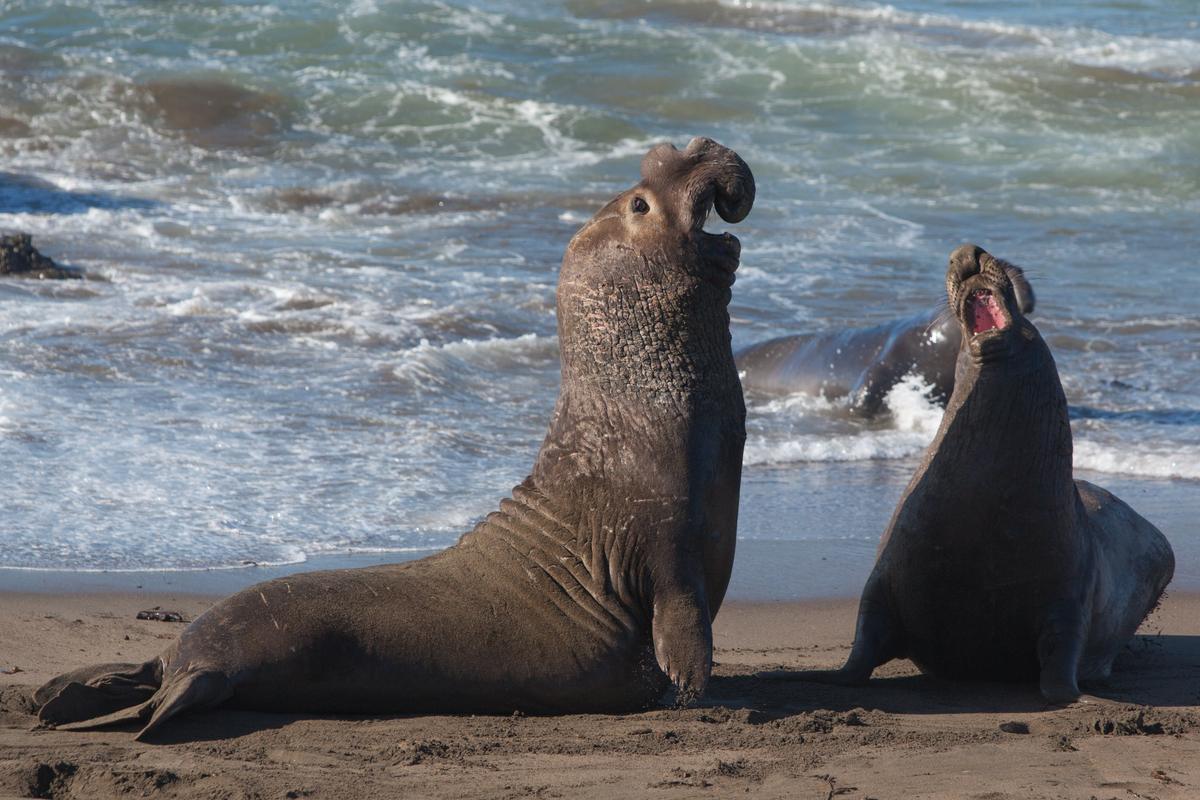
Yes, and the fights are brutal. Males battle on the beach for control of groups of females, called harems, rearing up and slamming their chests together while biting at each other's necks. NOAA says northern males usually form harems at 9 to 10 years old.
The winners, known as beachmasters, get to mate with most of the females. CSIRO notes that a southern elephant seal beachmaster may guard a harem of more than 100 females. Most males never win a harem at all. Holding one is exhausting: males fast throughout the breeding season, and NOAA says northern elephant seals can lose up to 36% of their body weight during this time.
How deep can elephant seals dive?
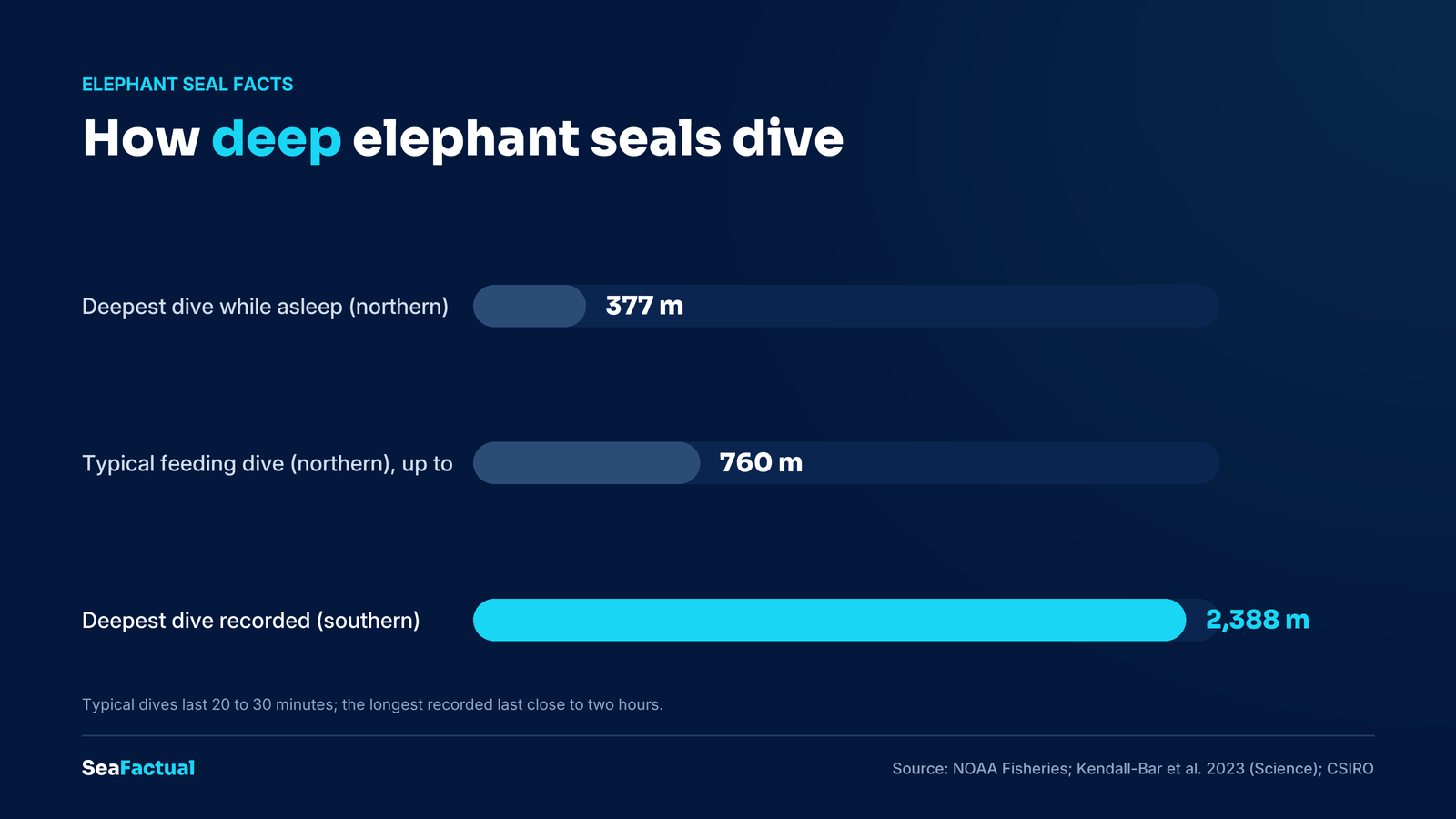
Elephant seals are among the deepest-diving mammals on Earth. NOAA says northern elephant seals spend about nine months of the year at sea and dive to around 300 to 760 metres (1,000 to 2,500 feet) for 20 to 30 minutes at a time, with only short breaks at the surface. They spend so much time underwater that they are rarely seen at sea.
The deepest dive ever recorded for an elephant seal is 2,388 metres (7,835 feet), by a southern elephant seal, according to CSIRO. Among mammals, only beaked whales are known to go deeper: Cuvier's beaked whale holds the record at 2,992 metres (9,816 feet). Even the sperm whale rarely goes much below 2,000 metres.
How long can elephant seals hold their breath?
The longest elephant seal dives last close to two hours. They manage it with a huge volume of blood for their body size, packed with oxygen-carrying pigments in both the blood and the muscles. They also slow their heart rate while diving.
A 1992 study of southern elephant seals fitted with depth recorders found that every seal made some dives longer than scientists calculated it could manage on its stored oxygen alone, and that the extended dives often came in long runs, the longest lasting two days. Elephant seals feature in our episode 10 Ocean Animals That Hold Incredible World Records for exactly this reason.
How do elephant seals sleep?
At sea, elephant seals sleep underwater, in short naps during their dives. In a 2023 study, scientists recorded the brain waves of wild northern elephant seals diving off California. They found that the seals took naps of less than 20 minutes while diving, often spiralling slowly downwards as they slept, sometimes deeper than 300 metres (1,000 feet).
By tracking hundreds of seals, the researchers worked out that elephant seals average only about two hours of sleep a day during their seven-month foraging trips. That rivals the African elephant for the least sleep of any mammal. On land, by contrast, they can sleep for hours at a time.
What do elephant seals eat?
Elephant seals feed mainly on squid and fish, and NOAA says they also eat rays and sharks. Most of their hunting happens in the dark midwater zone, hundreds of metres below the surface.
The journeys to reach that food are enormous. NOAA says some northern elephant seals have been recorded travelling more than 21,000 km (13,000 miles) on a single round trip, one of the longest migrations of any mammal. Males head north towards the Aleutian Islands and the Gulf of Alaska, while females feed farther out in the open ocean. A 2012 study of nearly 300 female migrations found that they concentrate their hunting along the boundary between two great North Pacific current systems, and that how much energy a female gains at sea predicts whether she will be pregnant.
Elephant seal pups
Females come ashore in winter and give birth to a single pup within a few days of arriving. NOAA says northern elephant seal pups are born black, are weaned after about a month and then moult into a silvery coat. Just before she leaves, the mother mates again and returns to sea, leaving the pup to teach itself to swim and find food.
Every year, adults also come ashore to moult. Unlike most seals, elephant seals shed their fur together with large patches of old skin all at once, a process that takes four to five weeks.
Are elephant seals endangered?
No, both species are listed as Least Concern on the IUCN Red List, but the northern elephant seal came close to disappearing. Commercial sealers killed huge numbers for the oil in their blubber in the 1800s, and the species was thought to be extinct. A small group survived in Mexico, and NOAA says today's populations in the US and Mexico all descend from those few hundred animals.
Protected by law, the population grew rapidly. The minimum population of the US stock alone was estimated at around 85,000 seals in 2013. Today the main threats include entanglement in fishing gear and vessel strikes.
Frequently asked questions
Are elephant seals dangerous to humans?
They are not aggressive towards people, but they are huge, fast over short distances and unpredictable, especially males in the breeding season. At beaches where they gather, visitors are asked to keep well back.
Why are they called elephant seals?
Because of their size and the adult males' long, trunk-like noses.
How long do elephant seals live?
NOAA gives a lifespan of about 19 years for female northern elephant seals and about 13 years for males, whose fighting and fasting take a heavy toll.
Where can you see elephant seals?
In California, large colonies gather at Piedras Blancas near San Simeon, Año Nuevo and Point Reyes, and on the Channel Islands, with the biggest crowds in winter. Southern elephant seals can be seen at Península Valdés in Argentina, the Falkland Islands, South Georgia and Macquarie Island, and on expedition cruises to the sub-Antarctic.
What eats elephant seals?
Orcas and great white sharks both prey on elephant seals. Read more in our orca facts and great white shark facts.
Want more?
Follow SeaFactual for a new ocean fact every day, and get the fact of the week in your inbox using the form below.
Sources and further reading
- NOAA Fisheries: Northern elephant seal
- CSIRO: The deepest diving animals
- Kendall-Bar et al. 2023, Science: Brain activity of diving seals reveals short sleep cycles at depth
- Robinson et al. 2012, PLoS ONE: Foraging behavior and success of a mesopelagic predator in the northeast Pacific Ocean
- Hindell et al. 1992, Canadian Journal of Zoology: Physiological implications of continuous, prolonged, and deep dives of the southern elephant seal
- IUCN Red List
Spotted a mistake? Tell us How we fact-check Last checked 22 November 2026