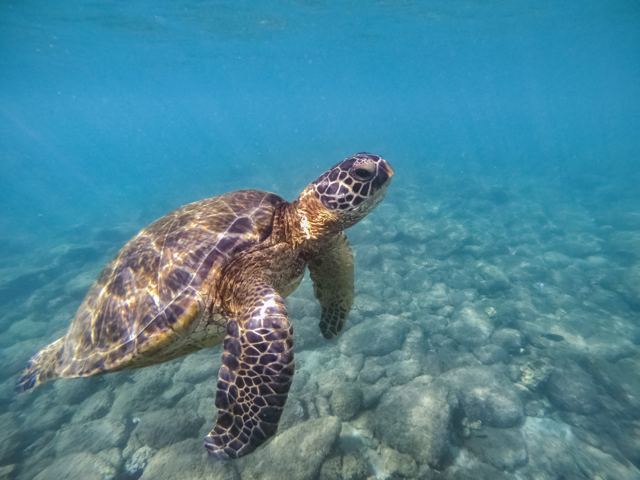
A hawksbill turtle on a coral reef.
In this article
- Hawksbill turtle quick facts
- Why is it called a hawksbill turtle?
- What do hawksbill turtles eat?
- Why are hawksbills important for coral reefs?
- How big do hawksbill turtles get?
- Where do hawksbill turtles live?
- Where do hawksbill turtles nest?
- How do hawksbill turtles nest?
- Why are hawksbill turtles critically endangered?
- Do hawksbill turtles glow?
- Frequently asked questions
The hawksbill is the sea turtle of the coral reef. It has a narrow, hooked beak like a bird of prey, a beautifully patterned shell and one of the strangest diets of any animal: sponges, packed with tiny needles of glass. That beautiful shell also made it the target of a centuries-long trade that pushed the species to the edge of extinction.
Here are the facts about hawksbill turtles: what they eat, how they got their name, how big they grow, where they nest and why they are critically endangered.
Hawksbill turtle quick facts
- Scientific name
- Eretmochelys imbricata
- Size
- Shell about 60 to 90 cm (2 to 3 feet) long
- Weight
- About 45 to 68 kg (100 to 150 lb) as adults
- Diet
- Mainly sea sponges, plus algae, corals, molluscs and jellyfish
- Home
- Tropical and subtropical seas worldwide, especially coral reefs
- Lifespan
- Unknown, but estimated at 50 years or more
- Conservation status
- Critically Endangered (IUCN Red List)
Why is it called a hawksbill turtle?
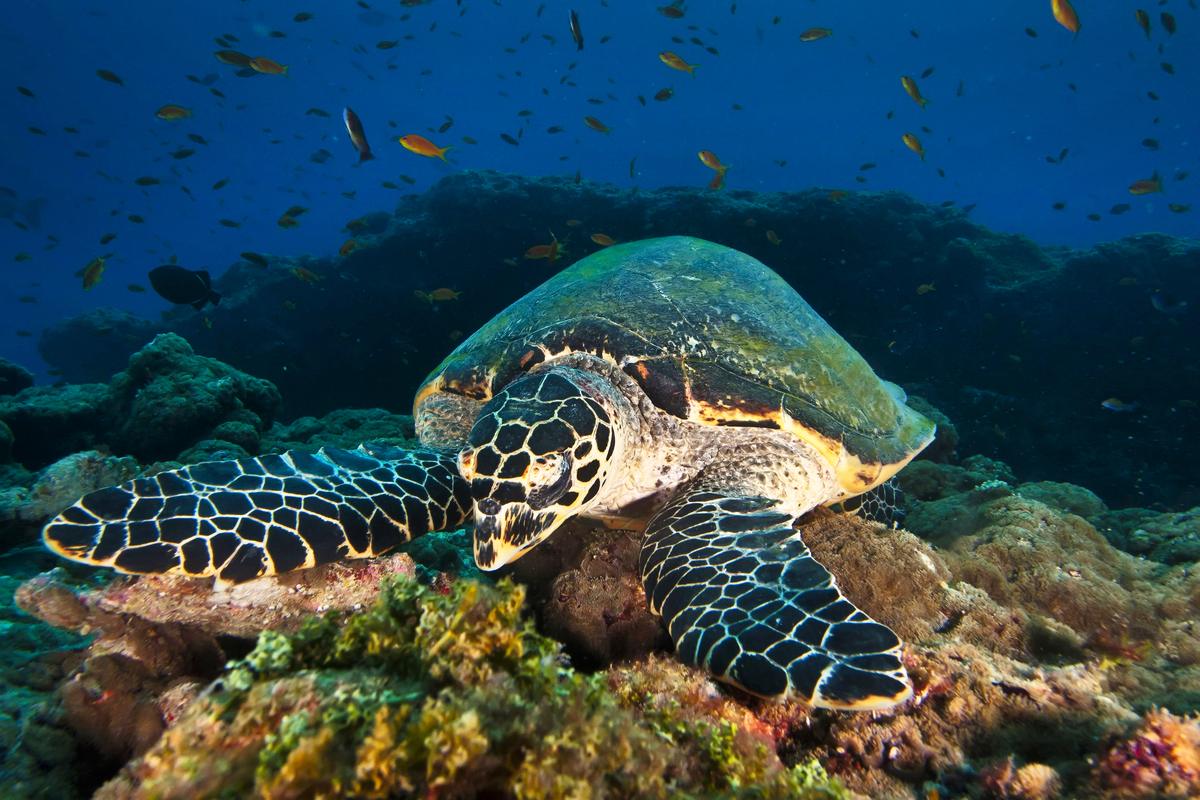
Because of its beak. NOAA Fisheries explains that the hawksbill's head tapers to a point and its lower jaw is V-shaped, giving it a hawk-like profile. The narrow, sharp beak is the perfect tool for reaching into the small holes and cracks in a reef to pull out food that other turtles cannot get at.
Hawksbills are also easy to recognise by their shells. The plates, or scutes, on the top shell overlap like roof tiles and are mottled in amber, orange, red, yellow, brown and black, and the back edge of the shell is jagged, like the teeth of a saw.
What do hawksbill turtles eat?
Hawksbills are the only sea turtles that can survive mainly on sea sponges, according to NOAA. That is a very unusual choice of food. Sponges are well defended: many are full of toxic chemicals, and their bodies are stiffened with spicules, tiny needle-like pieces of silica, the same material as glass.
In a 1988 study titled "a diet of glass", the biologist Anne Meylan studied what hawksbills in the Caribbean were eating. She found that they fed almost exclusively on sponges, including species that are toxic to other vertebrates, and that their diet contained more silica than that of other vertebrates. The hawksbill is one of fewer than a dozen animals with a backbone known to specialise on sponges.
They do eat other things too. NOAA lists algae, corals, molluscs, sea squirts, crustaceans, sea urchins, small fish and jellyfish. In places where sponges are scarce, such as Hawaii, hawksbills eat whatever is available.
Why are hawksbills important for coral reefs?
By eating sponges, hawksbills help keep the reef in balance. On many reefs, sponges compete with corals for space. Meylan's study suggested that by grazing on them, hawksbills may influence which animals grow where on the reef and help maintain its diversity. NOAA describes hawksbills as playing a key role in the function of marine ecosystems.
How big do hawksbill turtles get?
Hawksbills are one of the smaller sea turtles. NOAA says adults have shells about 60 to 90 cm (2 to 3 feet) long and weigh around 45 to 68 kg (100 to 150 lb). That makes them much smaller than green turtles and far smaller than the giant leatherback. Hatchlings are only about 5 to 8 cm (2 to 3 inches) long and mostly brown.
You can see how all seven species compare in our sea turtle facts guide.
Where do hawksbill turtles live?
Hawksbills live in tropical and subtropical waters in all the world's major oceans. As adults they stay mostly close to the coast, especially around healthy coral reefs, and in the eastern Pacific some large populations live in mangrove estuaries.
Young hawksbills start life in the open ocean. NOAA says that after leaving the beach, most hatchlings shelter in floating mats of seaweed and drifting debris for about one to five years before moving to reefs closer to shore.
Like other sea turtles, hawksbills can make long migrations between their feeding grounds and nesting beaches. A female that nested on Buck Island in the US Virgin Islands was tracked about 1,870 km (1,160 miles) to feeding grounds off Nicaragua.
Where do hawksbill turtles nest?
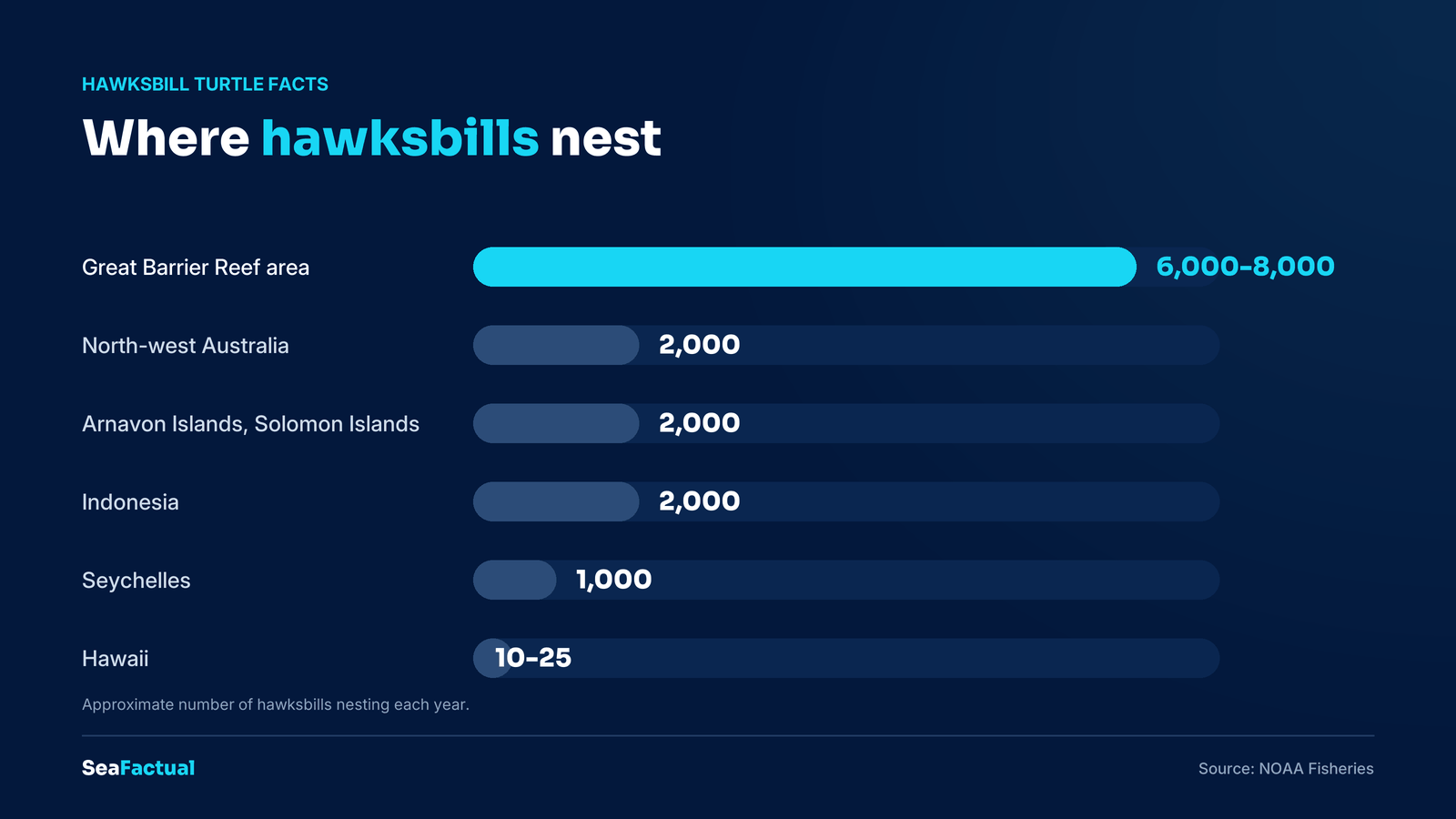
Hawksbills often nest in small numbers, on remote beaches. According to NOAA, the largest nesting populations are in Australia and the Solomon Islands. Around 6,000 to 8,000 hawksbills nest each year near the Great Barrier Reef, and about 2,000 nest on Australia's north-west coast.
In the Solomon Islands, the Arnavon Islands host the biggest rookery in the South Pacific, with around 2,000 nesting hawksbills a year. Hunted for their shells for centuries, these turtles are now showing encouraging signs of recovery after two decades of conservation and monitoring. In the Atlantic, the most nests are laid in Mexico, Cuba and Barbados. Hawaii's tiny population of 10 to 25 nesting females a year may be one of the smallest in the world.
How do hawksbill turtles nest?
Like all sea turtles, hawksbills nest on land. The female crawls up the beach at night, digs a deep hole with her back flippers and lays a clutch of soft, leathery eggs, then covers them with sand and returns to the sea. She may come ashore to nest several times in one season, and usually returns to the same region where she hatched.
Hawksbills are agile climbers for a turtle. They often nest high up the beach, among the bushes and trees at the back of the sand, where their nests are harder to find. As in other sea turtles, the temperature of the sand decides whether the eggs become males or females: warmer nests produce mostly females, a pattern explained in our article on ocean animals that break the rules.
When the hatchlings emerge, they head straight for the brightest horizon, which on a natural beach is the sea. Artificial lights on the coast can lead them the wrong way, which is why many nesting beaches now limit lighting.
Why are hawksbill turtles critically endangered?
Because of their shells. The patterned scutes of the hawksbill are the source of tortoiseshell, used for centuries to make combs, jewellery, spectacle frames and ornaments. NOAA says historical hunting for the shell nearly drove the species to extinction.
In a 2019 study, researchers pieced together 150 years of trade records and estimated that nearly 9 million hawksbills were killed for the tortoiseshell trade between 1844 and 1992, many times more than earlier estimates. Hawksbills were listed as Critically Endangered on the IUCN Red List in 1996, and international trade in tortoiseshell is now banned under CITES. Illegal hunting continues in many parts of the world, and hawksbills also face the threats that affect all sea turtles: being caught in fishing gear, the loss of nesting beaches, pollution, plastic and warming seas.
Do hawksbill turtles glow?
In 2015, marine biologists diving at night off the Solomon Islands filmed a hawksbill glowing bright red and green under blue light. Their report was the first record of biofluorescence in any sea turtle. The turtle absorbs blue light and gives it back out in other colours. Scientists are not yet sure whether it serves any purpose, or whether some of the glow came from algae living on its shell.
Frequently asked questions
Are hawksbill turtles dangerous?
No. Hawksbills are not aggressive towards people. Like all wild turtles, they should never be touched, chased or fed.
How long do hawksbill turtles live?
Nobody knows for certain, but NOAA estimates their lifespan at 50 years or more. Like other sea turtles, they take many years to reach maturity.
What is the difference between a hawksbill and a green turtle?
Hawksbills have a narrow, pointed beak, overlapping shell plates and a jagged rear edge to the shell. Green turtles have a short, rounded snout and smooth shell plates that sit edge to edge. Adult green turtles mainly eat seagrass and algae, while hawksbills mainly eat sponges.
Where can you see hawksbill turtles?
Hawksbills are often seen by divers and snorkellers on coral reefs, including the Caribbean (such as Bonaire, Barbados and the Cayman Islands), the Red Sea, the Maldives, the Seychelles, the Great Barrier Reef and Hawaii.
Is it legal to buy tortoiseshell?
International trade in hawksbill tortoiseshell is banned under CITES, and many countries also ban its sale. Travellers are advised never to buy tortoiseshell souvenirs.
Want more?
Follow SeaFactual for a new ocean fact every day, and get the fact of the week in your inbox using the form below.
Sources and further reading
- NOAA Fisheries: Hawksbill turtle
- Meylan 1988, Science: Spongivory in hawksbill turtles: a diet of glass
- Miller et al. 2019, Science Advances: The historical development of complex global trafficking networks for marine wildlife
- Gruber & Sparks 2015, American Museum Novitates: First observation of fluorescence in marine turtles
- IUCN Red List
Spotted a mistake? Tell us How we fact-check Last checked 22 November 2026