A lion's mane jellyfish, the largest jellyfish known.
In this article
Jellyfish have drifted through the oceans for more than 500 million years, long before the first dinosaurs, fish or trees. They have no brain, no heart and no blood, yet they are some of the most successful animals on the planet. One species can trail tentacles longer than a blue whale, and another can turn back the clock on its own life.
Here are the facts about jellyfish: what they are, how they sting, how big they get and whether any of them really live forever.
Jellyfish quick facts
- Not fish
- Jellyfish are invertebrates, related to corals and sea anemones
- Body
- About 95% water, with no brain, heart, blood or bones
- Age
- Jellyfish fossils date back more than 500 million years
- Biggest
- The lion's mane, with a bell up to about 1.8 metres (5.9 feet) across
- Longest tentacles
- Reported at around 37 metres (120 feet), also on the lion's mane
- Eyes
- Box jellyfish have 24
- Strangest trick
- The "immortal jellyfish" can turn back into a young polyp
- Stings
- Most cause only minor pain, but a few species are dangerous
Is a jellyfish a fish?
No. Despite the name, jellyfish are not fish. They are cnidarians (the "c" is silent), a group of simple animals that also includes corals, sea anemones and sea whips. Like their relatives, their bodies are arranged in a circle around a central point, which lets them sense food or danger from any direction. Many aquariums and scientists prefer to call them "jellies" or "sea jellies" for this reason.
Do jellyfish have brains?
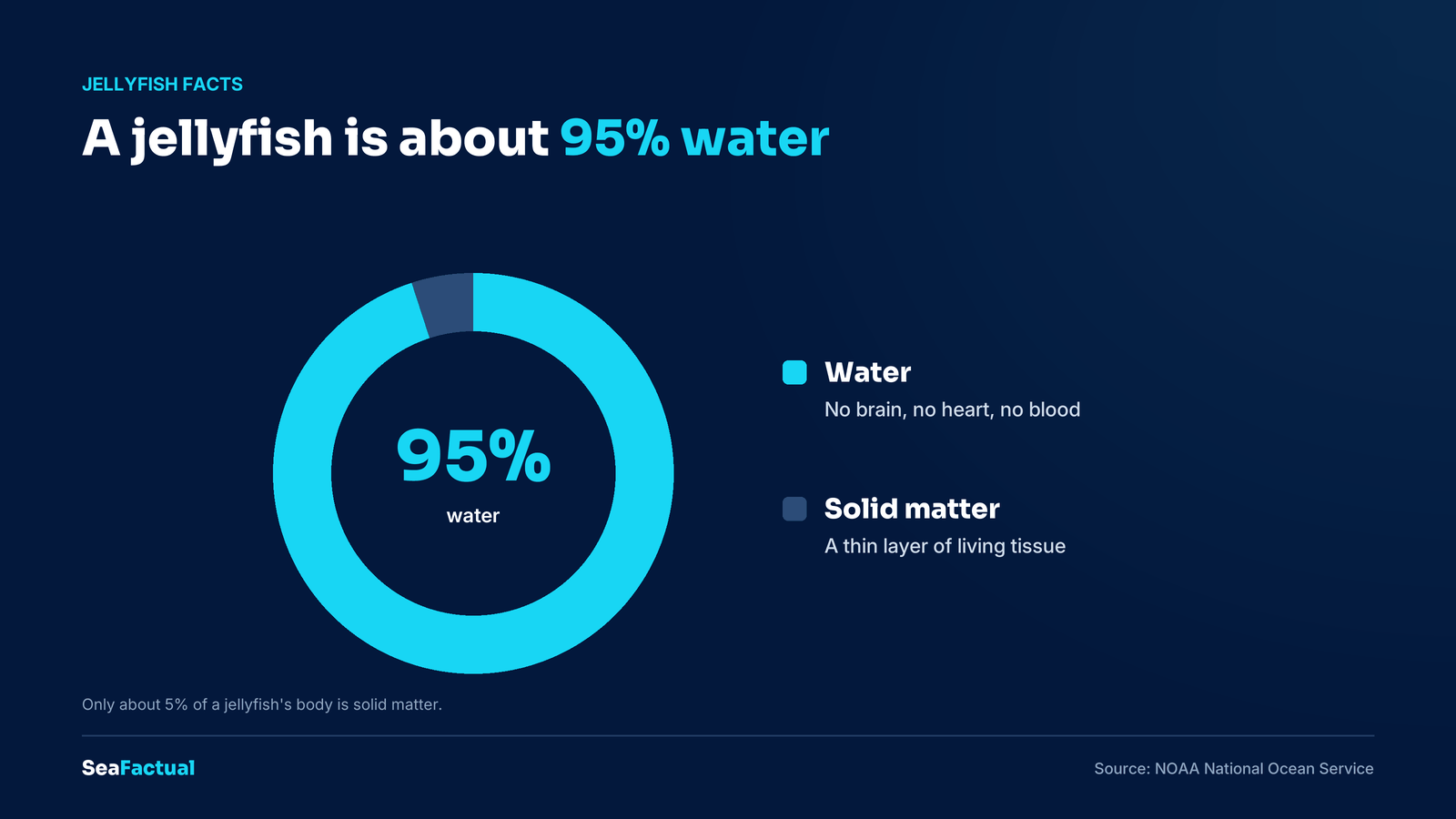
No. According to NOAA, jellyfish lack brains, blood and even hearts. Instead, a simple nerve net spread through the body lets them detect light, smell and touch, and respond.
A jellyfish's body has just three layers: a thin outer skin, a thick jelly-like middle layer called the mesoglea, and an inner lining. Only about 5% of a jellyfish is solid matter; the rest is water. That is why a jellyfish washed up on a beach collapses into a flat blob.
The digestive system is just as simple. A jellyfish has a single opening that works as both its mouth and its anus.
How do jellyfish sting?
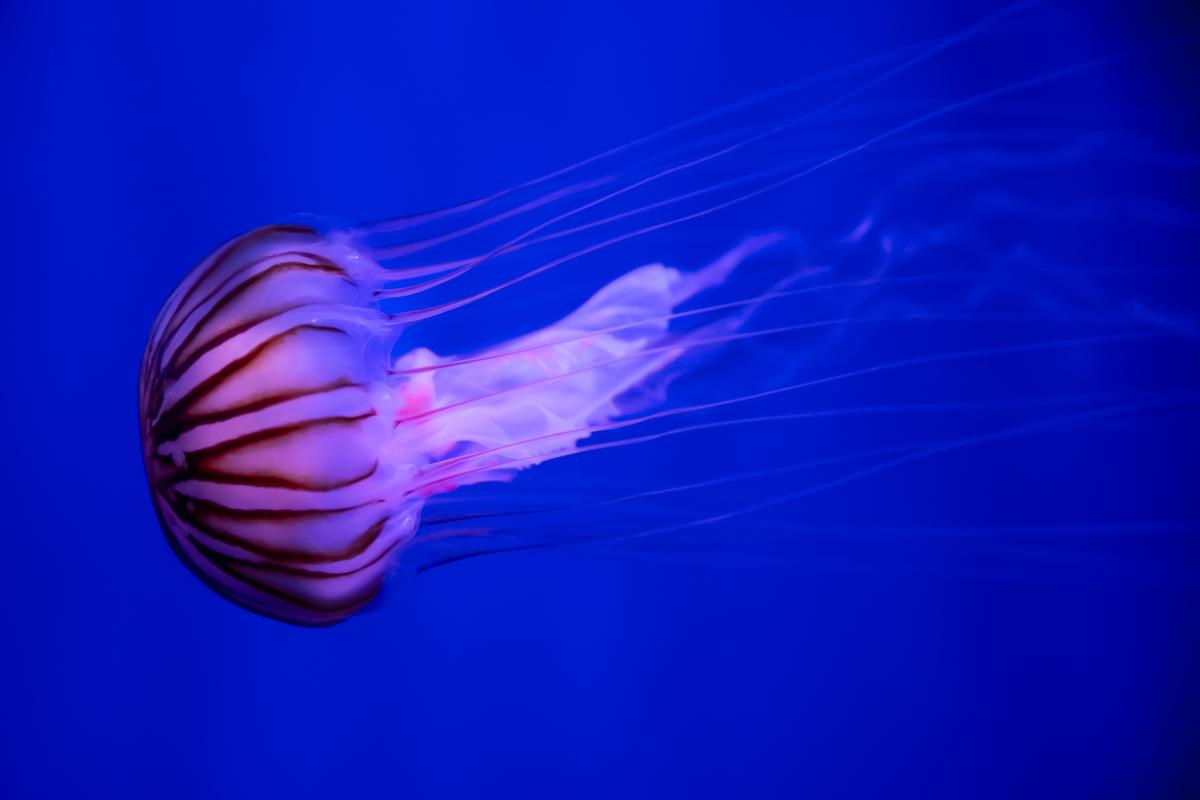
Jellyfish tentacles are covered in thousands of microscopic stinging cells called nematocysts. Each contains a tiny coiled thread. When something touches it, the thread fires out in a fraction of a second, piercing the skin and injecting venom.
Jellyfish use their stings to catch food. The Monterey Bay Aquarium describes how the Pacific sea nettle trails tentacles and frilly mouth-arms up to 4.6 metres (15 feet) long: prey that touches them is paralysed, passed along the mouth-arms and digested.
For people, NOAA says most jellyfish stings cause only minor discomfort. The stinging cells can keep working after a jellyfish has died or washed ashore, so it is wise never to touch one on the beach.
Which jellyfish are the most dangerous?
The most dangerous are box jellyfish, named for their cube-shaped bells. The Australian box jellyfish, Chironex fleckeri, found in northern Australia and the Indo-West Pacific, is one of the most venomous animals in the world, and a serious sting can kill an adult within minutes.
Box jellyfish are also remarkable for another reason: their eyes. A 2005 study showed that box jellyfish have 24 eyes, of four different types, and that some of them have lenses capable of forming images, all without a brain to process what they see.
If you are stung, get out of the water and seek medical help if the pain is severe, the sting covers a large area or the person feels unwell. First aid differs between species and regions: in tropical Australia, for example, lifeguards pour vinegar on box jellyfish stings. Follow local guidance and lifeguard advice, and in box jellyfish areas, swim inside stinger nets or wear a full-body suit during the stinger season.
What is the biggest jellyfish?
The lion's mane jellyfish is the largest jellyfish known. Oceana says its bell can be up to 1.8 metres (5.9 feet) across, with tentacles thought to reach around 36.6 metres (120 feet). The famous record comes from a lion's mane that washed up in Massachusetts in 1870, with tentacles reported at around 37 metres: longer than a blue whale.
Lion's manes live in cold waters of the Arctic, North Atlantic and North Pacific. A related species in southern Australia and New Zealand, the pink lion's mane, has a bell more than a metre (3.3 feet) wide and tentacles of more than 10 metres (33 feet), according to the Australian Museum, which notes that small fish often shelter among the tentacles of big individuals for protection.
It is one of the stars of our episode 10 Ocean Animals That Hold Incredible World Records.
Can a jellyfish live forever?
One tiny jellyfish comes closer than any other animal. Turritopsis dohrnii, nicknamed the immortal jellyfish, is only a few millimetres wide. When it is injured, starving or stressed, it can do something extraordinary: instead of dying, the adult jellyfish turns back into a polyp, the young stage of its life cycle.
Scientists described this in a 1996 study, which showed that the adult's cells transform into different types of cells as it reverts. In theory, the cycle can repeat again and again. In the wild, though, most immortal jellyfish are still eaten or die from disease, so "biologically immortal" is a better description than "living forever".
How old are jellyfish?
Jellyfish are one of the oldest groups of animals on Earth. In a 2023 study, palaeontologists described Burgessomedusa, a swimming jellyfish preserved in the Burgess Shale rocks of British Columbia, Canada. It lived in the middle Cambrian period, more than 500 million years ago, and is the oldest definite free-swimming jellyfish ever found. It had a box-shaped bell up to 20 cm (8 inches) high and more than 90 short tentacles.
The jellyfish life cycle
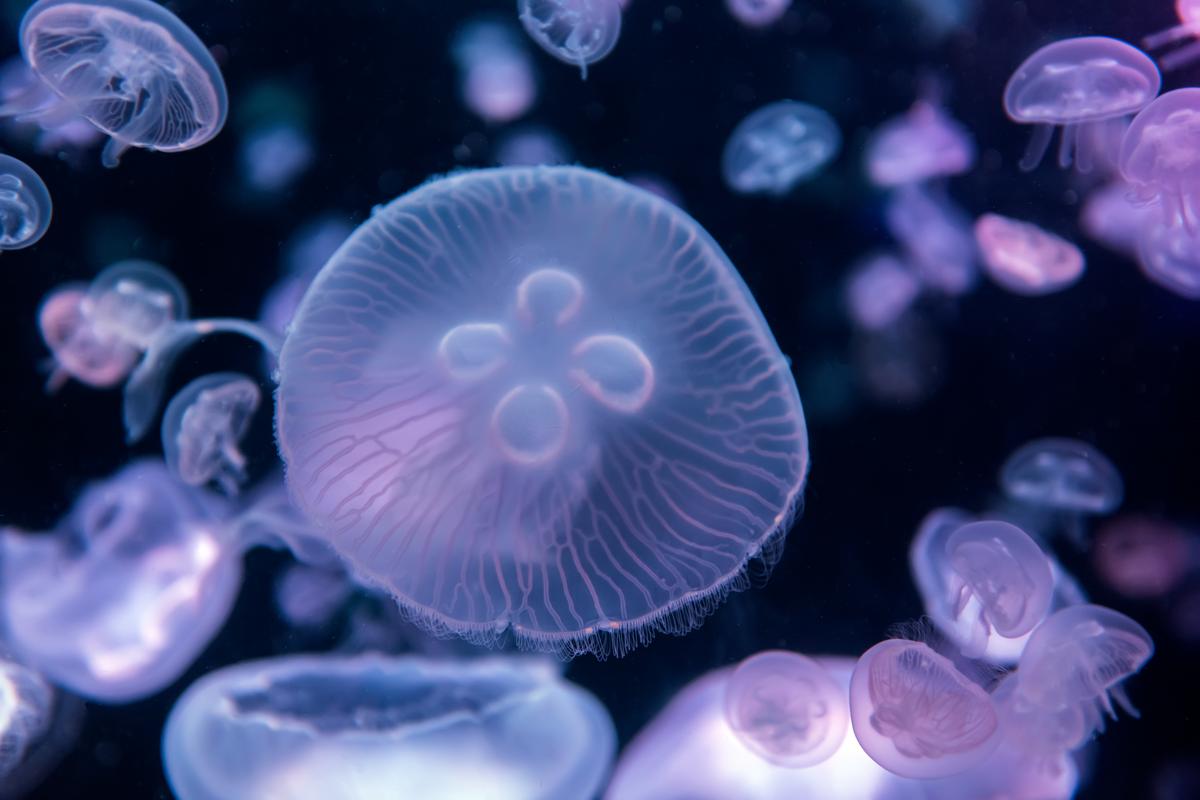
Most jellyfish have two main life stages. Fertilised eggs grow into tiny larvae that settle on the seabed and become polyps, small stalks attached to rocks or shells. A polyp can clone itself many times. Then, often in spring, it starts budding off tiny swimming jellyfish, which grow into the familiar bell-shaped adults, called medusae.
Because one polyp can release many young jellyfish, numbers can rise very quickly, producing huge blooms. The Monterey Bay Aquarium notes mounting evidence that human impacts on coastal waters may be creating conditions that favour jellies, leading to more frequent blooms.
What eats jellyfish?
Despite being mostly water, jellyfish are an important food for many animals. The leatherback sea turtle feeds almost entirely on jellyfish, and the ocean sunfish, many seabirds and some fish eat them too. Sea turtles can mistake floating plastic bags for jellyfish, which is one reason plastic pollution is so harmful to them.
Frequently asked questions
Do jellyfish have hearts?
No. Jellyfish have no heart, no blood and no brain. Their bodies are so thin that oxygen can pass straight in from the water.
Can a dead jellyfish still sting you?
Yes. The stinging cells can still fire after a jellyfish has died or been washed up, so never touch jellyfish on the beach, even if they look dried out.
What is the most dangerous jellyfish?
The Australian box jellyfish, Chironex fleckeri, is usually considered the most dangerous. Its venom can kill a person within minutes. Some smaller box jellyfish, such as the Irukandji, are also dangerous despite being only about a centimetre across.
Where can you see jellyfish?
Jellyfish live in every ocean, from the poles to the tropics. Moon jellyfish are common around the coasts of Europe and North America in summer, and big public aquariums, such as Monterey Bay Aquarium in California, have spectacular jelly exhibits. Palau's Jellyfish Lake is famous for swimming among millions of golden jellyfish whose stings are too weak to feel, while northern Australia's beaches are home to the dangerous box jellyfish.
How long do jellyfish live?
Most adult jellyfish live for a few months to about a year, though their polyps can survive much longer. The exception is the immortal jellyfish, which can revert to a polyp and start its life again.
Want more?
Follow SeaFactual for a new ocean fact every day, and get the fact of the week in your inbox using the form below.
Sources and further reading
- NOAA National Ocean Service: What are jellyfish made of?
- Oceana: Lion's mane jellyfish
- Australian Museum: Pink lion's mane jellyfish
- Monterey Bay Aquarium: Sea nettle
- Moon et al. 2023, Proceedings of the Royal Society B: A macroscopic free-swimming medusa from the middle Cambrian Burgess Shale
- Nilsson et al. 2005, Nature: Advanced optics in a jellyfish eye
- Piraino et al. 1996, Biological Bulletin: Reversing the life cycle: medusae transforming into polyps
Spotted a mistake? Tell us How we fact-check Last checked 22 November 2026