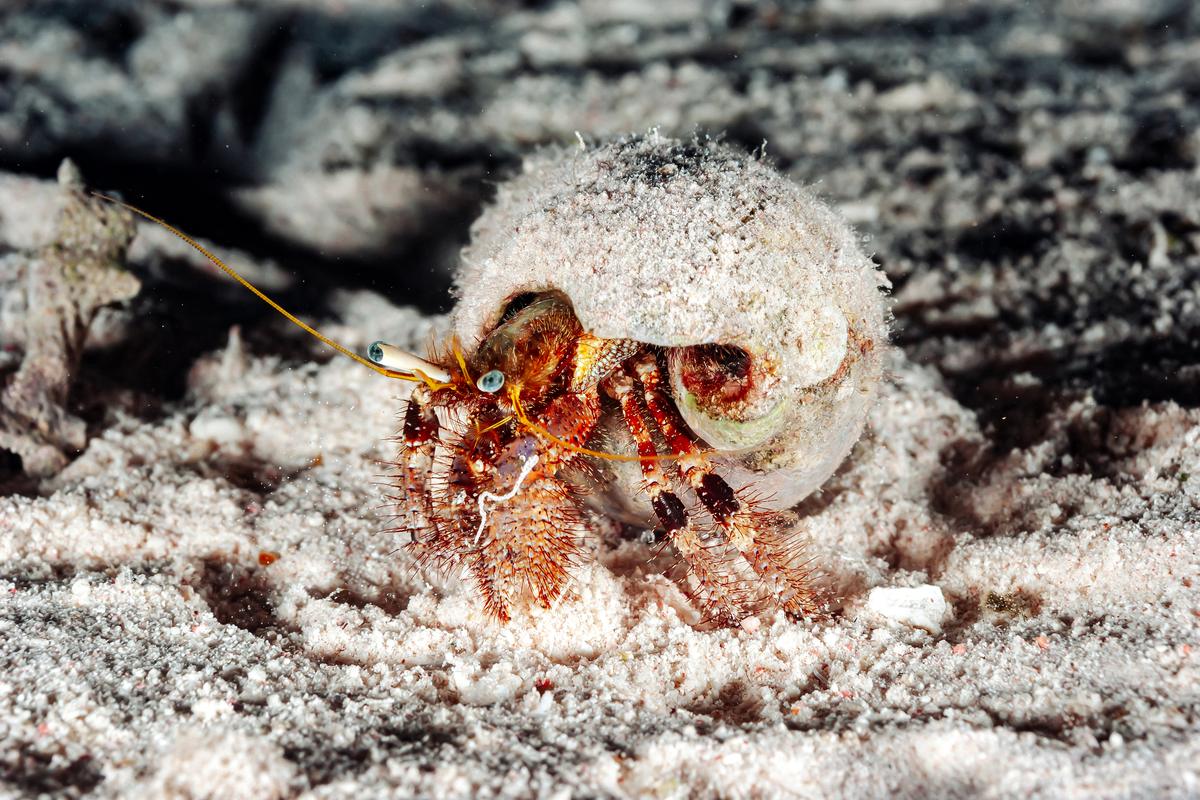
A white-spotted hermit crab in Lembeh, Indonesia.
In this article
A hermit crab spends its whole life looking for a better home. It cannot grow its own shell, so it borrows one from a dead sea snail, and every time it grows, it has to find a bigger one. When a good shell turns up, hermit crabs will even line up from biggest to smallest and swap homes one after another, like a chain of house moves.
Here are the facts about hermit crabs: why they need shells, how their shell swaps work, how they grow, their giant relatives and the surprising threat they face from plastic.
Hermit crab quick facts
- Group
- Paguroidea, the hermit crabs and their relatives
- Species
- Over 800 worldwide, almost all of them in the ocean
- Home
- Empty snail shells, swapped for bigger ones as they grow
- Size
- From a few millimetres to the coconut crab, with a leg span of up to 1 metre (3 feet 3 inches)
- Diet
- Omnivorous scavengers, eating algae, tiny shellfish and dead animals
- Breathing
- Gills, which land hermit crabs must keep moist
- Biggest threat
- A shortage of shells, and beach plastic that traps them
What is a hermit crab?
Despite the name, hermit crabs are not true crabs. A true crab, like a blue crab, has a hard shell covering its whole body. According to National Geographic, a hermit crab only has a hard exoskeleton on the front half of its body. The back half is a soft, curled abdomen that it has to protect.
That is why it lives in a borrowed shell, usually one left behind by a dead sea snail such as a whelk. According to the Smithsonian's National Zoo, a hermit crab grips the inside of the shell with its abdomen and its back legs, and a small hooked appendage at the tip of its body clamps onto the shell's central spiral. Rough surfaces inside the shell help it hold on.
There are over 800 species of hermit crab. Almost all of them live in the sea, from rock pools to coral reefs and the deep ocean. About a dozen are land hermit crabs, the ones most people know as pets, and just one species, found in Vanuatu, lives in fresh water.
Why do hermit crabs need new shells?
Hermit crabs keep growing throughout their lives, and the shell does not grow with them. Like all crustaceans, a hermit crab grows by moulting: shedding its old exoskeleton and growing a larger one. According to the National Aquarium, hermit crabs moult at least once a year, and small ones can moult as often as every other month.
Moulting is a risky time. The National Zoo explains that a crab builds up water pressure in its body to split its old exoskeleton. Some species bury themselves in sand to moult, while others stay inside their shell, a process that can take 45 to 120 days. A freshly moulted crab often eats its old exoskeleton, possibly for the calcium and minerals.
Once it has grown, the old shell is too tight, and the crab has to find a bigger one. Good shells are scarce, and the National Aquarium notes that hermit crabs will fight to the death over them.
Before moving in, a hermit crab inspects a new shell carefully. It looks at it, tests whether it can move it, feels its surface and shape, and checks that the opening is clear, before quickly swapping its soft body across.
How do hermit crabs swap shells?
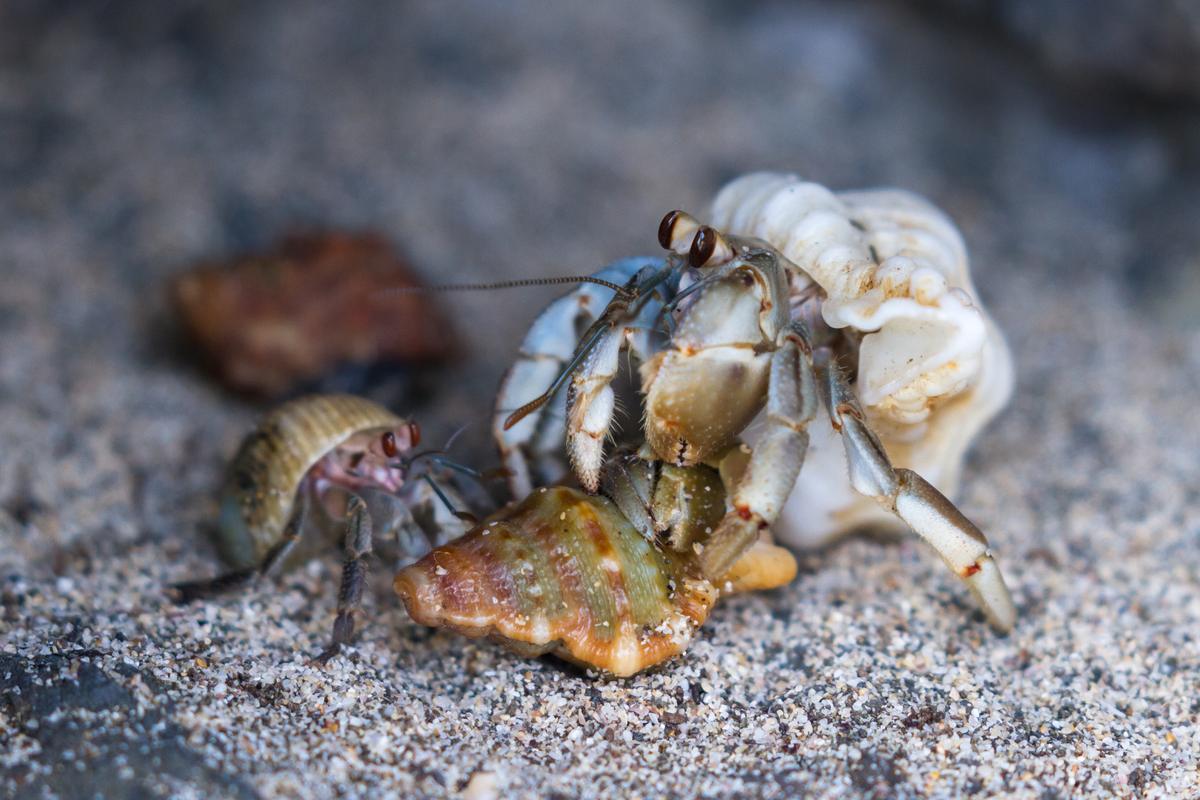
This is one of the most remarkable behaviours in the animal world. When a large, empty shell turns up, hermit crabs can form a vacancy chain.
According to researchers at Tufts University, crabs gather around the new shell and queue up in a line from largest to smallest. When the biggest crab moves into the empty shell, each crab in the line swiftly moves into the shell just left by the crab in front of it. In a few moments, a whole group of crabs has upgraded its home.
A 2010 study of Caribbean land hermit crabs found that these synchronous chains are common in the wild. It also described two behaviours that help them happen: waiting, where crabs hang around a shell that is too big for them until a larger crab arrives, and piggybacking, where a crab holds on to another crab's shell, ready to take it.
Not every crab is lucky. When there are not enough shells, some hermit crabs end up with no shell at all, leaving their soft bodies exposed to predators. Researchers have even seen hermit crabs using bottle caps and pen lids as makeshift homes.
Why do some hermit crabs carry sea anemones?
Some hermit crabs decorate their shells with live sea anemones, and it is not just for show. The anemone's stinging tentacles help protect the crab, and in return the anemone gets a free ride and scraps from the crab's meals.
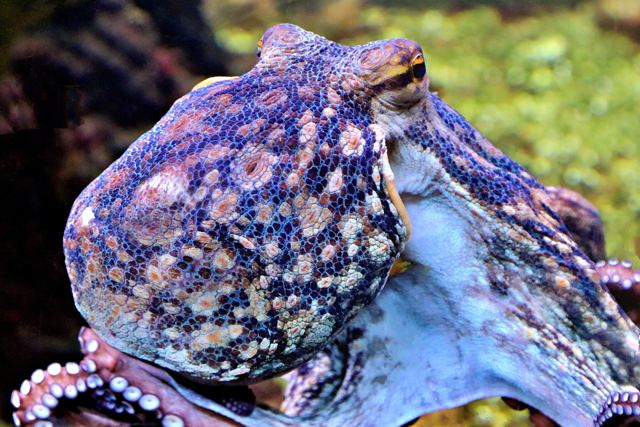
In a classic 1971 study, scientists showed that anemones on the shells of Dardanus hermit crabs protected them from octopuses, one of their main predators. The study also noted that these crabs actively move their anemones onto their new shell when they change homes.
What is the biggest hermit crab?
The biggest relative of the hermit crabs is the coconut crab, the largest crustacean that lives its whole adult life on land. According to the Natural History Museum, it can have a leg span of up to 1 metre (3 feet 3 inches), can lift objects as heavy as a 10-year-old child, and may live for up to 60 years.
Young coconut crabs carry shells like other hermit crabs. Adults grow far too big for any shell and rely on their own hard exoskeleton instead, according to the National Aquarium, which says they can weigh almost 4 kg (9 lb). They eat fruit and seeds, and also hunt larger prey such as birds and rats.
How does plastic harm hermit crabs?
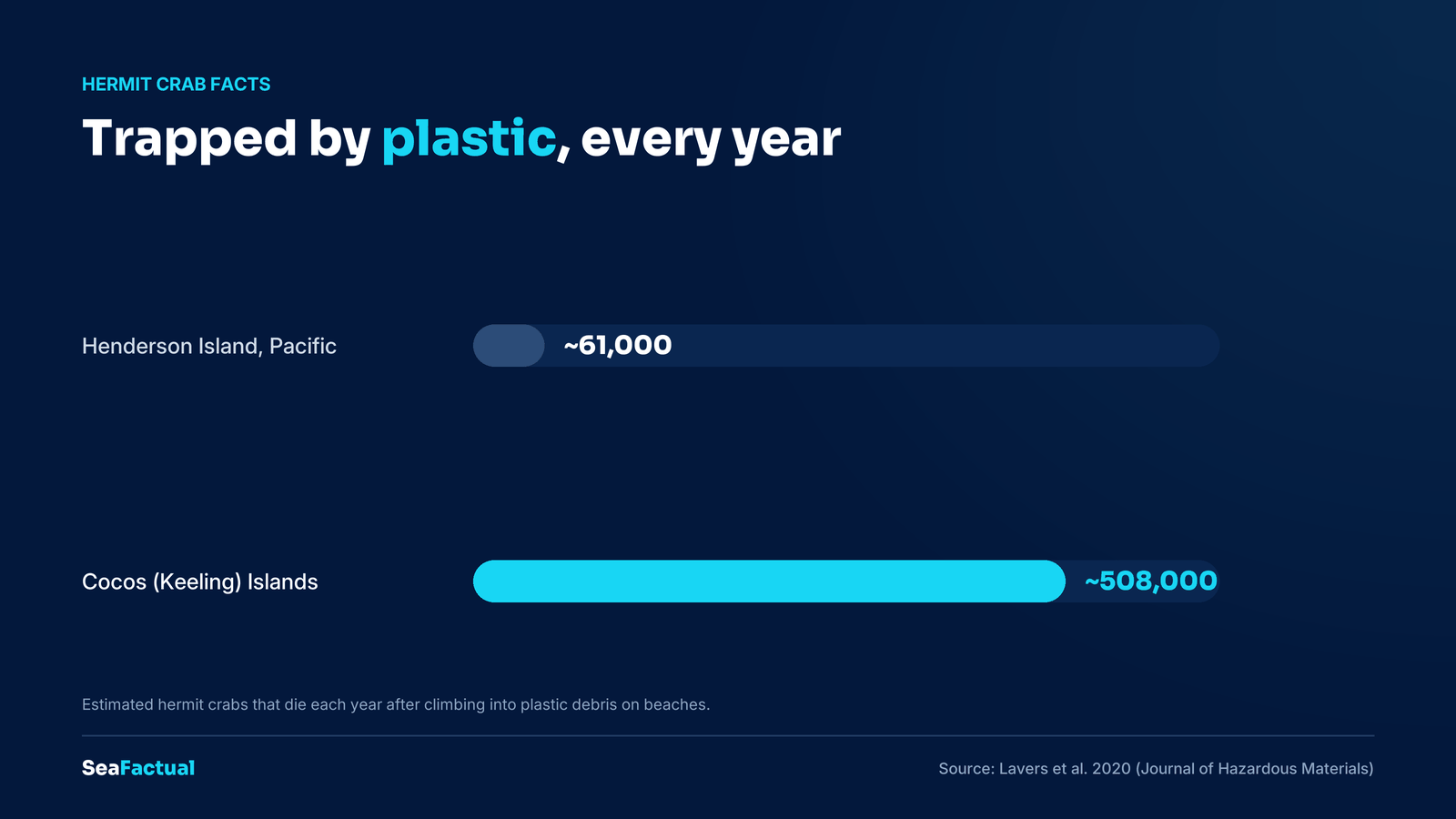
Hermit crabs are always searching for new shells, and plastic bottles and containers on beaches look like shelter. Once a crab climbs in, it often cannot climb back out up the smooth plastic.
In a 2020 study, scientists surveyed beaches on two remote islands. They estimated that around 508,000 hermit crabs die this way every year on the Cocos (Keeling) Islands in the Indian Ocean, and around 61,000 on Henderson Island in the Pacific. According to the Natural History Museum, it was thought to be the first time anyone had measured the population-level impact of plastic on any species.
Worse, a hermit crab that dies releases a chemical signal that tells other hermit crabs a shell has become free, so one trapped crab lures in more. The Natural History Museum reports that the team found over 250 hermit crab shells in a single plastic container.
Frequently asked questions
Where can you see hermit crabs in the wild?
Almost anywhere there is sea. Hermit crabs live in rock pools and shallow water on coasts around the world, including the UK, Europe and North America, and on coral reefs in the tropics. Land hermit crabs are easiest to see on tropical beaches in the Caribbean, Florida, Central America, the Indian Ocean and the Pacific islands, often coming out at dusk.
Do hermit crabs kill other hermit crabs for their shells?
They fight over shells, sometimes fiercely, and a crab may try to pull another out of a shell it wants. The National Aquarium says hermit crabs will fight to the death for shells, because without one they cannot survive.
Are hermit crabs social?
Yes, despite the name. Many live in groups, sometimes of a hundred or more. Caribbean land hermit crabs gather in huge numbers when they travel to the shore to release their eggs into the sea, according to National Geographic.
Can hermit crabs breathe underwater?
Marine hermit crabs breathe with gills, like other crabs. Land hermit crabs have reduced gills inside a moist chamber, according to the National Zoo. They breathe air, but they need damp conditions to stop their gills drying out, and they cannot survive long underwater.
What do hermit crabs eat?
Hermit crabs are scavengers that eat almost anything they find, including algae, tiny clams and mussels, and bits of dead animals.
Want more?
Follow SeaFactual for a new ocean fact every day, and get the fact of the week in your inbox using the form below.
Sources and further reading
- National Geographic: Hermit crabs
- Smithsonian's National Zoo: Land hermit crab
- National Aquarium: Hermit crabs
- Tufts University: Social networking helps hermit crabs find homes
- Rotjan et al. 2010, Behavioral Ecology: Social context of shell acquisition in Coenobita clypeatus hermit crabs
- Ross 1971, Nature: Protection of hermit crabs (Dardanus spp.) from octopus by commensal sea anemones
- Lavers et al. 2020, Journal of Hazardous Materials: Entrapment in plastic debris endangers hermit crabs
- Natural History Museum: Coconut crabs
- Natural History Museum: Over 600,000 hermit crabs die in plastic bottles
Spotted a mistake? Tell us How we fact-check Last checked 21 November 2026