A cushion sea star in shallow tropical water.
In this article
Starfish are not fish at all. They have no brain, no blood and no bones, they see with eyes on the tips of their arms, and they can regrow a lost limb. Some even eat by pushing their stomach out of their body and digesting their prey on the spot.
Scientists prefer to call them sea stars, but whichever name you use, here are the facts: how many arms they have, how they move, see and eat, and why some species are in serious trouble.
Starfish quick facts
- Not fish
- Sea stars are echinoderms, related to sea urchins and sea cucumbers
- Species
- Around 2,000, all living in the sea
- Arms
- Usually five, but some species have 10, 20 or even 40
- Blood
- None; seawater pumped through the body does the job instead
- Eyes
- A simple eye at the tip of each arm
- Super power
- Can regrow lost arms
- Feeding
- Many push their stomach out of their mouth to digest prey
- Biggest threat
- Sea star wasting disease, which has killed billions on the Pacific coast of North America
Is a starfish a fish?
No. According to NOAA, sea stars are not fish: they have no gills, scales or fins, and they live only in salt water. There are around 2,000 species.
Sea stars belong to a group of animals called echinoderms, meaning "spiny skin", along with sea urchins, sand dollars, brittle stars and sea cucumbers. Echinoderms have a body built around five-part symmetry, which is why the classic sea star has five arms.
How many arms does a starfish have?
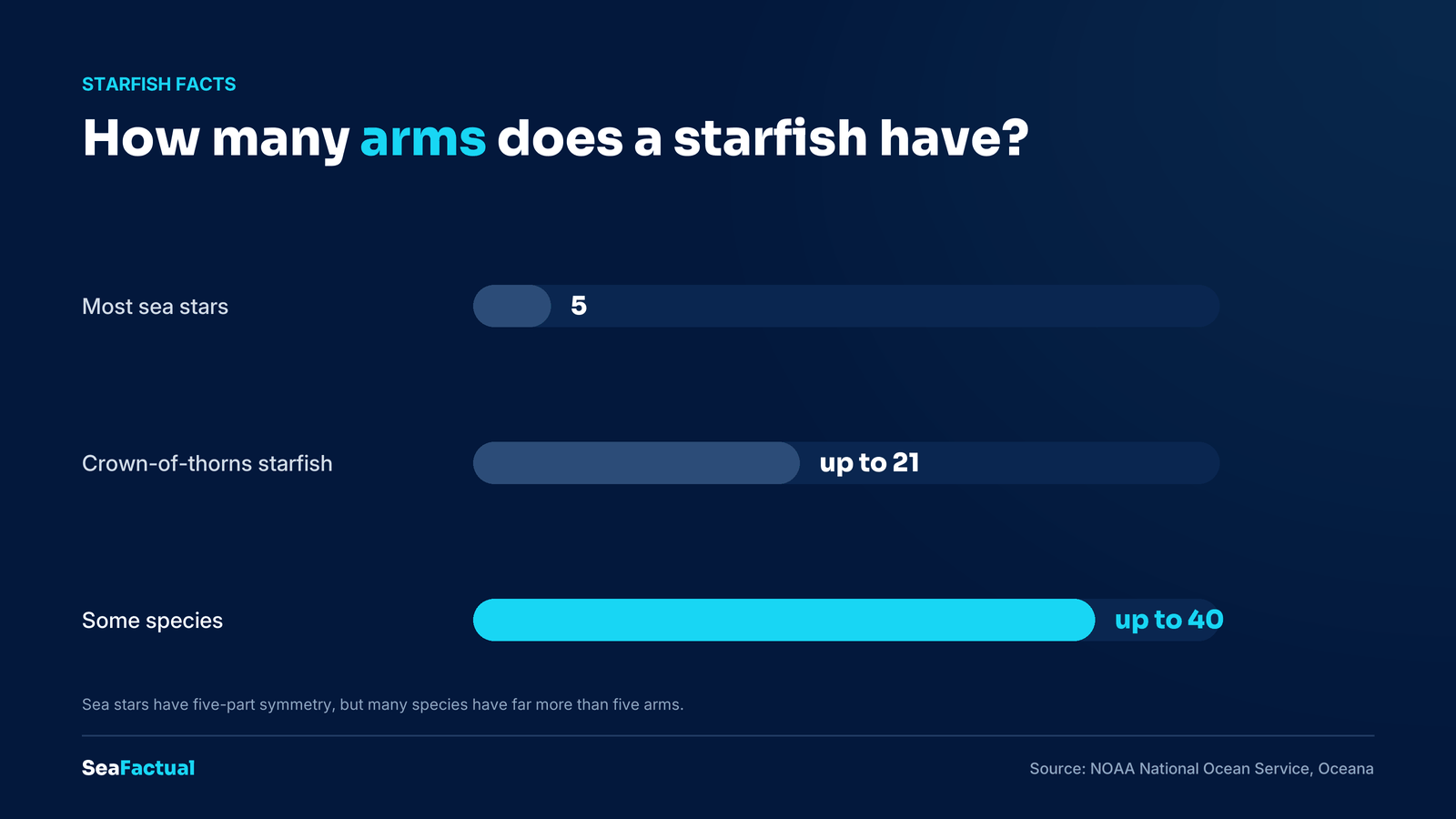
Most sea stars have five arms, but by no means all. NOAA says species with 10, 20 or even 40 arms exist. The crown-of-thorns starfish has between 8 and 21, according to Oceana, and the sunflower sea star of the North Pacific usually has more than 20.
Do starfish have blood?
No. Instead of blood, sea stars pump seawater around their bodies through a network of canals called the water vascular system. It carries nutrients and also powers their movement.
On the underside of each arm are hundreds of tiny tube feet, each one a little hydraulic tube with a suction pad at the end. By pushing water in and out of them, a sea star can walk, cling to rocks and grip prey. They are not always slow: NOAA says an adult sunflower sea star can move at about one metre (3.3 feet) a minute on around 15,000 tube feet.
Can starfish see?
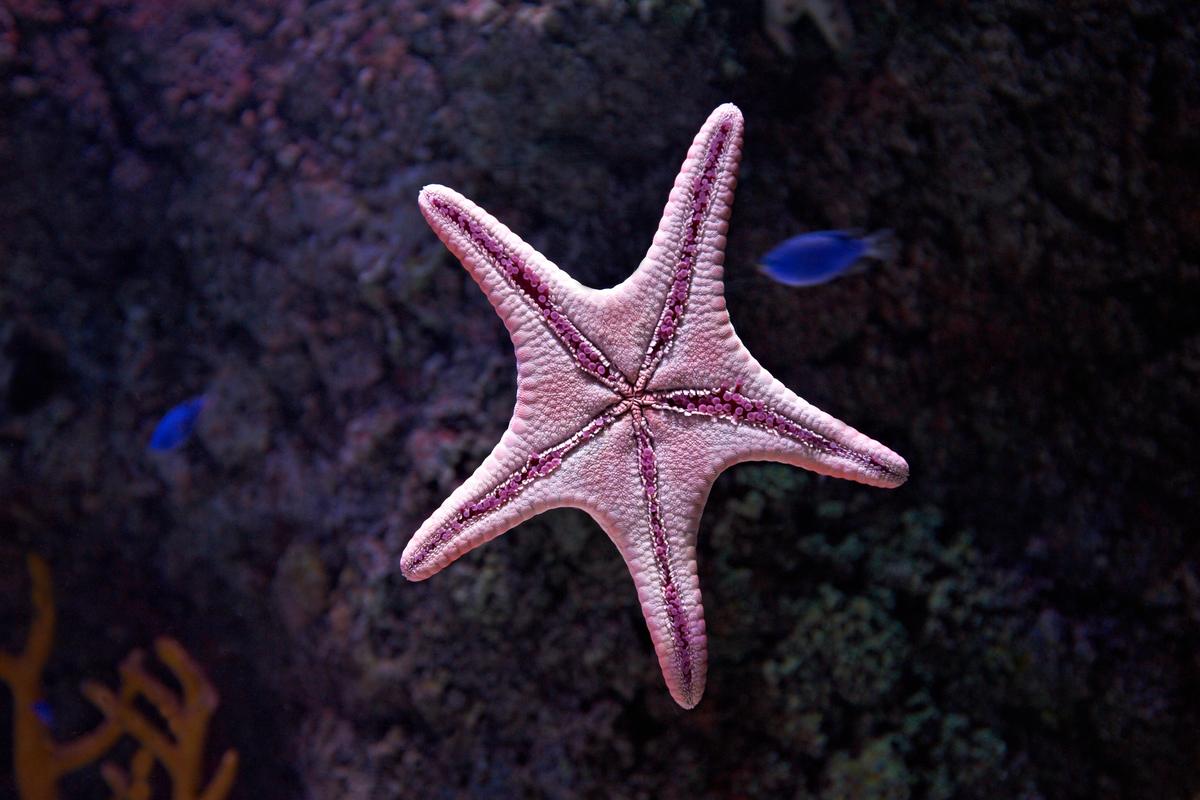
Yes, a little. Most sea stars have a small compound eye at the tip of each arm, looking a bit like an insect's eye without the lenses. Scientists knew about these eyes for around two centuries without knowing what they were for.
In a 2014 study, researchers tested a blue sea star from coral reefs. Its eyes turned out to be slow and colour-blind, with very blurry vision, but good enough to make out large shapes such as the reef. Sea stars with intact eyes found their way back to the reef when they were moved away; those with their eyes removed wandered randomly.
Can starfish regrow their arms?
Yes. If a sea star loses an arm to a predator, it can grow a new one. In some species, a severed arm that keeps part of the central disc can even grow into a whole new sea star. Regrowing a limb takes a lot of energy and can take months or longer, but it gives sea stars a remarkable way to survive attacks.
How do starfish eat?
A sea star's mouth is on its underside, in the middle of the body. Many species eat in an extraordinary way: they push their stomach out through their mouth and over their prey, then release digestive juices that turn it into a soup they can absorb.
This lets a sea star eat animals far bigger than its mouth. Some use their tube feet to pull apart the two halves of a mussel or clam, opening a tiny gap just wide enough to slide their stomach inside the shell.
Which starfish destroys coral reefs?
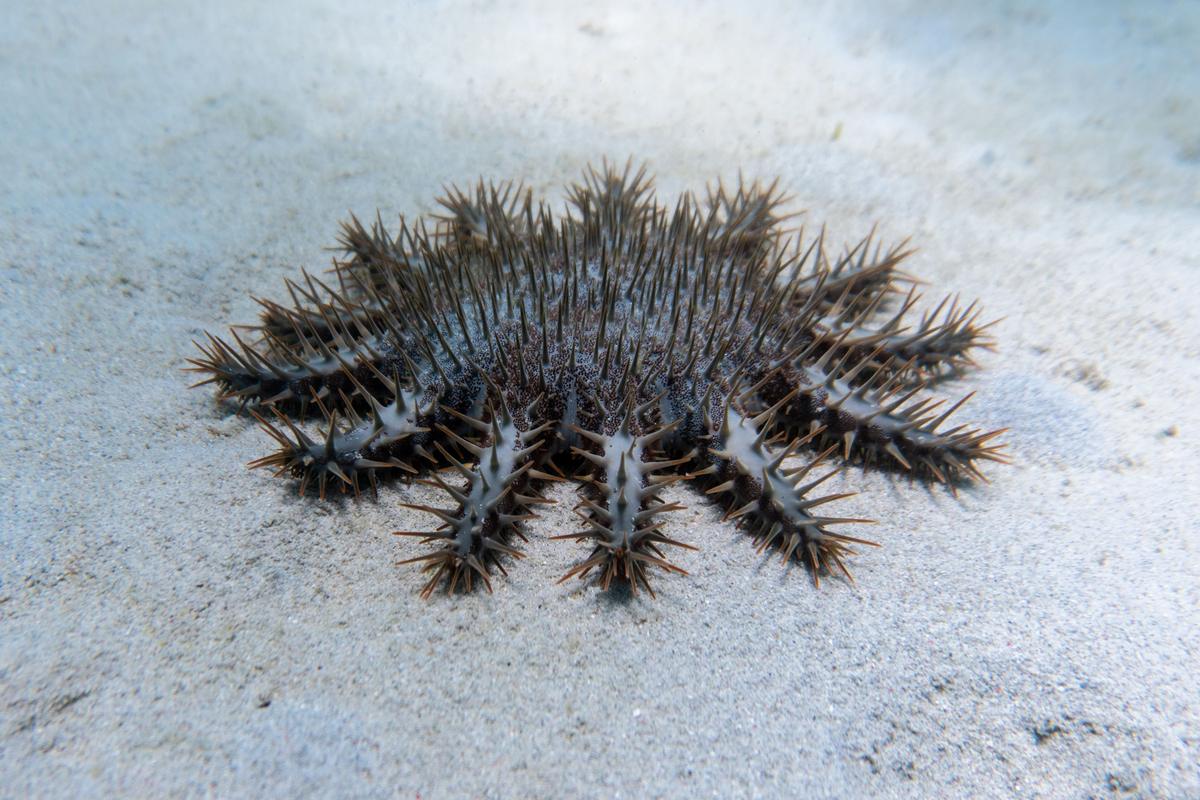
The crown-of-thorns starfish is a large, spiny sea star of the Indo-Pacific that feeds on living coral. Oceana says it can grow more than 70 cm (2.3 feet) across and that a single one can eat up to 12 square metres (129 square feet) of coral polyps a year.
In normal numbers it is part of a healthy reef. But during population outbreaks, crown-of-thorns starfish can strip whole reefs of coral, and outbreaks are one of the main causes of coral loss on Australia's Great Barrier Reef. Its spines are also venomous and can cause a painful wound, so it should never be handled. Read more in our coral facts.
What is sea star wasting disease?
From 2013, sea stars along the Pacific coast of North America began dying in enormous numbers. Affected animals develop lesions, lose their arms and literally disintegrate within days. A 2014 study showed that the disease could pass from sick sea stars to healthy ones and pointed to a virus as a likely cause, although scientists still debate exactly what drives it.
The sunflower sea star, once one of the biggest and fastest sea stars in the world, was hit hardest. A 2019 study found it had collapsed across most of its range, from Mexico to Alaska, with the disease made worse by a marine heatwave. It is now listed as Critically Endangered on the IUCN Red List.
That loss matters. Sunflower sea stars eat sea urchins, and without them urchin numbers exploded in some places, eating away kelp forests. Sea otters, another urchin predator, play a similar role: see our sea otter facts.
How do starfish have babies?
Most sea stars have separate males and females, which release eggs and sperm into the water. The fertilised eggs grow into tiny swimming larvae that drift in the plankton before settling and changing into miniature sea stars. Some species can also reproduce without a partner, by splitting their body in two and regrowing the missing parts.
Frequently asked questions
Do starfish have brains?
No. Sea stars have no brain. Instead, a ring of nerves around the mouth connects to a nerve running down each arm, which is enough to coordinate their tube feet and respond to light, touch and chemicals in the water.
Is it safe to pick up a starfish?
It is best not to. Sea stars breathe by absorbing oxygen through their skin and tube feet, and taking one out of the water, or covering it in sunscreen from your hands, can harm it. Crown-of-thorns starfish should never be touched, because their spines are venomous.
How long do starfish live?
It depends on the species. Many live for several years, and some larger species are thought to live for decades.
Where can you see starfish?
Sea stars live in every ocean, from rock pools to the deep sea. Good places to see them include rock pools on the coasts of the UK, Ireland and the Pacific Northwest of the US and Canada, the tropical shallows of the Caribbean and Indo-Pacific, and coral reefs such as Australia's Great Barrier Reef, where the blue sea star is common.
Why are starfish called sea stars?
Because they are not fish. Many scientists and aquariums use "sea star" to avoid the confusion, in the same way that "jelly" is often preferred to "jellyfish". Read more in our jellyfish facts.
Want more?
Follow SeaFactual for a new ocean fact every day, and get the fact of the week in your inbox using the form below.
Sources and further reading
- NOAA National Ocean Service: Are starfish really fish?
- Oceana: Crown-of-thorns starfish
- Garm & Nilsson 2014, Proceedings of the Royal Society B: Visual navigation in starfish
- Hewson et al. 2014, PNAS: Densovirus associated with sea-star wasting disease and mass mortality
- Harvell et al. 2019, Science Advances: Disease epidemic and a marine heat wave are associated with the continental-scale collapse of a pivotal predator
- IUCN Red List
Spotted a mistake? Tell us How we fact-check Last checked 22 November 2026