A sperm whale near the surface off Portugal.
In this article
- Sperm whale quick facts
- How big is a sperm whale?
- Sperm whales have the biggest brain of any animal
- How deep can a sperm whale dive?
- What do sperm whales eat?
- The loudest sound of any animal
- How do sperm whales talk to each other?
- Do sperm whales sleep?
- How do sperm whales raise their calves?
- Are sperm whales endangered?
- Where can you see sperm whales?
- Frequently asked questions
The sperm whale is an animal of extremes. It is the largest predator with teeth on Earth, it carries the heaviest brain of any animal, and it hunts in pitch darkness hundreds of metres below the surface. It also makes the loudest sound of any animal, and uses clicks to talk to its family.
Here are the facts about sperm whales: how big they get, how deep they dive, what they eat, how they communicate and where you can see one.
Sperm whale quick facts
- Size
- Males up to about 16 metres (52 feet); females up to about 12 metres (40 feet)
- Weight
- Males up to around 41 tonnes (45 US tons); females around 14 tonnes (15 US tons)
- Brain
- The heaviest of any animal, around 8 kg (about 17 lb)
- Diet
- Mainly squid, plus deep-sea fish, sharks and skates
- Diving
- Routinely to about 600 metres (2,000 feet), and to 1,000 metres (3,280 feet) or more
- Lifespan
- 60 years or more
- Family groups
- Females and young live in units of about a dozen adults
- Conservation status
- Vulnerable (IUCN); Endangered under the US Endangered Species Act
How big is a sperm whale?
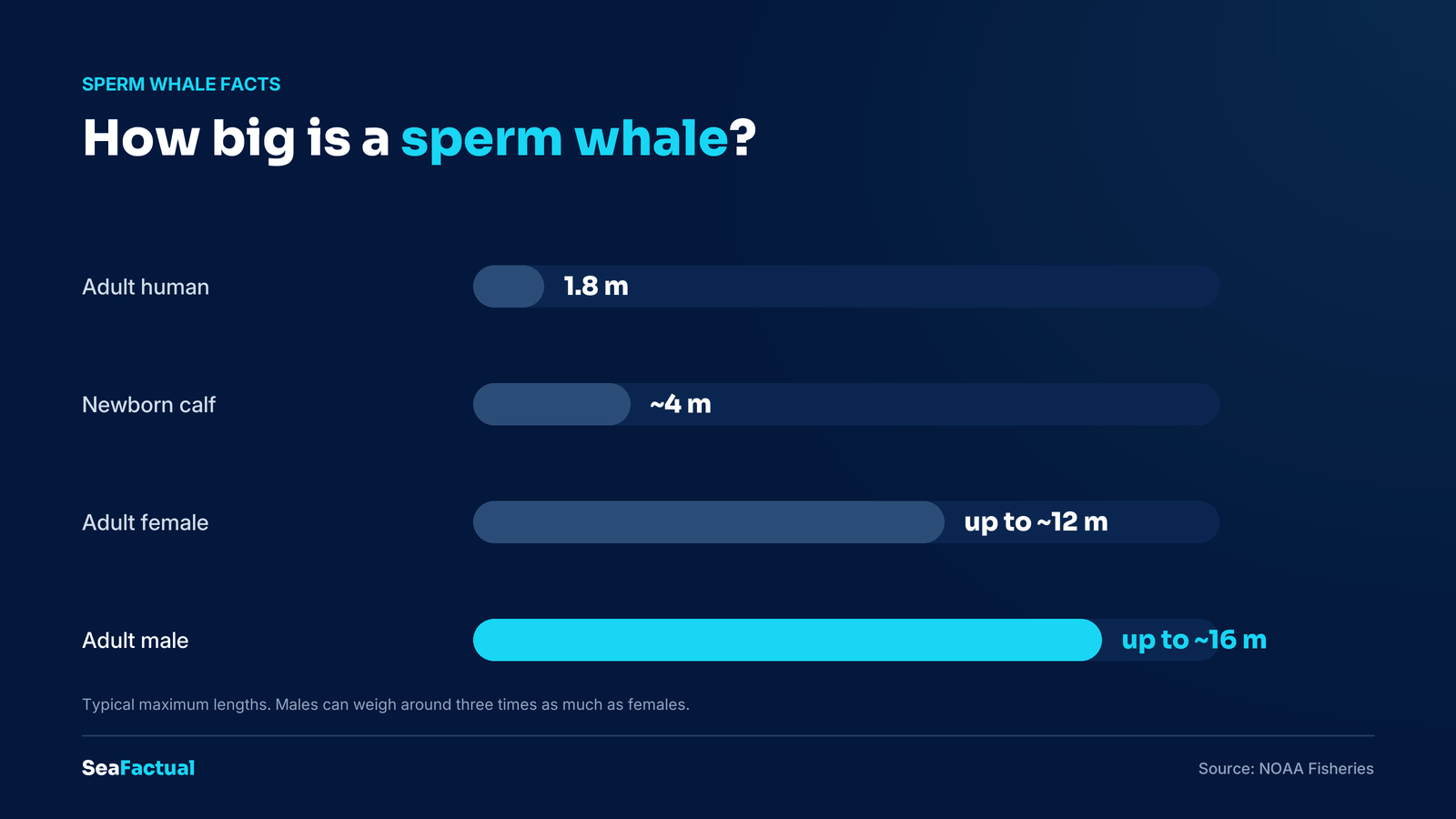
The sperm whale is the largest toothed whale and the largest toothed predator on the planet. According to NOAA Fisheries, males grow up to about 16 metres (52 feet) long and weigh up to around 41 tonnes (45 US tons). Females are much smaller, reaching about 12 metres (40 feet) and around 14 tonnes (15 US tons).
That difference is one of the biggest between the sexes of any whale: a big male can weigh around three times as much as a female.
Around a third of a sperm whale's length is its enormous, box-shaped head. The lower jaw is long and narrow, with roughly 18 to 28 cone-shaped teeth on each side, which fit into sockets in the upper jaw. The upper jaw has only a few small teeth that never break through the gum.
Sperm whales have the biggest brain of any animal
The sperm whale's brain weighs around 8 kilograms (about 17 lb), more than five times as much as a human brain. National Geographic describes it as the largest brain of any creature known to have lived on Earth.
There is one twist. A 2014 study comparing brain weights found that the biggest male orcas have brains that rival those of sperm whales, so the two species share the record among living animals. Relative to its huge body, though, the sperm whale's brain is not unusually large: brain size in whales scales with body size, and dolphins have much bigger brains for their size.
How deep can a sperm whale dive?
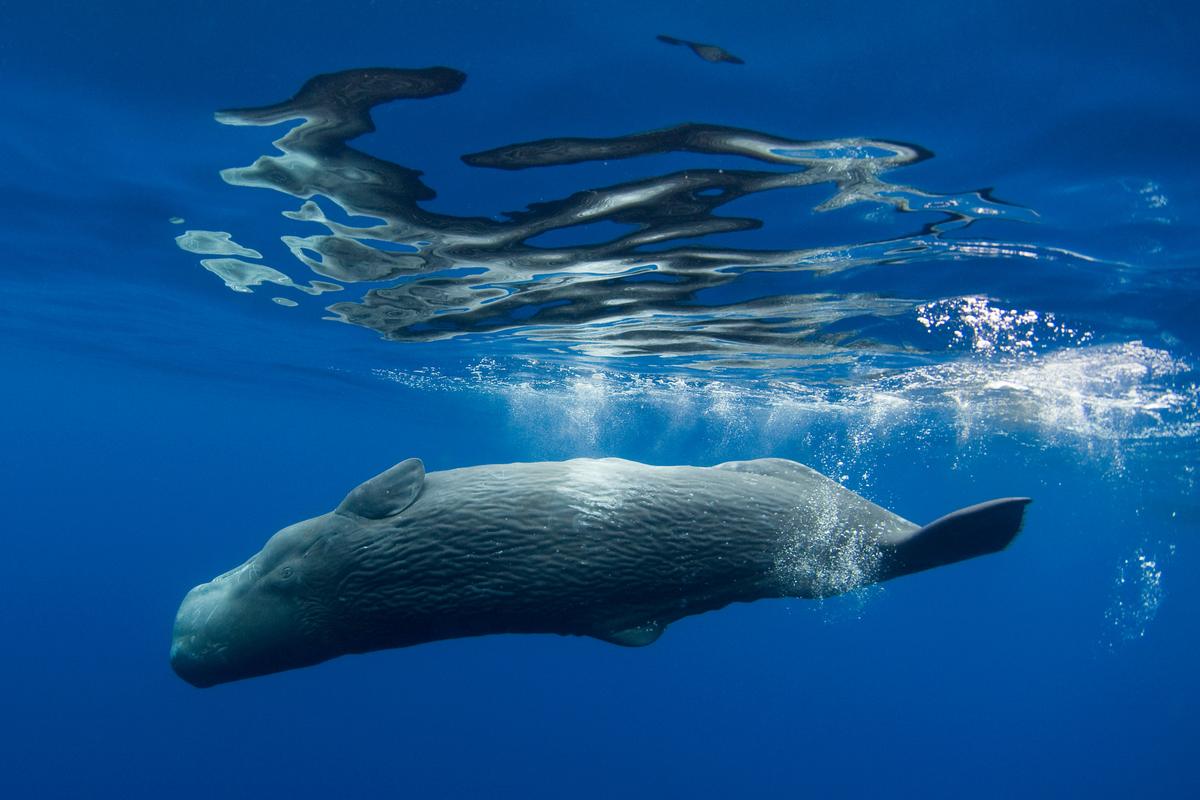
Sperm whales are among the deepest-diving mammals. NOAA says they routinely dive to about 600 metres (2,000 feet) and stay down for around 45 minutes, then rest at the surface for several minutes before diving again. Dives to 1,000 metres (3,280 feet) or more, lasting up to about 90 minutes, have been recorded.
At those depths there is no sunlight at all. Sperm whales find their food by echolocation: they send out powerful clicks and listen for the echoes bouncing back off squid and fish.
What do sperm whales eat?
Sperm whales eat mainly squid, including large deep-sea squid, along with deep-water fish, sharks and skates. NOAA estimates they eat about 3 to 3.5% of their body weight each day, which for a big male means more than a tonne (2,200 lb) of food.
Many sperm whales carry circular scars on their heads from the suckers of squid they have fought. Hard squid beaks that cannot be digested can build up in the gut, and in a small number of whales they become trapped in a waxy lump called ambergris, once one of the most valuable substances in the perfume industry.
The loudest sound of any animal
Sperm whale clicks are the loudest sounds made by any animal. In a 2003 study off Norway, researchers measured clicks with source levels of up to 236 decibels (re 1 µPa), and concluded that they were by far the loudest sounds recorded from any biological source. (Decibels underwater are measured on a different scale from decibels in air, so the number cannot be compared directly with sounds we hear.)
The sound is produced in the whale's head and focused through the spermaceti organ, a huge chamber of waxy oil. NOAA describes spermaceti as an oil sac that helps the whales focus sound. Whalers once mistook it for sperm, which is how the species got its name.
How do sperm whales talk to each other?
Sperm whales live in tight family groups. NOAA says that on average about 12 females and their young form a social unit, and females usually stay with the same unit for life. Young males leave between the ages of about 4 and 21 and form "bachelor" groups, before roaming alone into colder waters as they grow.
Family members communicate using codas: short, patterned sequences of around 3 to 40 clicks. Different groups of families, called clans, use different sets of codas, a little like dialects. A 2022 study of whales in the Pacific found that clans use certain codas as identity markers, especially where clans overlap: evidence of symbolic culture in a non-human animal.
Researchers are now asking whether the codas have structure, like the sounds of a language. A 2024 study analysed thousands of codas from whales off Dominica and found that small changes in rhythm and tempo combine in systematic ways, giving sperm whales a far larger set of distinct calls than previously thought. What the calls mean is still unknown.
Do sperm whales sleep?
Yes, and they do it in a remarkable way. In a 2008 study, researchers using tags and boat surveys found sperm whales hanging motionless and upright in the water, heads up or heads down, just below the surface. Groups of whales drift like this together in short bouts and do not react to passing boats, which suggests they are deeply asleep.
How do sperm whales raise their calves?
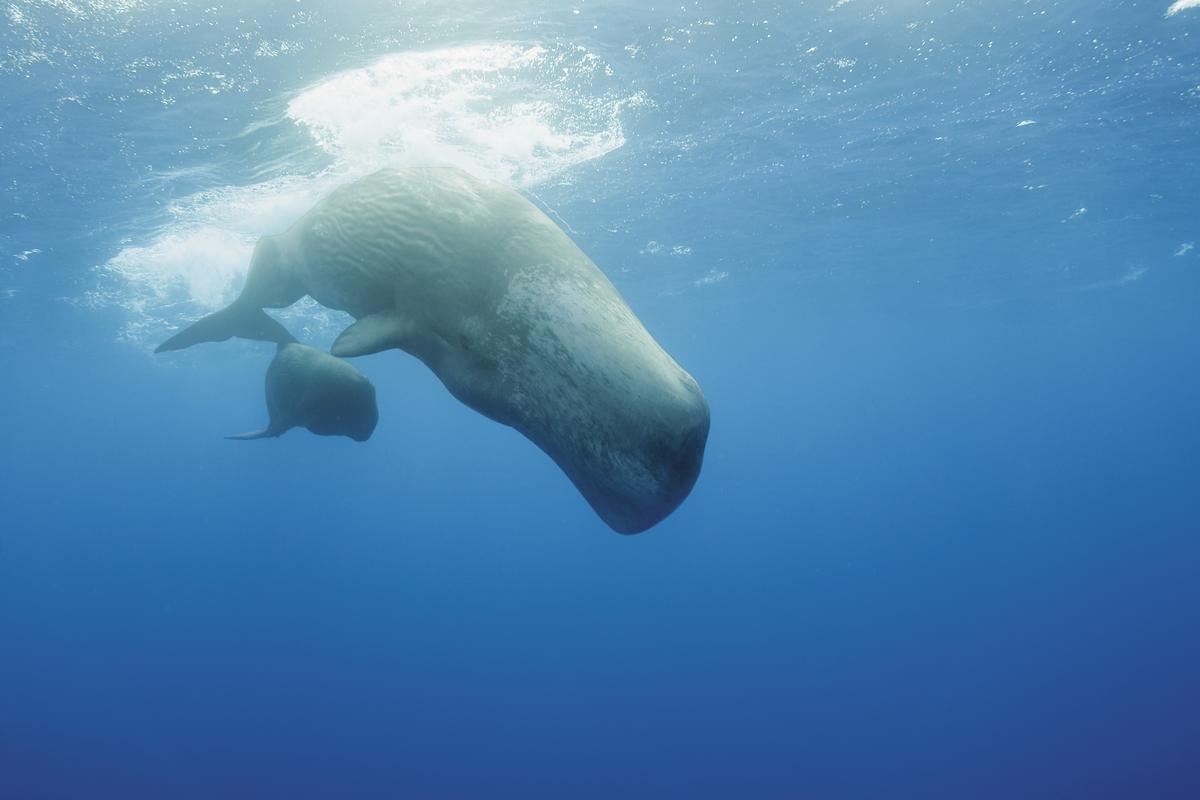
Sperm whales breed very slowly. According to NOAA, a female gives birth to a single calf roughly once every five to seven years, after a pregnancy of 14 to 16 months. The newborn is already about 4 metres (13 feet) long.
Calves eat some solid food before their first birthday but keep nursing for several years. When a mother dives to hunt, other females in the group stay near the surface with her calf, an arrangement that works like a babysitting service. The same teamwork protects the group from orcas: under attack, adults have been seen forming a circle around the young with their heads together and tails facing out.
Are sperm whales endangered?
The sperm whale is listed as Vulnerable on the IUCN Red List and as Endangered under the US Endangered Species Act. Commercial whalers hunted sperm whales from about 1800 until the 1980s for the oil in their heads and blubber, which was burned in lamps and used in candles and lubricants. That hunting nearly wiped out many populations, and they are still recovering.
Today the main threats are entanglement in fishing gear, ship strikes, ocean noise, plastic and other marine debris, and oil spills.
Sperm whales also inspired one of the most famous novels ever written: Herman Melville's Moby-Dick, based partly on the true story of the whaleship Essex, which was rammed and sunk by a sperm whale in 1820.
Where can you see sperm whales?
Sperm whales live in deep water in every ocean, from the tropics to the edges of the polar ice. Females and young stay in warm waters, while adult males travel into colder seas. Some of the best places to see them include:
- Dominica, in the Caribbean, where resident families live close to shore
- The Azores, Portugal, in the middle of the North Atlantic
- Kaikōura, New Zealand, where a deep undersea canyon brings males close to the coast
- Andenes, northern Norway, for large males
- Sri Lanka and Mauritius, in the Indian Ocean
Choose a responsible operator that keeps its distance and limits the time spent with each whale.
Frequently asked questions
How big is a sperm whale compared to a blue whale?
The blue whale is far bigger, reaching more than 30 metres (98 feet) long. But the sperm whale is the largest whale with teeth, and the largest toothed predator on Earth. Blue whales and other baleen whales, like the humpback whale, filter food through plates of baleen instead.
Are sperm whales dangerous to humans?
Not to swimmers or whale watchers. There are no records of sperm whales hunting people. Their reputation comes from the whaling era, when harpooned whales sometimes smashed boats, and from the sinking of the Essex in 1820.
How long can a sperm whale hold its breath?
Typically around 45 minutes on a hunting dive, and up to about 90 minutes on the deepest dives.
Do sperm whales eat giant squid?
Yes, they eat squid of many sizes, including large deep-sea species such as giant and colossal squid, though most of the squid they eat are much smaller. Sucker scars on their skin show that some squid fight back.
Where can you see sperm whales?
Sperm whales live in deep ocean water worldwide. Reliable places to see them include Dominica in the Caribbean, the Azores, Kaikōura in New Zealand, Andenes in Norway, Sri Lanka and Mauritius. They also appear in our episode 10 Ocean Animals That Break the Rules of Nature.
Want more?
Follow SeaFactual for a new ocean fact every day, and get the fact of the week in your inbox using the form below.
Sources and further reading
- NOAA Fisheries: Sperm whale
- Oceana: Sperm whale
- National Geographic: Sperm whale
- Møhl et al. 2003, Journal of the Acoustical Society of America: The monopulsed nature of sperm whale clicks
- Ridgway & Hanson 2014, Brain, Behavior and Evolution: Sperm whales and killer whales with the largest brains of all toothed whales
- Miller et al. 2008, Current Biology: Stereotypical resting behavior of the sperm whale
- Hersh et al. 2022, PNAS: Evidence from sperm whale clans of symbolic marking in non-human cultures
- Sharma et al. 2024, Nature Communications: Contextual and combinatorial structure in sperm whale vocalisations
- IUCN Red List
Spotted a mistake? Tell us How we fact-check Last checked 22 November 2026