A southern stingray off Bimini, in the Bahamas.
In this article
Stingrays are flat, graceful relatives of sharks that spend much of their lives gliding over the seabed or hiding beneath the sand. They have a venomous barb in their tail and a sixth sense that lets them find prey they cannot see. And the biggest of them lives not in the sea, but in rivers.
Here are the facts about stingrays: how their sting works, whether they are dangerous, how they hunt, how big they get and where to see them.
Stingray quick facts
- Type of animal
- Cartilaginous fish, closely related to sharks
- Species
- The main stingray family alone has around 90 species, plus river stingrays and other groups
- Biggest
- The giant freshwater whipray, with reports of animals of 300 kg (660 lb) or more
- Sting
- A sharp, serrated, venomous spine on the tail, used only in defence
- Senses
- Can detect the tiny electric fields of hidden animals
- Diet
- Clams, crabs, shrimp, worms and small fish
- Babies
- Born live, with small litters of pups
- Habitat
- Warm and temperate seas worldwide, plus some rivers and lakes
What is a stingray?
Stingrays are cartilaginous fish: like sharks, their skeletons are made of flexible cartilage rather than bone. Their bodies are flattened into a disc, formed from huge pectoral fins joined to the head, which they ripple or flap to swim.
The best-known group is the whiptail stingray family, Dasyatidae. A 2016 review of its classification covered 89 recognised species. Other stingray groups include the river stingrays of South America, the round stingrays and the butterfly rays. Manta rays and eagle rays belong to the same wider group, but manta rays have no stinging barb at all.
How does a stingray sting?
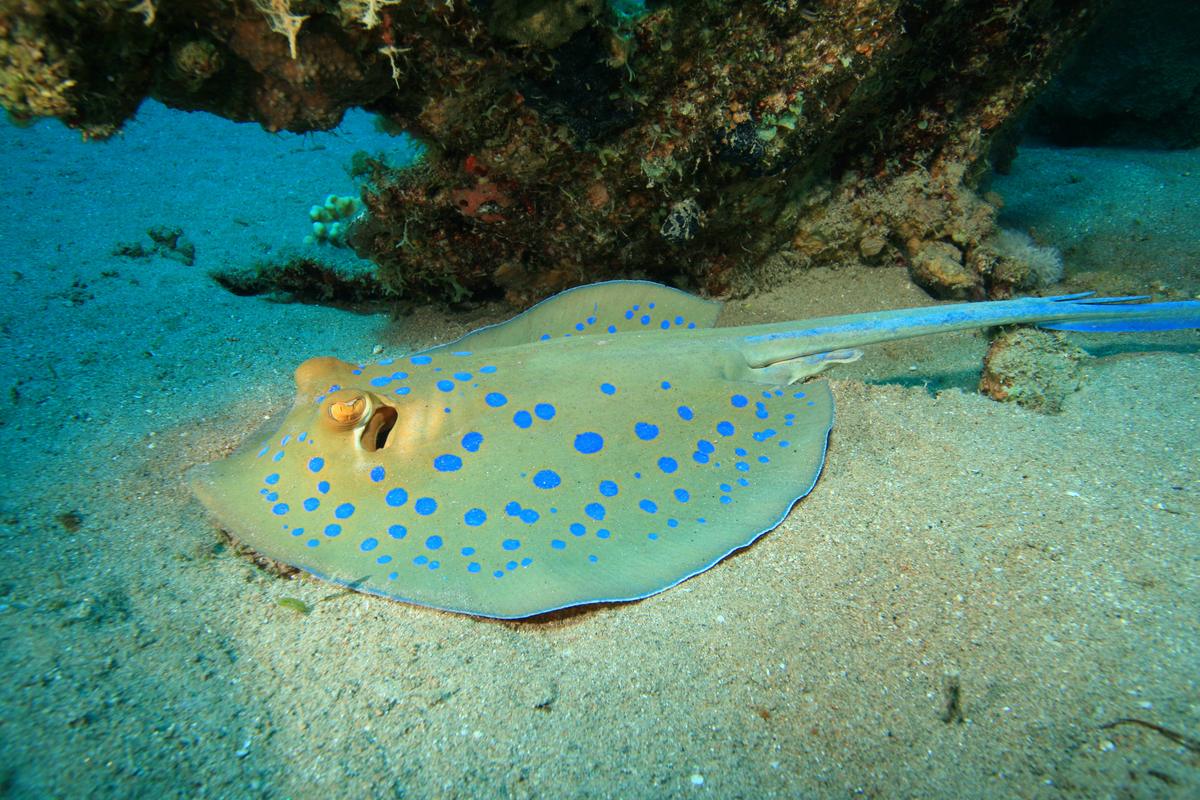
Most stingrays have one or more sharp spines, or barbs, partway along the tail. The barb is made of a hard, bone-like material, edged with backward-facing serrations, and covered in a sheath of skin containing venom glands.
A stingray does not attack. Its barb is purely for defence. If a predator grabs it or a person steps on it, the ray whips its tail up and forward, driving the barb into the leg or foot. The serrations tear the skin, and the venom causes intense pain, swelling and sometimes nausea, faintness or infection. Stingrays shed and regrow their barbs from time to time.
Are stingrays dangerous?
Stingrays are gentle animals, and serious injuries are rare. Most happen when someone steps on a ray hidden in the sand in shallow water. Oceana notes that a surprised southern stingray might use its spine if accidentally stepped on, and that the rays themselves are "peaceful creatures".
Deaths are extremely rare, usually from a barb piercing the chest or abdomen. The most famous case was the Australian wildlife presenter Steve Irwin, who was killed by a stingray barb while filming on the Great Barrier Reef in 2006.
How to stay safe:
- Do the stingray shuffle: slide your feet along the sand instead of stepping, so rays feel you coming and swim away
- Never grab or corner a ray, and do not swim directly over one resting on the bottom
- If you are stung, get out of the water and seek medical help. A review of stingray injuries describes the standard first aid used by doctors: soaking the wound in hot (not scalding) water to ease the pain, then checking it for fragments of barb and treating any infection
How do stingrays find food?
Stingrays hunt mainly on the seabed, where their prey often hides under the sand. They find it using electroreception. Their snout and underside are dotted with tiny jelly-filled pores called the ampullae of Lorenzini, which can detect the faint electrical signals produced by the muscles and heartbeat of buried animals.
Once they have found something, they dig it out. Oceana describes how southern stingrays flap their fins to stir up the sand, and have even been seen shooting jets of water from their mouths to uncover hidden prey. They eat clams, crabs, shrimp, worms and small fish, crushing hard shells with flat, plate-like teeth.
How do stingrays breathe while buried in sand?
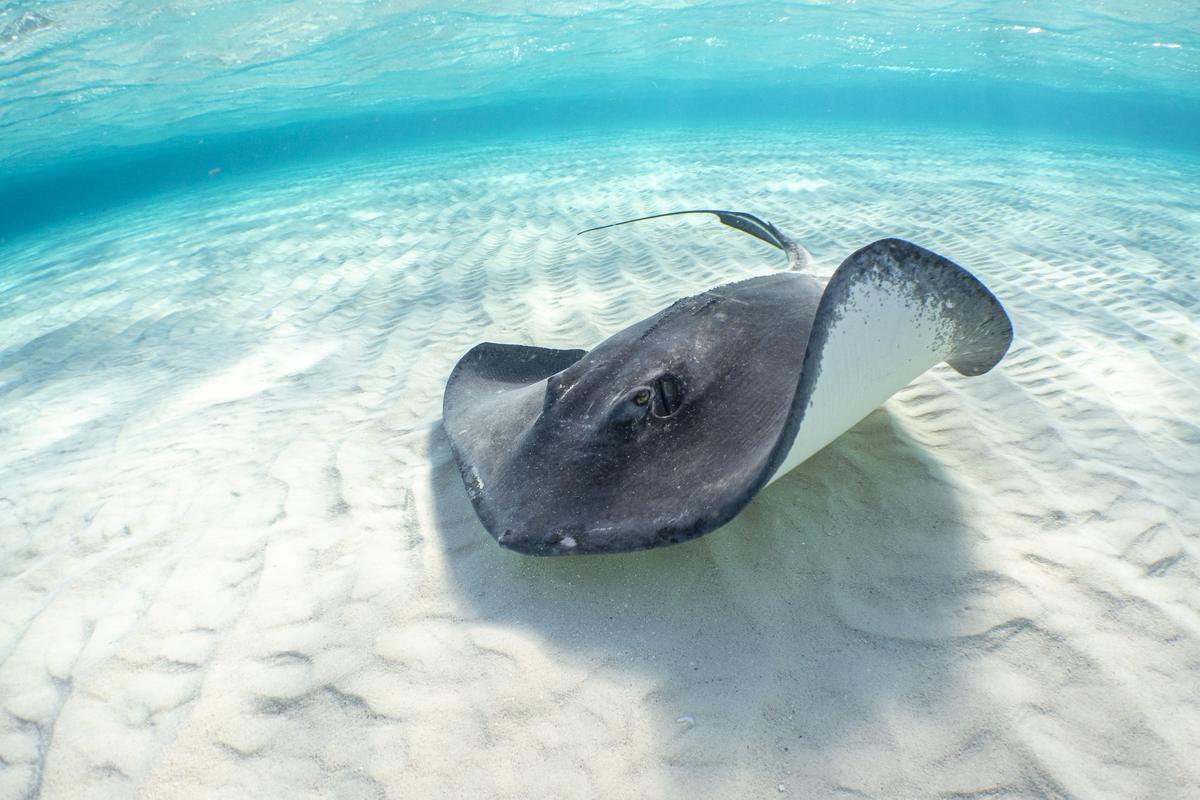
A stingray's mouth and gill slits are on its underside, while its eyes are on top. If it breathed through its mouth while lying on the seabed, it would suck in sand. Instead, it draws water in through two openings just behind the eyes, called spiracles, and pushes it out over the gills below.
This lets a stingray lie completely still under a layer of sand, with just its eyes and spiracles showing, hidden from predators such as hammerhead sharks. Southern stingrays can flick sand over their own backs to bury themselves.
What is the biggest stingray?
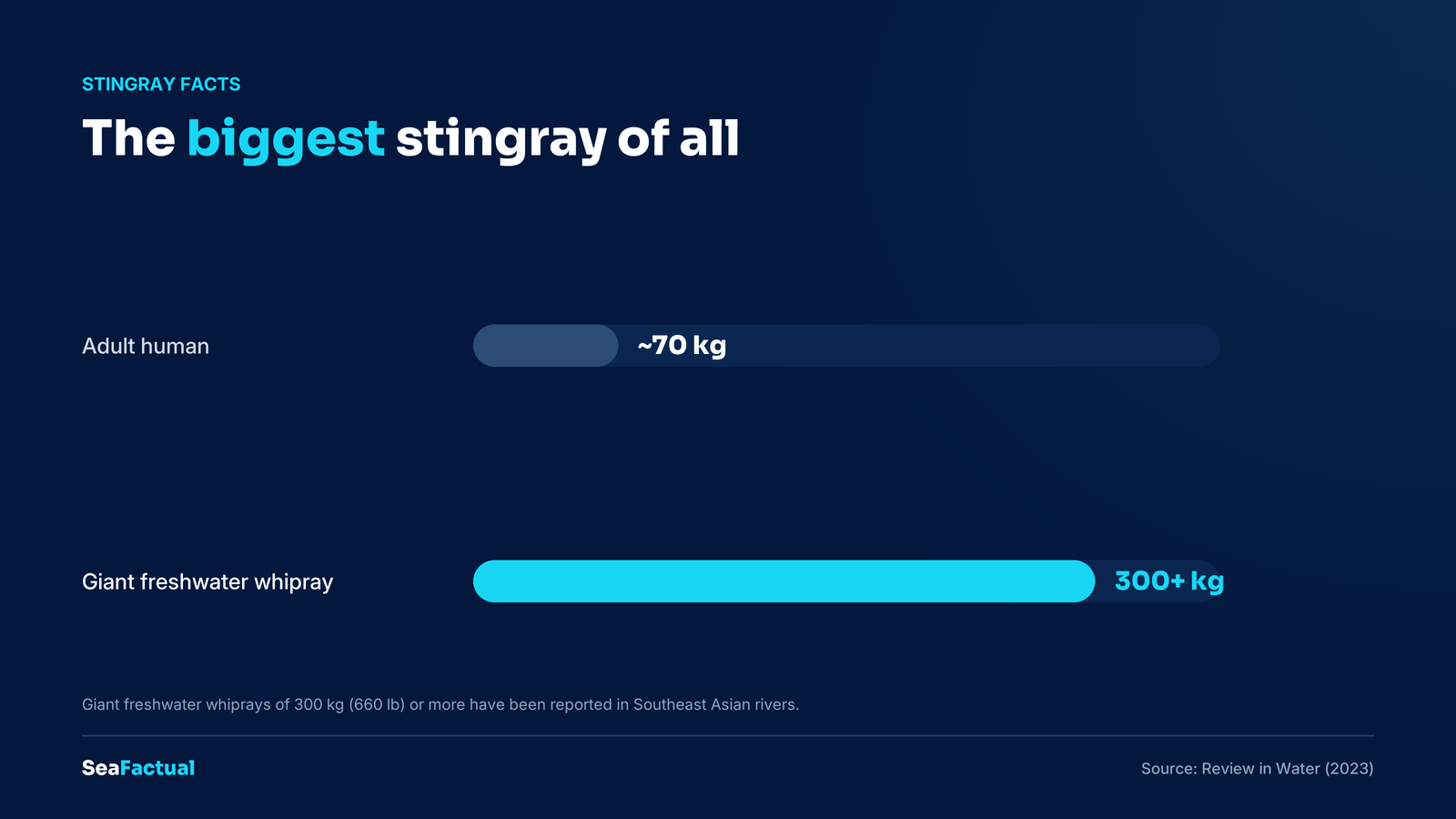
The biggest stingray of all lives in fresh water. The giant freshwater whipray (Urogymnus polylepis) of Southeast Asian rivers is the heaviest known stingray. A 2023 review found that whiprays of 300 kg (660 lb) or more have been reported in most countries where it lives. It is listed as Endangered, threatened by fishing, bycatch, pollution and damage to its rivers.
At sea, the biggest stingrays include the smooth stingray of Australia and New Zealand and the short-tail stingray, both of which can weigh well over 100 kg (220 lb). The manta ray is larger still, with NOAA reporting giant mantas of more than two tonnes, but mantas belong to a separate family.
How do stingrays have babies?
Stingrays give birth to live young. The eggs hatch inside the mother, where the embryos are nourished by a protein-rich fluid sometimes called "uterine milk". The pups are born fully formed, with soft barbs covered in a sheath so they do not injure their mother; the barbs harden soon after birth.
Litters are small. According to Oceana, southern stingrays have an average of about four pups per litter. Because they grow slowly and have few young, many stingrays are vulnerable to overfishing. The southern stingray is listed as Near Threatened, largely because of accidental capture in fisheries.
Where can you see stingrays?
Stingrays live in warm and temperate waters worldwide, from coral reefs and sandy lagoons to estuaries and even rivers. Some famous places to see them include:
- Stingray City, Grand Cayman, where snorkellers stand in shallow water among southern stingrays
- The Bahamas and Florida Keys, in sandy shallows and seagrass
- The Red Sea and Maldives, for bluespotted ribbontail rays on the reef
- Hamelin Bay, Western Australia, where large smooth stingrays visit the beach
- Moorea, French Polynesia, for pink whiprays in the lagoon
Wherever you see them, never touch, chase or feed rays, and shuffle your feet when wading.
Frequently asked questions
What is the difference between a stingray and a manta ray?
Stingrays mostly live on or near the seabed, eat shellfish and other small animals and have a venomous barb on the tail. Manta rays swim in open water, filter tiny plankton and have no barb. Mantas are also much bigger, with wingspans of up to around 7 metres (23 feet). Read more in our manta ray facts.
Can a stingray kill you?
It is extremely rare. Most stings cause severe pain in the foot or ankle but are not life-threatening. Deaths usually involve a barb piercing the chest or abdomen.
Are stingrays related to sharks?
Yes. Rays and sharks are close relatives: both are cartilaginous fish, with skeletons made of cartilage instead of bone, and many rays are thought to have evolved from shark-like ancestors. You can read more about their relatives in our bull shark facts and great white shark facts.
Where can you see stingrays?
Stingrays live in tropical and temperate waters around the world. Well-known spots include Stingray City in Grand Cayman, the Bahamas and Florida Keys, the Red Sea, the Maldives, Hamelin Bay in Western Australia and the lagoons of French Polynesia. Cooler coasts, such as those of the UK, have common stingrays in summer, though they are rarely seen.
Do stingrays have bones?
No. Like sharks, stingrays have skeletons made of cartilage, the same flexible material found in your nose and ears. Their barb is not bone either, but a hard, mineralised spine.
Want more?
Follow SeaFactual for a new ocean fact every day, and get the fact of the week in your inbox using the form below.
Sources and further reading
- Last, Naylor & Manjaji-Matsumoto 2016, Zootaxa: A revised classification of the family Dasyatidae
- Oceana: Southern stingray
- Campbell et al. 2023, Water: A review of the conservation status and ecology of the giant freshwater whipray
- Meyer 1997, Wilderness & Environmental Medicine: Stingray injuries
- NOAA Fisheries: Giant manta ray
- IUCN Red List
Spotted a mistake? Tell us How we fact-check Last checked 22 November 2026