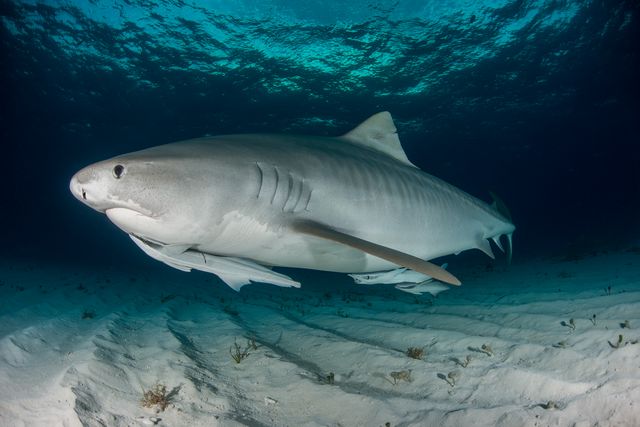
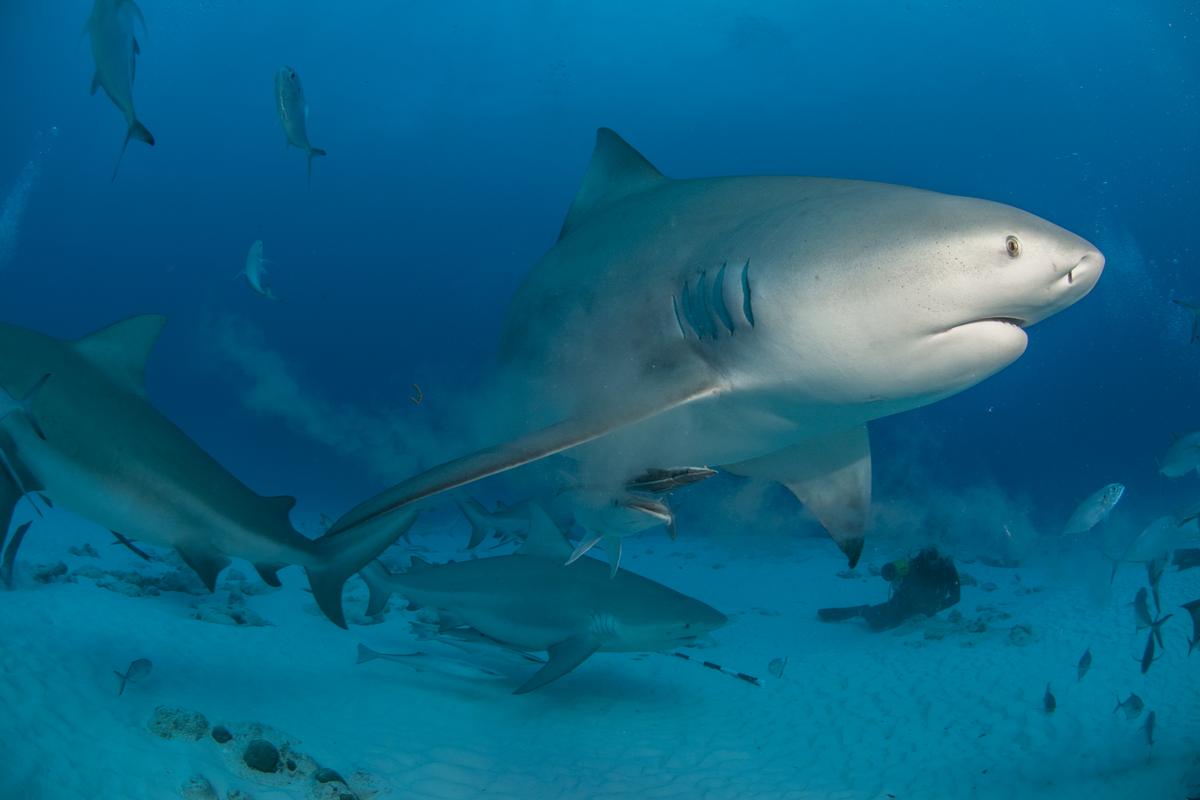
Bull sharks off Playa del Carmen, Mexico.
In this article
Most sharks cannot survive in fresh water. The bull shark can. It has been found 3,700 km (2,300 miles) up the Amazon and more than 3,000 km (1,860 miles) up the Mississippi, and it swims in and out of one of Central America's biggest lakes. It also has, pound for pound, one of the most powerful bites of any shark.
Here are the facts about bull sharks: how they survive in rivers, how big they get, what they eat, how they have their young and how dangerous they really are.
Bull shark quick facts
- Scientific name
- Carcharhinus leucas
- Length
- Mature at about 1.6 to 2.3 metres (5 to 7.5 feet); the largest reported 4 metres (13 feet)
- Weight
- Up to a reported 316 kg (698 lb)
- Habitat
- Warm coasts worldwide, plus rivers, estuaries and lakes
- Diet
- Mostly bony fish and smaller sharks, plus stingrays
- Pups
- 1 to 13 per litter, born live after 10 to 11 months
- Lifespan
- More than 25 years
- Bite
- The highest bite force for its body size of 13 sharks and rays compared in one study
Can bull sharks live in fresh water?
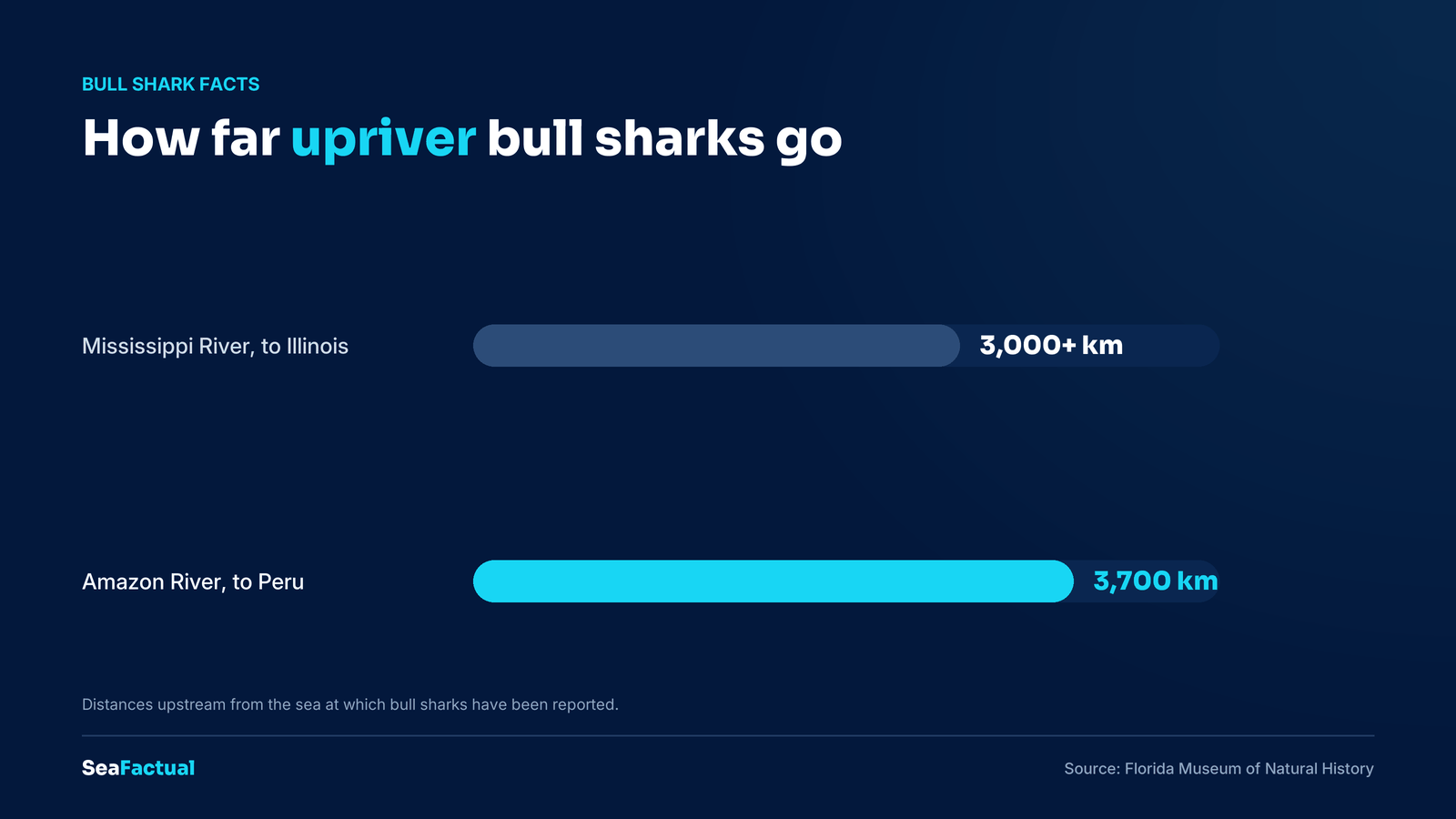
Yes. The bull shark is one of very few sharks that readily moves into fresh water and can stay there for long periods, according to the Florida Museum. It has been reported 3,700 km (2,300 miles) up the Amazon in Peru and more than 3,000 km (1,860 miles) up the Mississippi, as far as Illinois.
It can cope with the opposite extreme too. Bull sharks have been found in water far saltier than the open sea, at 53 parts per thousand, compared with about 35 in normal seawater.
How do bull sharks survive in fresh water?
Sharks normally keep their blood almost as salty as the sea around them, partly by holding on to a chemical called urea. In fresh water, that would make their bodies soak up water like a sponge.
Bull sharks get around this by changing how their bodies work. In a study of young bull sharks moved between fresh water and seawater, sharks in fresh water kept far less salt and urea in their blood. The activity of the salt-pumping machinery in their kidneys and rectal gland, an organ sharks use to get rid of excess salt, changed depending on which kind of water they were in.
The sharks of Lake Nicaragua
Lake Nicaragua is the largest lake in Central America, and it has bull sharks. For years, scientists thought they were a separate, landlocked population trapped in the lake.
They were wrong. In a tagging study published in 1971, scientists tagged sharks where the San Juan River meets the Caribbean Sea and later caught some of them in the lake, proving that the sharks travel up and down the river between the sea and the lake.
How big do bull sharks get?
Bull sharks are short and very stout, with a broad, blunt, rounded snout and small eyes. According to the Florida Museum:
- The largest reported bull shark was 4 metres (13 feet) long.
- The heaviest reported weighed 316.5 kg (698 lb).
- Males mature at 1.6 to 2.3 metres (5 to 7.4 feet) and females at 1.8 to 2.3 metres (6 to 7.5 feet).
- They take a long time to grow up, reaching maturity at around 15 to 20 years old, and can live for more than 25 years.
Their small eyes may be a clue to how they hunt. Bull sharks often live in cloudy, murky water, which suggests that sight may matter less to them than to many other sharks.
How strong is a bull shark's bite?
Bull sharks have very wide heads, and that gives them an exceptionally strong bite. In a 2012 study, scientists calculated the bite force of bull sharks from the anatomy of their jaws and muscles. Compared with 12 other sharks, rays and their relatives, the bull shark had the highest bite force for its body size, beating both the great white and the great hammerhead.
The biggest shark in the study had a calculated bite force of almost 6,000 newtons at the back of its jaws, equivalent to the weight of about 600 kg (1,300 lb). The researchers found that the widening of the head is the main reason for big bites in sharks.
The great white has a bigger bite overall, because it is a much bigger animal. See how it compares in our great white shark facts.
What do bull sharks eat?
Mostly bony fish and smaller sharks, including young bull sharks. According to the Florida Museum, in the western Atlantic they commonly eat fish such as mullet, tarpon, catfish, snook and mackerel, as well as stingrays.
Bull sharks have occasionally been found with sea turtles, dolphins, seabirds, squid and even dogs in their stomachs.
They look sluggish as they cruise slowly near the bottom, but they can put on sudden bursts of speed of more than 19 km/h (11 mph) over short distances to catch fast prey.
How do bull sharks have babies?
Bull sharks give birth to live young. The pups grow inside their mother for 10 to 11 months, fed through a yolk-sac placenta, a connection to the mother that works a little like a mammal's placenta. A female has between 1 and 13 pups at a time, each about 56 to 81 cm (22 to 32 inches) long.
This is where fresh water becomes important. Females give birth in river mouths, coastal lagoons and low-salinity estuaries, according to the Florida Museum. These shallow, brackish nurseries keep the pups away from most bigger sharks, although young bull sharks can still be eaten by tiger sharks, sandbar sharks and larger bull sharks.
Are bull sharks dangerous?
Bull sharks are one of the few sharks that can be dangerous to people. The International Shark Attack File counts them among the "Big Three", along with the white shark and the tiger shark. All three are large, live where people swim and have teeth made for cutting.
In its species records, bull sharks are linked to 119 confirmed unprovoked bites. The real figure is probably higher. The Shark Attack File points out that bull sharks look very similar to other requiem sharks, so bites by them are often not correctly identified.
Their habits add to the risk. Bull sharks like shallow, murky coastal water, river mouths and harbours, exactly the places people swim, surf and fish.
Even so, bites are rare. Huge numbers of people share the water with bull sharks every year without incident, and the sharks are under far more pressure from people than the other way round: they are caught in fisheries around the world, and they grow slowly, taking 15 to 20 years to mature. Since its 2020 assessment, the bull shark has been listed as Vulnerable on the IUCN Red List, according to FishBase.
Frequently asked questions
Where can you see bull sharks?
Bull sharks live on warm coasts all around the world. Well-known places to dive with them include Playa del Carmen in Mexico (usually from November to March), Beqa Lagoon in Fiji, the Bahamas and South Africa. They also turn up in harbours, estuaries and rivers in places such as Florida, the Gulf of Mexico, Brazil and eastern Australia.
How far north do bull sharks go?
In the western Atlantic, bull sharks migrate north along the US coast in summer, as far as Massachusetts, then head back to warmer water when the coast cools, according to the Florida Museum.
Can bull sharks live in lakes?
Yes. The best-known example is Lake Nicaragua, where bull sharks reach the lake by swimming up the San Juan River from the Caribbean Sea.
What is the difference between a bull shark and a tiger shark?
Both are large, dangerous requiem sharks, but tiger sharks are bigger, have stripes and live mainly in salt water. Bull sharks are plain grey, stockier, with a shorter snout, and can live in fresh water. Read more in our tiger shark facts.
How fast can a bull shark swim?
Bull sharks can reach more than 19 km/h (11 mph) in short bursts.
Want more?
Follow SeaFactual for a new ocean fact every day, and get the fact of the week in your inbox using the form below.
Sources and further reading
- Florida Museum: Bull shark species profile
- Florida Museum, International Shark Attack File: Species implicated in attacks
- Thorson 1971, Copeia: Movement of bull sharks between Caribbean Sea and Lake Nicaragua demonstrated by tagging
- Pillans et al. 2004, Journal of Comparative Physiology B: Freshwater to seawater acclimation of juvenile bull sharks
- Habegger et al. 2012, Zoology: Feeding biomechanics and theoretical calculations of bite force in bull sharks
- FishBase: Carcharhinus leucas, bull shark
Spotted a mistake? Tell us How we fact-check Last checked 21 November 2026