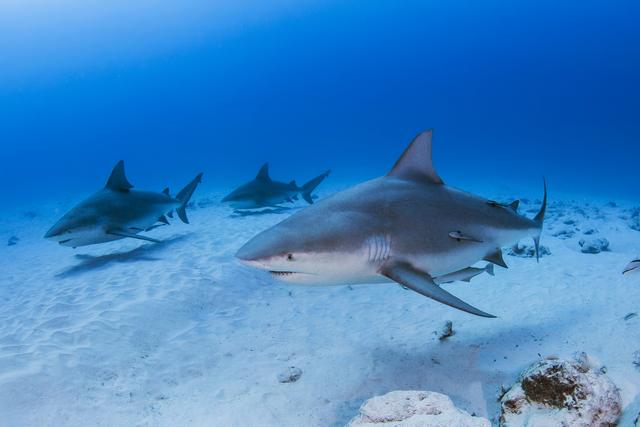
A tiger shark over the sand banks of the northern Bahamas.
In this article
Tiger sharks have been found with tin cans, plastic bottles and sacks in their stomachs. They crunch through sea turtle shells, swallow songbirds that fall into the sea, and give birth to as many as 80 pups at a time. Few animals in the ocean have a reputation quite like the tiger shark.
Here are the facts: how big tiger sharks get, what they eat, why they have stripes, how far they travel and how dangerous they really are.
Tiger shark quick facts
- Scientific name
- Galeocerdo cuvier
- Length
- Usually 3.25 to 4.25 metres (11 to 14 feet); the largest over 5.5 metres (18 feet)
- Weight
- Usually 385 to 635 kg (850 to 1,400 lb); the largest over 900 kg (2,000 lb)
- Diet
- Almost anything, from turtles and rays to seabirds and carrion
- Pups
- 10 to 82 per litter, after a pregnancy of 13 to 16 months
- Lifespan
- Validated ages over 20 years; probably close to 30
- Range
- Warm and temperate seas worldwide, except the Mediterranean
- Conservation status
- Near Threatened
How big do tiger sharks get?
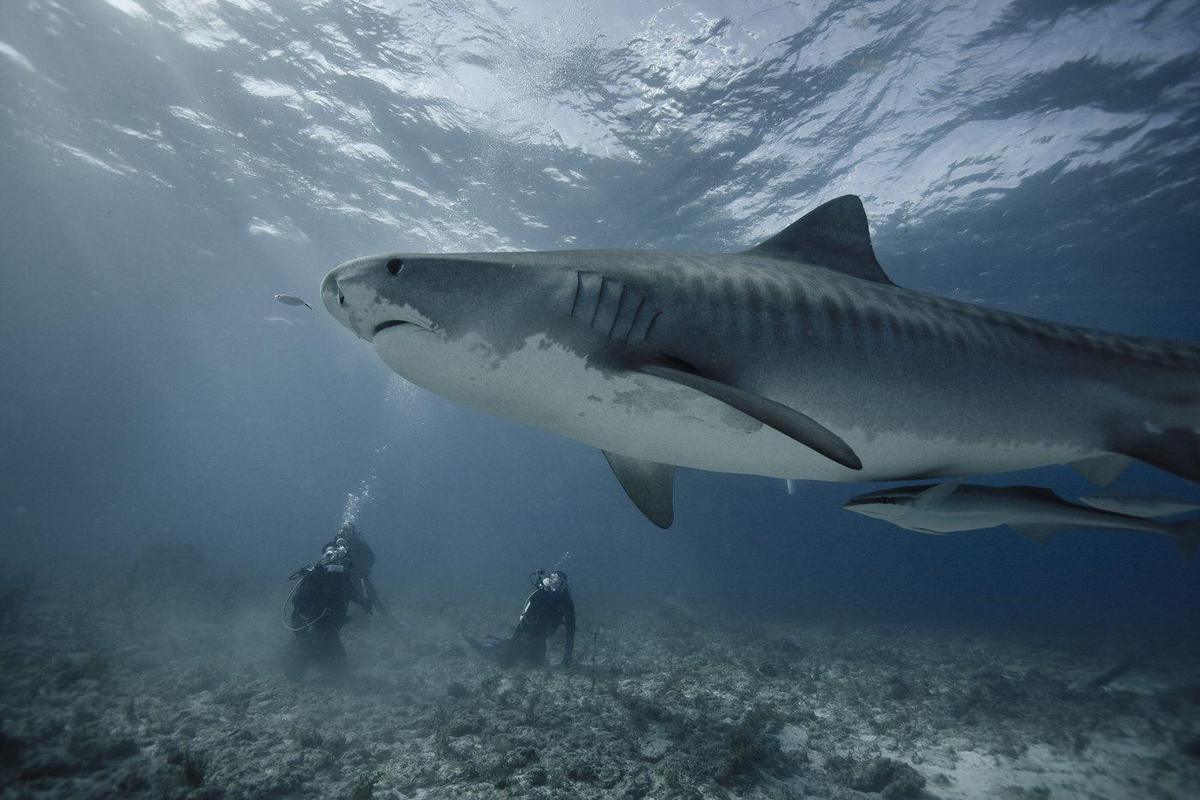
The tiger shark is one of the largest predatory sharks in the world. According to the Florida Museum, adults commonly reach 3.25 to 4.25 metres (11 to 14 feet) and weigh 385 to 635 kg (850 to 1,400 lb). The biggest individuals grow to more than 5.5 metres (18 feet) and are estimated to weigh over 900 kg (2,000 lb).
Only a few predatory sharks get bigger. The great white is the best known of them. See how it compares in our great white shark facts.
Why do tiger sharks have stripes?
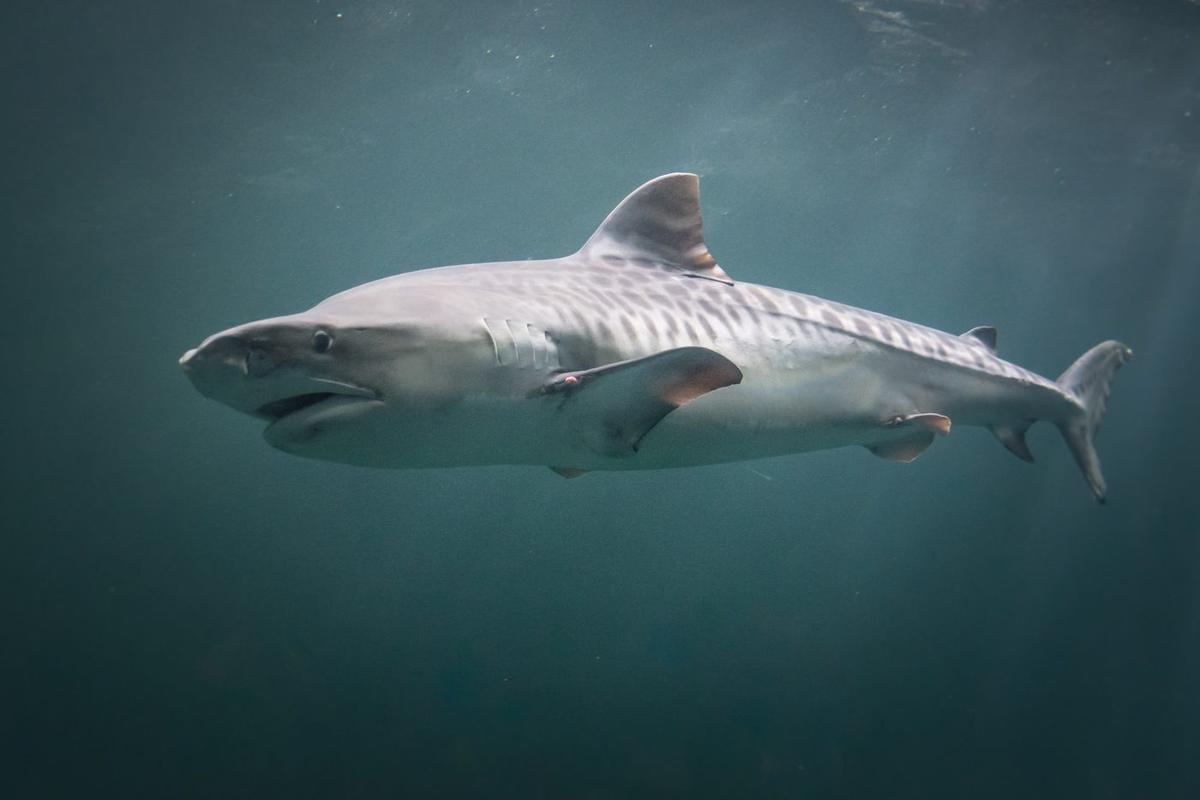
Tiger sharks get their name from the dark bars and spots along their backs. The pattern is strongest in young sharks. As a tiger shark grows, the stripes fade, and large adults can look almost plain grey.
The pattern may work as camouflage, breaking up the young shark's outline in dappled, shallow water. Other clues to a tiger shark are its short, very blunt snout, large eyes and long upper tail fin.
What do tiger sharks eat?
The tiger shark has a reputation for eating almost anything, and the Florida Museum calls it "the least discriminative" of all sharks. Its natural diet includes:
- Sea turtles, a favourite in many areas
- Rays, other sharks and bony fish
- Seabirds, dolphins and squid
- Crabs, lobsters and other crustaceans
- Carrion, including dead whales
Its teeth are made for this. Each one has a curved point, finely serrated edges and a deep notch, a little like a cockscomb. Combined with a sawing shake of the head, they let a tiger shark cut through tough skin, bone and even turtle shell. Read more about its armoured prey in our sea turtle facts.
What a tiger shark eats changes as it grows. A study of tiger sharks in Hawaii found that bigger sharks took bigger prey, moving on to animals such as turtles and marine mammals.
Do tiger sharks really eat number plates?
Tiger sharks are nicknamed the "dustbins of the sea". One female caught in the Red Sea had two empty cans, a plastic bottle and two sacks in her stomach, according to the Florida Museum, and rubbish is often found in tiger sharks caught near harbours and river mouths. Number plates and chunks of car tyre are also reported from tiger shark stomachs. They are not food, of course. They are a sign of a hunter that tests almost anything it finds.
Tiger sharks eat songbirds
One of the strangest finds came from the Gulf of Mexico. In a 2019 study, researchers examining 105 young tiger sharks found the remains of land birds, not seabirds, including species such as barn swallows. They traced them to 11 bird species. Most of the cases happened in autumn, when migrating songbirds cross the Gulf and some, exhausted or caught in storms, fall into the sea.
How do tiger sharks have babies?
Tiger sharks give birth to live young, but in an unusual way. Unlike their close relatives, they do not have a placenta. According to the Florida Museum, the embryos first live off the yolk of a large egg, then switch to absorbing fluid inside the mother's uterus.
Pregnancy lasts 13 to 16 months, and a female can give birth to anywhere from 10 to 82 pups. Each pup is born about 51 to 76 cm (20 to 30 inches) long and is on its own from the moment it is born.
How far do tiger sharks travel?
A very long way. In a 2015 study, scientists followed tiger sharks with satellite tags for up to three years. Adult males made round trips of more than 7,500 km (4,650 miles) every year in the north-west Atlantic, spending winter around Caribbean coral reefs and summer far out in the open ocean, then returning to the same winter spots year after year.
Tiger sharks are at home in murky coastal water, harbours and river mouths, as well as around reefs and remote islands. They have been recorded at depths of 350 metres (1,150 feet).
How long do tiger sharks live?
Ageing sharks is hard. Scientists count growth bands in their vertebrae, a bit like tree rings, but the bands are not always reliable in older sharks. To check them, a 2008 study used radioactive carbon left in the oceans by nuclear bomb tests in the 1950s and 1960s, which marks the bands laid down in those years.
The study confirmed tiger sharks aged 20 years (males) and 22 years (females), and its growth model predicted maximum ages of about 27 and 29 years. Some tiger sharks may live longer, but those are the best-tested figures.
Are tiger sharks dangerous?
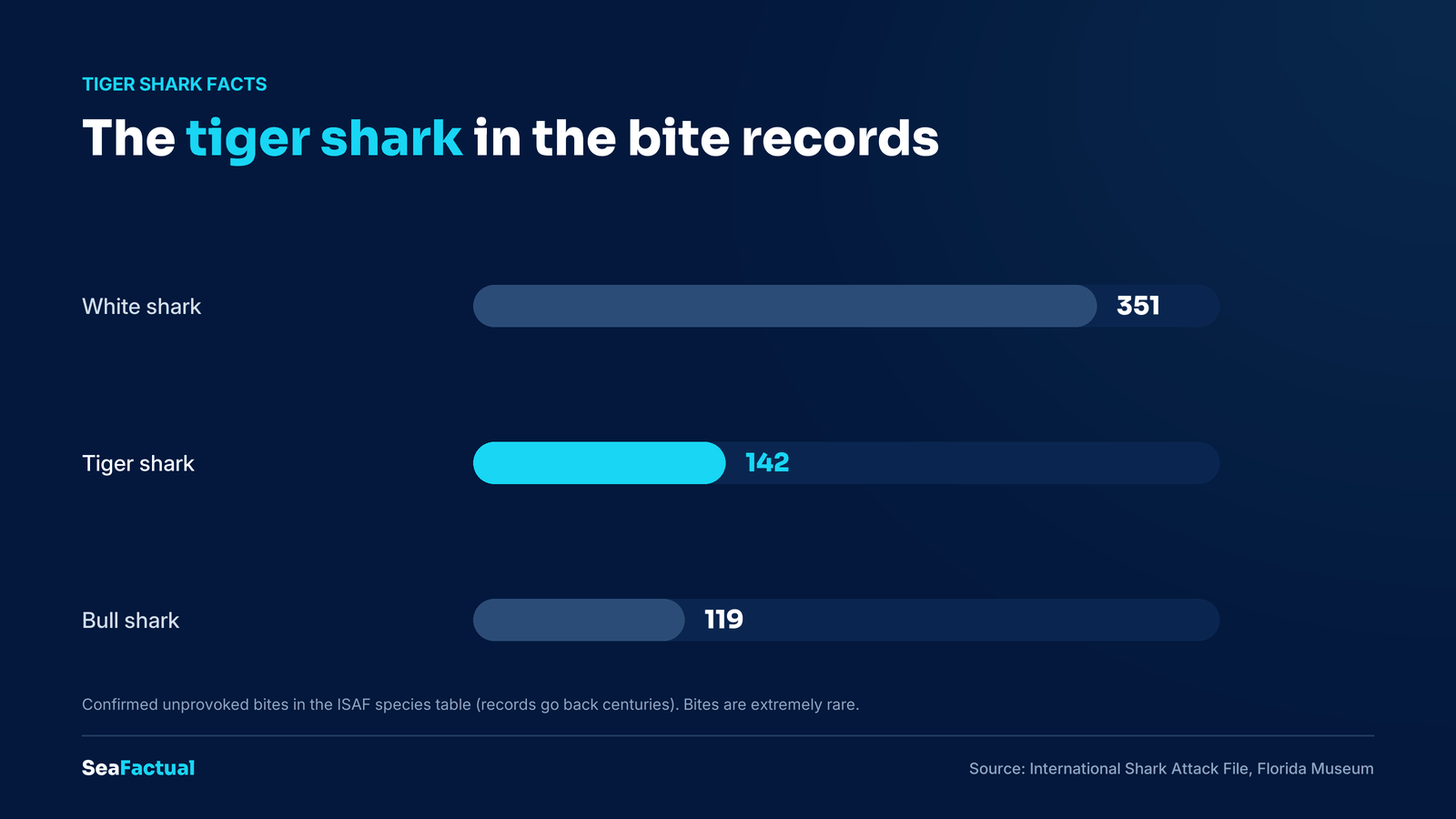
Tiger sharks are one of the few sharks that can be dangerous to people. The International Shark Attack File calls the white, tiger and bull sharks the "Big Three". All three are large, live where people swim and have teeth made for cutting. In its species records, tiger sharks are linked to 142 confirmed unprovoked bites, second only to the white shark.
Even so, bites are extremely rare. Tiger sharks share the water with huge numbers of swimmers, surfers and divers every day, and almost all of those encounters pass without incident. Many dive operators now run carefully managed dives with tiger sharks, particularly in the Bahamas.
The bigger danger is to the sharks. Tiger sharks are caught in fisheries around the world and are listed as Near Threatened on the IUCN Red List. Because females take more than a year to carry each litter, populations are slow to recover.
Frequently asked questions
Where do tiger sharks live?
In warm and temperate seas around the world. Well-known places to see them include Hawaii, the Bahamas, Florida, South Africa and Western Australia. They rarely stray into cold water, though the Florida Museum notes confirmed reports from as far north as Iceland and the UK, probably from wandering sharks following the warm Gulf Stream.
What is the difference between a tiger shark and a bull shark?
Both are large, powerful requiem sharks, but the bull shark has no stripes and is famous for something else: it can live in fresh water. Bull sharks have been recorded 3,700 km (2,300 miles) up the Amazon and more than 3,000 km (1,860 miles) up the Mississippi.
What eats tiger sharks?
Adult tiger sharks have few predators apart from people. Orcas are known to hunt large sharks, and newborn tiger sharks are small enough to be eaten by other big sharks.
Is a sand tiger shark the same as a tiger shark?
No. The sand tiger is a completely different shark, with a mouthful of ragged, needle-like teeth. It is slower and much less dangerous than the tiger shark.
Why are they called tiger sharks?
Because of the dark stripes on their backs, which are boldest in young sharks and fade with age.
Want more?
Follow SeaFactual for a new ocean fact every day, and get the fact of the week in your inbox using the form below.
Sources and further reading
- Florida Museum: Tiger shark species profile
- Florida Museum, International Shark Attack File: Species implicated in attacks
- Lowe et al. 1996, Environmental Biology of Fishes: Ontogenetic dietary shifts and feeding behavior of the tiger shark in Hawaiian waters
- Drymon et al. 2019, Ecology: Tiger sharks eat songbirds
- Lea et al. 2015, Scientific Reports: Repeated, long-distance migrations by a philopatric predator
- Kneebone et al. 2008, Marine Biology: Using bomb radiocarbon analyses to validate age and growth estimates for the tiger shark
- UT Marine Science Institute, Science and the Sea: Big appetites
- Florida Museum: Bull shark species profile
Spotted a mistake? Tell us How we fact-check Last checked 21 November 2026